By Staff Reporter
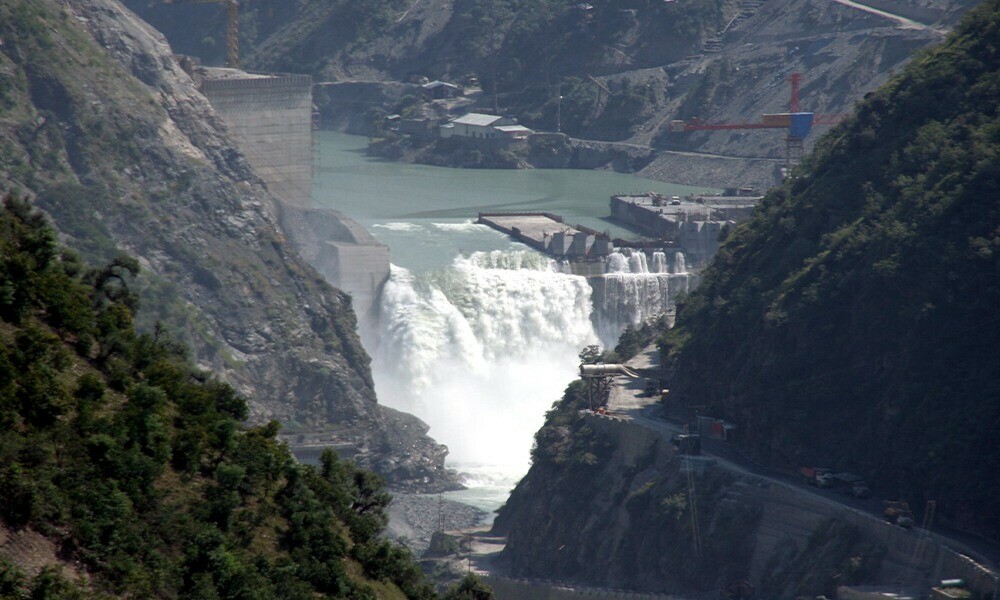
ISLAMABAD: Pakistan accused India on Friday of deliberately disrupting the flow of the Jhelum River by abruptly holding and releasing water from upstream hydroelectric projects, a move that officials said was exacerbating a water crisis already straining the country’s vast agricultural heartland after similar fluctuations in the Chenab River.
The allegations, which echo longstanding tensions over shared waterways under the Indus Waters Treaty, come amid reports of sharply reduced inflows into Pakistan’s Mangla Dam, a critical reservoir that feeds irrigation canals across Punjab Province. Officials warned that the disruptions were threatening crops on millions of acres of farmland at a time when water levels in the Chenab had only just begun to stabilise after a week of volatility.
“It is really serious and alarming because around 15 million of the total 25 million acres of agricultural land, which is irrigated through various canals, is receiving either less water or no water these days,” a senior official of the irrigation department said, spe.
The Foreign Office in Islamabad said it had sent a letter to Indian authorities on Thursday seeking clarification on the sudden variations in the Chenab River, which had caused inflows to plummet and disrupted water supplies to the Marala-Ravi link canal and other channels vital for wheat and other crops in Punjab. Now, the focus has shifted to the Jhelum, where the office of the Pakistan Commissioner on Indus Waters reported reduced inflows from Indian-controlled upstream areas into Mangla Dam.
According to an internal report reviewed by officials, inflows at Mangla stood at 5,000 cusecs on Dec. 14, with outflows at 33,000 cusecs. But by the next day, inflows dropped to 3,300 cusecs and held steady at that level through Dec. 19, even as outflows remained unchanged at 33,000 cusecs. For comparison, inflows a year earlier were recorded at 4,400 cusecs, with outflows at 25,000 cusecs.
Data from the Kerot Hydropower Project, located just upstream from Mangla in Pakistan, showed nearly identical patterns, reinforcing suspicions of manipulation on the Indian side. “This indicates the abrupt holding and release of water by Indian authorities in their territory,” said a senior official of the Private Power Infrastructure Board, which oversees the Kerot project. “It is a serious matter,” he warned.
Another senior irrigation department official attributed the disruptions to India’s control over run-of-the-river hydroelectric plants along the rivers. “Indian authorities are controlling and disrupting the rivers’ flows by holding and releasing water from their run-of-the-river hydroelectric plants,” he said. The Jhelum, flowing through Mangla Dam, the Rasool Barrage and an array of link canals, irrigates a huge chunk of land in Punjab.
The Chenab, monitored at the Marala headworks, supplies water to a considerable area as well. “The disruption of flows by Indian authorities is severely affecting crops,” the official said, adding that India had compounded problems during recent floods by “abruptly releasing water without informing us.” Even as concerns mounted over the Jhelum, Pakistan’s Ministry of Water Resources announced on Friday that flows in the Chenab had stabilised after a period of sharp declines.
In a statement, the ministry said the Punjab irrigation department was closely tracking the river at Marala, where data showed discharge had steadied following “a significant period of volatility.” “Hydrological records from the first half of December 2025 confirm that an extraordinary reduction in flows was observed, persisting from December 10 to December 16,” the statement said. It cited satellite imagery showing a reduction in the surface area of India’s Baglihar reservoir from Dec. 8 to 13, followed by an increase. “This reduction, followed by [an] increase in the surface area of Baglihar reservoir, leads to believe that India has emptied Baglihar reservoir followed by its refilling,” the ministry said, noting that under the Indus Waters Treaty, India is prohibited from emptying dead storage reservoirs at run-of-the-river plants.
“Pakistan’s commissioner for Indus waters has taken up the matter with the Indian commissioner for Indus waters and asked for the details [and] data relating to extraordinary reduction in flows of Chenab River, under the framework of the [IWT],” the statement added. The ministry reported a “positive shift” in Chenab levels starting Dec. 17, with flows rising to 6,399 cusecs by 7 a.m. that day. “Punjab Irrigation Department data indicates that as of December 19, 2025, the river flows are presently within the last ten-year range of maximum to minimum flows,” it said. Officials pledged to continue monitoring river levels to adapt water management strategies to any future changes.
The disputes unfold against a backdrop of frayed relations over the Indus Waters Treaty, a 1960 agreement brokered by the World Bank that allocates the use of six rivers between the two nuclear-armed neighbors. The treaty allocates the basin’s rivers between the rivals: Pakistan controls the western rivers — the Indus, Jhelum and Chenab — for irrigation and other essential uses, while India holds sway over the eastern ones — the Ravi, Beas and Sutlej. India may tap the western rivers for limited hydropower but cannot store or divert substantial volumes without safeguards. In April, India announced it was holding the treaty in abeyance after an attack on tourists in occupied Kashmir’s Pahalgam area that killed 26 people, an incident New Delhi attributed to Pakistan without providing evidence.
Pakistan denounced the move as an “act of war,” arguing that the treaty contains no provision for unilateral suspension. Islamabad said it was considering legal action, citing a violation of the 1969 Vienna Convention on the Law of Treaties. In June, the Permanent Court of Arbitration in The Hague issued a Supplemental Award of Competence in a case Pakistan had filed in 2023 challenging the design of Indian hydropower projects on rivers allocated to Pakistan under the treaty. The award stated that India could not unilaterally hold the treaty in abeyance.
The two countries, which have fought three wars since their independence in 1947, have long accused each other of weaponizing water resources, with climate change and population growth intensifying pressures on the Indus basin. In Punjab, where agriculture accounts for a significant portion of Pakistan’s economy, farmers have reported parched fields and delayed plantings.
Deputy Prime Minister Ishaq Dar accused India on Friday of weaponising water by manipulating the flow of the Chenab River, a move that officials said threatened the livelihoods of millions, escalating tensions between the two nuclear-armed neighbors over shared transboundary rivers.
“We witnessed in April this year India’s unilateral abeyance of the Indus Waters Treaty,” Dar told a briefing for foreign diplomats in the capital. “But what we are witnessing now is material breaches by India that strike at the heart of the IWT with escalating consequences for regional stability and sanctity of international law.”
Dar cited two instances of “unusual, abrupt variations” in the Chenab’s flow this year: from April 30 to May 21, and from Dec. 7 to Dec. 15. “These variations in water flow are of extreme concern to Pakistan as they point to the unilateral release of water by India into the Chenab River,” he said. “India has released this water without any prior notification or any data or information sharing with Pakistan as required under the treaty.”
The disruptions, he added, came at a pivotal moment in Pakistan’s farming season, endangering food and economic security. “India’s manipulation of water has prompted our Indus water commissioner to write a letter to his Indian counterpart seeking clarification on the matter as provided in the IWT,” Dar said. “India’s most recent action clearly exemplifies the weaponisation of water to which Pakistan has been consistently drawing attention of the international community.”
He accused India of flouting technical rules in building the Kishanganga and Ratle hydropower projects, and of expanding storage capacity that imperils 240 million Pakistanis. “India continues to build illegal dams in sheer disregard of the treaty obligations to impose fait accompli,” he said. “With the building of dams, Indian capacity to store and manipulate water is also increasing which endangers Pakistan’s security, economy, and the livelihood of 240 million people.”
He faulted India for ceasing to share hydrological data and halting joint monitoring, leaving Pakistan vulnerable to floods and droughts. “Such illegal and irresponsible Indian conduct has all the potential to trigger a humanitarian crisis in Pakistan,” Dar asserted. “If India is allowed to violate the treaty and obligations under the treaty with impunity, we are setting a very dangerous precedent.”
Copyright © 2021 Independent Pakistan | All rights reserved