By Staff Reporter
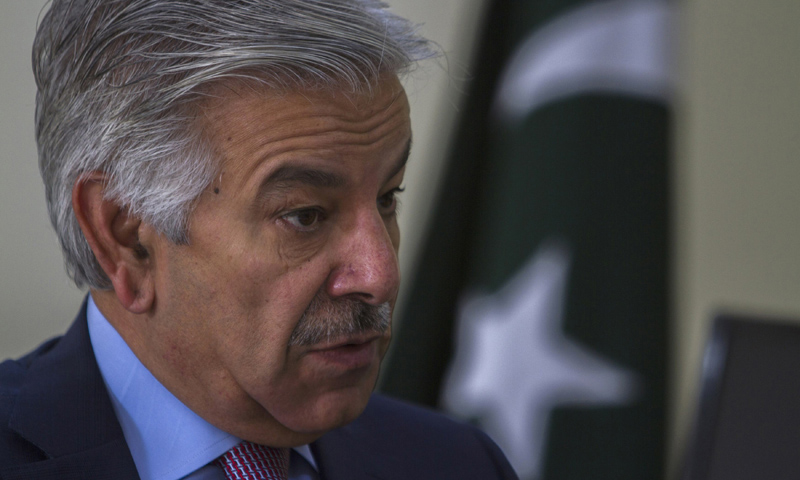
ISLAMABAD: Pakistan’s defence minister warned on Wednesday that the country would strike “deep into Afghanistan” if the Taliban regime allowed its territory to be used for terrorist attacks against Pakistan, escalating tensions after the collapse of mediated peace talks in Istanbul.
“We will conduct strikes, we definitely will,” Khawaja Muhammad Asif told reporters at Parliament House in Islamabad, when asked about Pakistan’s options in the face of cross-border attacks. “If their territory is used and they violate our territory, then, if we need to go deep into Afghanistan to retaliate, we surely will.”
The stark ultimatum came hours after Asif issued a blistering warning on the social media platform X, accusing the Taliban of treachery and daring them to test Pakistan’s resolve. “We have borne your treachery and mockery for too long, but no more,” he wrote. “Any terrorist attack or any suicide bombing inside Pakistan shall give you the bitter taste of such misadventures. Be rest assured and test our resolve and capabilities, if you wish so, at your own peril and doom.”
In a lengthy post, Asif asserted that Pakistan could “completely obliterate the Taliban regime and push them back to the caves for hiding,” evoking the chaotic American operation in Tora Bora in December 2001 that scattered Al Qaeda leaders into Afghanistan’s mountains. “If they wish so, the repeat of the scenes of their rout at Tora Bora, with their tails between the legs, would surely be a spectacle to watch for the people of the region.”
Asif dismissed the Afghan narrative of their country as a “graveyard of empires,” a reference to foreign powers’ historical failures there. “Pakistan certainly doesn’t claim it to be an empire but Afghanistan is definitely a graveyard, surely for its own people,” he wrote. “Never a graveyard of empires but certainly a playground of empires you have been throughout history.” “If the Taliban regime wants to fight us, the world will Insha Allah (God willing) see that their threats are only performative circus!”
The rhetoric marked a sharp breakdown in fragile diplomacy between the neighbors, whose 2,600-kilometer shared border has long been a flash point for militancy. Talks in Istanbul, facilitated by Turkey and Qatar, concluded without agreement on Tuesday after four days of discussions. Attaullah Tarar, information minister, said the negotiations failed to produce a “workable solution,” accusing Kabul of evading commitments to rein in militants operating from Afghan soil.
The failure followed a surge in cross-border clashes earlier this month, the heaviest in years, that underscored the volatility of relations since the Taliban returned to power in Afghanistan in 2021 after the American withdrawal. Pakistan carried out airstrikes near Kabul targeting camps of the Tehreek-e-Taliban Pakistan, a militant group that Islamabad says enjoys sanctuary under Taliban rule. Taliban forces responded with assaults on Pakistani military posts along the frontier. The sides agreed to a temporary ceasefire in Doha and committed to reconvene in Istanbul for lasting mechanisms.
The tensions coincide with a spike in militant violence inside Pakistan, particularly in the northwest, where TTP attacks have killed scores of soldiers and civilians in recent months. Pakistan has repeatedly demanded assurances that Afghan territory will not be used by the TTP or other groups for raids into Pakistan. Kabul denies harboring militants and has urged Islamabad to respect its sovereignty and cease cross-border strikes.
Asif, speaking to reporters, laid the blame squarely on the Taliban, accusing them of insincerity and serving as a proxy for India. “Kabul was not sincere at any level for any arrangement,” he said. “On the directives of India and by becoming its proxy, Fitna al-Hindustan wants to leverage its position over Pakistan through Afghanistan.” “The entire leadership of Kabul is playing in the hands of India.”
He described a tortuous negotiation process in Istanbul, where working groups from both sides were present and agreements appeared imminent multiple times, “three or four times I think”, only for Kabul to veto them. “Again and again, whenever something was finalised and an agreement was drafted … they contacted Kabul and a ‘no’ came from Kabul,” Asif said. Pakistani security officials said the Afghan delegation appeared riven by divisions among rival power centers in Kandahar, Kabul and Khost, complicating any written guarantees on militant sanctuaries.
The Taliban side, Asif said, acknowledged that the TTP, which Pakistan has banned, must be stopped from attacks and conceded that the group used Afghan soil. “They were agreeing with everything but were not ready to give in writing,” he said. Including the TTP in future talks was not on the table, Asif made clear. “Even if they had said so, it would have been a total refusal from us.”
Even the mediators, Qatar and Turkey, now recognised the “futoor (infirmity)” in Kabul’s intentions, he said. “We made this attempt with full sincerity so that Pakistan and Afghanistan can live in peace as good neighbors. But if they have handed over their reins to Delhi, then this will be difficult.”
Pressed on the prospects for better sense to prevail, Asif said it “can only be prayed, [but] there’s no medicine.” The defence minister questioned the Taliban’s legitimacy altogether, noting their lack of broad international recognition and inability to control Afghanistan. “That government does not have its writ in the entire Afghanistan,” he said. “Afghanistan is practically shattered into pieces, where one or the other influential terrorist group … there is a congregation of international terrorism there.”
Afghanistan, he added, “neither fulfills the definition of a state” nor does its interim administration view itself as one. “They are the ones who are involved in the killings, and they are taking financial benefits by being the rulers.”
The United Nations expressed alarm at the impasse. “Yes, it is, of course” a concern,” Stéphane Dujarric, a spokesman for Secretary General António Guterres, told reporters at United Nations headquarters in New York. “We very much hope that even if the talks are on pause, the fighting will not renew.”
Copyright © 2021 Independent Pakistan | All rights reserved