By Staff Reporter
ISLAMABAD: Pakistan has warned the UN Security Council that terrorist groups operating from safe havens in Afghanistan pose the greatest threat to its national security, urging robust international action to dismantle networks exploiting both physical and digital platforms to target the country.
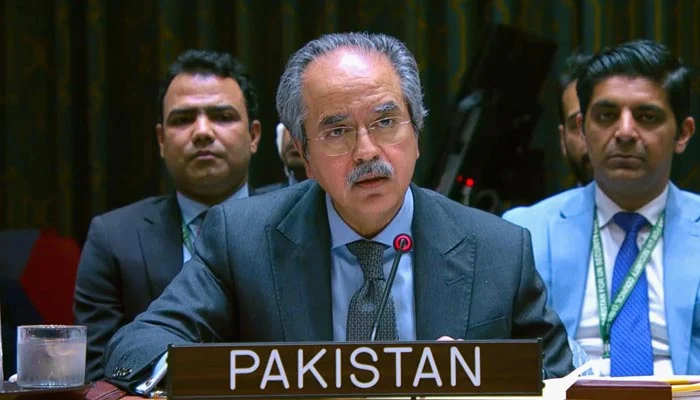
In a Tuesday address to the Council, Pakistan’s UN envoy, Ambassador Asim Iftikhar Ahmed, listed Al Qaeda, Islamic State-Khorasan (IS-K), Tehrik-e-Taliban Pakistan (TTP), the East Turkestan Islamic Movement (ETIM), and Baloch insurgent groups like the Balochistan Liberation Army (BLA) and Majeed Brigade as operating freely across the Afghan border.
“We have credible evidence of collaboration among these groups through joint training, illicit weapons trade, refuge to terrorists, and coordinated attacks,” Ahmed said, citing over 60 terrorist camps as hubs for cross-border attacks on Pakistani civilians, security forces, and development projects.
Ahmed highlighted the heavy toll of Pakistan’s counterterrorism operations, noting that 12 soldiers were killed this month in a single clash while thwarting infiltrations.
He said Pakistani forces had seized sophisticated military equipment, left behind by foreign troops during the 2021 Afghanistan withdrawal, now used by groups like the TTP, which he described as the largest UN-designated terrorist group in Afghanistan with some 6,000 fighters.
The envoy also flagged the growing digital threat, with around 70 propaganda accounts traced to Afghan IP addresses spreading extremist content. “Curbing these networks requires full cooperation from social media platforms with governments,” he said.
Pakistan and China have jointly requested the UN’s 1267 Sanctions Committee to designate the BLA and Majeed Brigade as terrorist organizations, a move Ahmed urged the Council to expedite to curb their activities.
Ahmed also addressed Afghanistan’s broader challenges, noting that four years of Taliban rule have ended decades of civil war but left the country mired in sanctions, poverty, narcotics, and human rights issues.
He pointed out that the UN’s 2025 Humanitarian Needs and Response Plan, requiring $2.42 billion, has received just 27 percent of its funding. Pakistan, which has hosted millions of Afghan refugees for over 40 years, faces “inadequate international assistance,” Ahmed said, calling for a fairer global burden-sharing.
While acknowledging the end of Afghanistan’s civil war, he described the situation as “deeply worrying” and stressed that sustained engagement, not isolation, is essential for peace.
Copyright © 2021 Independent Pakistan | All rights reserved