By Staff Reporter
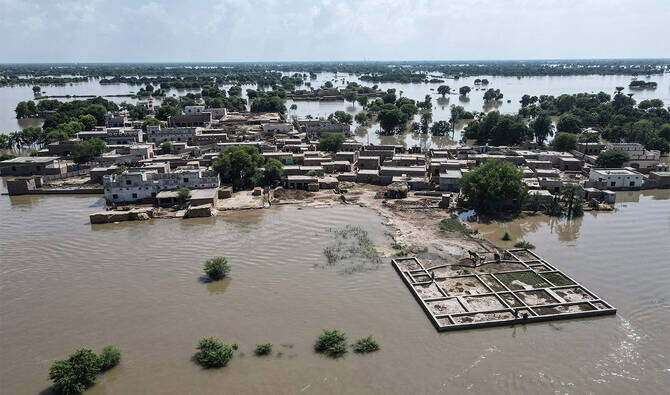
LAHORE: The Punjab government will soon launch a comprehensive survey to assess the toll of floods that have ravaged 28 districts, officials said Wednesday, as teams race to drain stagnant water, restore roads, and curb disease outbreaks.
The directive, issued by Prime Minister Shehbaz Sharif, follows a dyke collapse four days ago that inundated villages and severed highways. While water levels are dropping in most of Punjab’s major rivers, a surging Sutlej River threatens fresh devastation in southern districts like Multan, Bahawalpur, and Lodhran.
Chief Secretary Zahid Akhtar Zaman, leading a high-level meeting at the Civil Secretariat, outlined the survey’s goals: cataloging deaths, destroyed homes, ruined crops, and lost livestock. “A survey would be initiated soon to assess loss of human lives during the flood and the damage caused to houses, crops and livestock,” he said. To ensure accuracy, he ordered deputy commissioners to oversee the process in person.
Relief Commissioner Nabeel Javed reported that 2,000 assessment teams are mobilizing. The floods have hit 4,500 villages, affecting 4.7 million people across 47,000 rural mouzas. Authorities have evacuated 2.6 million residents and 2 million cattle, establishing 337 relief camps, 429 medical posts, and 368 veterinary stations.
Javed confirmed 118 deaths from flood-related incidents, with nine bodies—drowning victims—recovered in Muzaffargarh’s Alipur tehsil as waters receded. In northern districts like Narowal, Sialkot, Chiniot, Jhang, Okara, Sahiwal, and Sargodha, displaced families are returning home.
But in the south, the Sutlej’s rise has swamped lowlands. The Noraja Bhutta dyke’s failure flooded Jalalpur Pirwala’s union councils, including Noraja Bhutta, Basti Lang, Bahadurpur, Dipal, Sundra, Kanu, Jhando, Beetowali, and Kotla Chakar.
To protect the tehsil’s urban core, officials breached Gillani Road, diverting water to rural areas. The deluge damaged the Multan-Sukkur Motorway (M-5) at five points, flooding villages like Phagal Marhi, Hayatpur, Jhanmp, Soiwala, and Muradpur.
Near Uch Sharif, Jhangra and Basti Mir Chakar Rind were submerged, and the Multan-Uch Sharif motorway is closed after damage at multiple sites. National Highway Authority (NHA) teams are diverting traffic, with repairs pending lower water levels.
Zaman ordered additional tents and rations for Uch Sharif and instructed Bahawalpur’s deputy commissioner to supervise relief on-site. He also called for rapid aid distribution elsewhere, with officials monitoring in person. “As water levels recede, water ponding must be cleared without any delay,” he said, emphasizing drainage, disease prevention, sanitation, and road repairs.
Multan’s administration spokesman Waseem Yousuf said while Chenab levels are falling, “a major flood surge in the Sutlej was expected to reach Jalalpur within days,” endangering villages in Lodhran and Bahawalpur.
The Provincial Disaster Management Authority noted declining levels in the Jhelum, Sutlej, Ravi, and Chenab rivers. However, “a low-level flood persists at Panjnad, with water level now at 148,450 cusecs, while Ganda Singh Wala continues to be in a medium flood with water level 95,000 cusecs,” a spokesman said
. Sulemanki Headworks recorded rising inflows at 88,238 cusecs; Islam Headworks held at 71,751 cusecs. Dams are strained: Mangla at 95 percent capacity, Tarbela full, and India’s Bhakra, Pong, and Thein at 88, 94, and 88 percent, respectively, Javed said. NHA crews are working nonstop to repair the M-5 near Jalalpur Pirwala, with one carriageway temporarily restored. “Engineers and experts continued permanent repair work,” the agency said.
Copyright © 2021 Independent Pakistan | All rights reserved