By Staff Reporter
ISLAMABAD: Pakistan on Thursday hailed a resolution by Afghan scholars barring the use of their country’s territory for attacks on other nations as a positive step, but dismissed it as insufficient and renewed demands for formal written guarantees from the Taliban government in Kabul to curb cross-border terrorism.
The move came amid lingering friction between the two neighbours, fueled by deadly border skirmishes in October and Islamabad’s accusations that Afghan-based militants, including the Pakistani Taliban, continue to launch assaults into Pakistan.
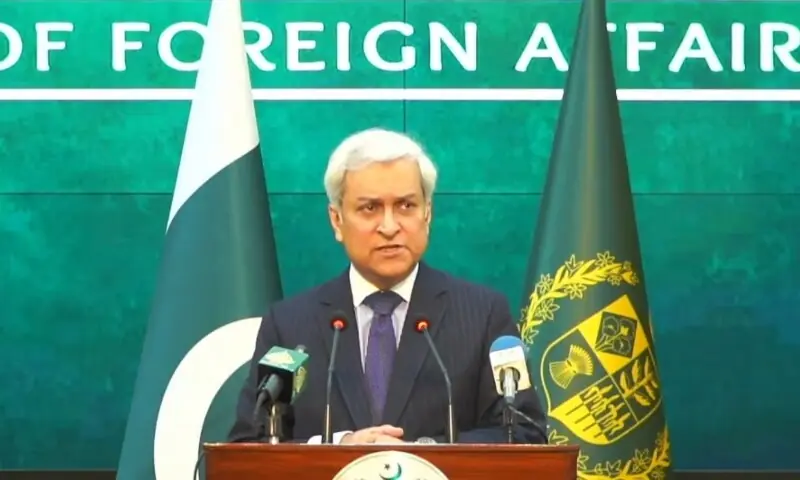
Foreign Office spokesman Tahir Hussain Andrabi, addressing reporters at his weekly briefing, described the scholars’ declaration as a “positive development” but cautioned that similar pledges from Afghan authorities in the past had gone unfulfilled. “Any developments with regards to the fact that Afghan leadership, the segment of Afghan society, realised the gravity of the situation that their soil is being used by not just TTP, but also by their own nationals to perpetrate terrorism in Pakistan — any realisation to this effect is positive and one would certainly welcome it,” Andrabi said. He added that the resolution fell short of the explicit commitments Pakistan seeks, noting it made no direct reference to Pakistan or the Tehrik-i-Taliban Pakistan. “The resolution does not qualify to be a full written assurance.”
According to a report by the Afghan broadcaster Tolo News, about 1,000 scholars convened at Kabul University on Wednesday and adopted a measure stating that “no one will be allowed to use Afghanistan’s soil against other countries for attacks.” The resolution further asserted that the Afghan government could take action against violators. Afghanistan has rejected Pakistan’s claims, insisting it bears no responsibility for its neighbour’s internal security lapses.
The scholars’ gathering unfolded against a backdrop of heightened hostilities. In October, Taliban forces and allied fighters initiated an assault on Pakistani border positions, prompting a week of intense clashes. Pakistani officials said their counterstrikes killed more than 200 militants, including through airstrikes extending into Kabul and Kandahar Province. Twenty-three Pakistani soldiers died in the fighting. A fragile ceasefire has held since, but diplomatic efforts in Istanbul and Doha have yet to yield an accord on halting infiltrations. Andrabi reaffirmed Pakistan’s willingness to provide humanitarian aid to Afghans, underscoring Islamabad’s concern for their welfare despite the disputes.
Separately, the spokesman clarified that no formal extradition treaty exists between Pakistan and Britain, though individual cases can proceed on an ad hoc basis. “In the absence of a formal treaty, the extradition cases can be processed on a case-to-case basis,” he said. “And certain cases were submitted to the British High Commission in Islamabad for their consideration.”
The comments followed Pakistan’s recent push to repatriate two critics of the current government living in Britain: Mirza Shahzad Akbar, a former adviser to ex-Prime Minister Imran Khan on accountability and interior affairs, and Adil Raja, a retired army major turned YouTube commentator.
Interior Minister Mohsin Naqvi raised the matter this month with Britain’s high commissioner in Islamabad, Jane Marriott, handing over dossiers and urging that the men “should be immediately handed over” as they are “wanted in Pakistan” on charges including anti-state propaganda. Akbar, who fled to London in April 2022 after Khan’s ouster, faces allegations tied to his role in the previous administration. Raja, convicted in absentia last year under the Pakistan Army Act through a field general court-martial, is accused of fomenting dissent via social media from his base in Britain.
Copyright © 2021 Independent Pakistan | All rights reserved