By Staff Reporter
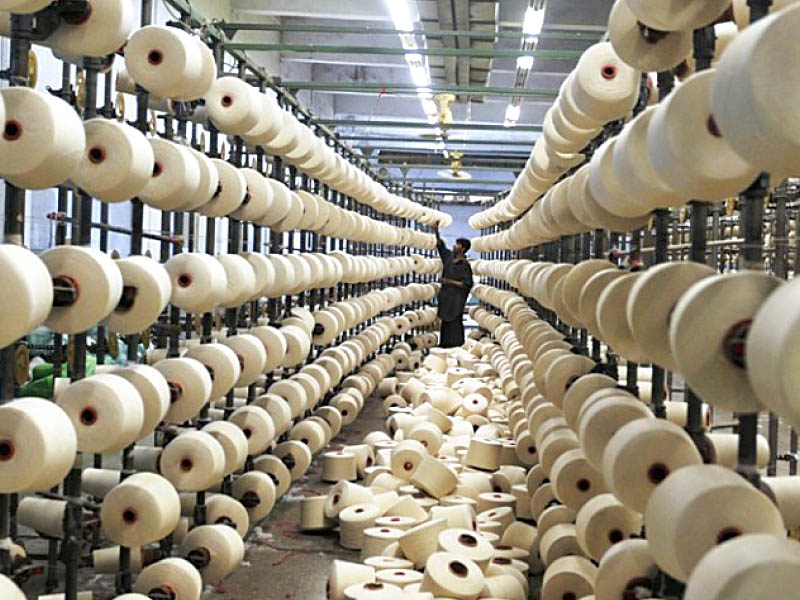
ISLAMABAD: Pakistan’s textile exports climbed to their highest monthly level on record in July, as gains in readymade garments and cotton yarn offset a slowdown in cotton cloth and helped anchor the country’s broader trade recovery at the start of the fiscal year.
Shipments of textile products rose 8.07% from a year earlier to $1.814 billion, from $1.678 billion in July 2025, according to data released Tuesday by the Pakistan Bureau of Statistics. The increase came despite what the bureau’s data suggests were headwinds from the suspension of trade with Afghanistan since October and a pullback in demand from the United Arab Emirates tied to regional conflict in the Middle East.
Readymade garments were the standout performer, with exports rising 15% in value to $460 million from $399.99 million, and climbing more than 23% by volume — evidence that Pakistani exporters are gaining ground in higher-value finished goods rather than relying solely on raw and semi-processed materials. Cotton yarn exports jumped 18.69% to $66.53 million from $56.05 million, while towels rose 13.37% to $106.36 million.
Knitwear, the largest single category, increased a more modest 4.06% to $533.84 million from $513 million, with bedwear up 4.16% to $308.5 million. Cotton cloth, Pakistan’s most basic textile export, was essentially flat, slipping 0.10% to $141.6 million even as shipped volumes fell more than 4%, underscoring the sector’s continued shift away from unfinished goods.
Smaller categories showed more mixed results. Other textile materials rose 21.98% to $7.946 million, and made-up articles excluding towels and bedwear increased 10.56% to $7.72 million. Tents, canvas and tarpaulin exports climbed 16.83% to $790,000. On the losing side, other cotton yarn fell 23.26% to $227,500, and art, silk and synthetic textile exports dropped 8.22% to $3.041 million.
Measured against June, textile exports surged 43.13%, rising from $1.267 billion to $1.814 billion — a jump that mirrors the broader rebound in national trade figures for the month.
Total Exports Rise, But Imports Rise Faster
Pakistan’s total exports reached $2.962 billion in July on a provisional basis, up 32.11% from $2.242 billion in June and 10.40% higher than the $2.683 billion recorded in July 2025. The gain was not confined to textiles: food exports rose 2.47% to $437 million, driven by a 19.15% jump in rice shipments to $200 million, with basmati exports up 37.37% to $76.5 million. Chemical and pharmaceutical exports increased 24% to $127.2 million, led by a 38% rise in plastic materials to $34.6 million, even as pharmaceutical goods exports themselves fell 16% to $28.7 million.
Not every category shared in the advance. Vegetable exports slid 19.13% to $12.8 million, fruit shipments dropped 33.7% to $33.7 million, and sporting goods exports fell 20.2% to $31 million, weighed down by a 43% collapse in football exports to $14.65 million.
Imports, however, outpaced the export gain. Total imports rose to $9.940 billion in July, a provisional figure up 44.08% from $6.899 billion in June and 18.90% higher than the $5.837 billion recorded a year earlier. That left Pakistan with a trade deficit of $6.978 billion for the month, widening the gap even as export earnings improved.
The import bill was driven largely by machinery and transport-related purchases. Machinery imports climbed 41.3% to $1.31 billion, with electrical machinery imports surging 87.7% to $549.5 million and construction and mining machinery jumping 158% to $28.4 million. Transport-sector imports rose 39.7% to $422.3 million, as imports of complete built-up cars increased 74.8% to $57.4 million and CKD/SKD vehicle kits rose 39.7% to $188 million.
Petroleum imports bucked the trend, falling 5.2% to $1.276 billion, with petroleum products down 22.6% to $491.5 million and LNG imports down 23.6% to $176.7 million. Crude oil imports moved in the opposite direction, rising 29.8% to $517 million on higher international prices, while LPG imports increased 11.7% to $91.7 million.
For the full fiscal year 2025-26 that ended in June, Pakistan’s total exports came to $30.139 billion on a provisional basis, a 5.93% decline from $32.040 billion in the prior year — a reminder that July’s strength marks a rebound from a softer year rather than a continuation of sustained momentum.
Cotton Arrivals Climb Despite Sowing Shortfall
Separately, cotton arrivals at ginning factories nationwide reached 1.113 million bales as of August 15, a 25.48% increase from the 887,000 bales recorded during the same period last year, according to data from the Pakistan Cotton Ginners’ Association. The gain marks a partial recovery from the steep multi-year decline that has gripped the sector since arrivals stood at 2.116 million bales in August 2023, though this season’s total sowing area of 1.6 million hectares still falls well short of the 2.16 million-hectare target, at roughly 74.3% of plan.
Sindh drove the bulk of the increase, with arrivals surging 42% to 734,000 bales from 518,000 a year earlier — still well below the province’s August 2023 peak of 1.479 million bales. Punjab’s output was comparatively flat, edging up 3% to 379,000 bales.
Cotton Ginners Forum Chairman Ihsanul Haq flagged a widening gap between the PCGA’s tally and estimates from Punjab’s Crop Reporting Service, which put the province’s production nearly 35% higher, at 585,000 bales as of August 13. Haq attributed part of the discrepancy to the movement of an estimated 60,000 to 70,000 bales of cotton and lint from Sindh into Punjab, drawn by stronger price realizations in Punjab’s markets — a flow that obscures the true scale of the province’s output decline.
Of the season’s total arrivals, 1.019 million bales have been pressed into finished bales and 950,000 have been sold, with textile mills accounting for 937,000 bales of purchases against just 13,000 bales bought by exporters and traders. No purchases were recorded under the Trading Corporation of Pakistan’s support program this season. Unsold stock stood at 68,208 bales, while 94,488 bales remained unginned, roughly double the 47,414 bales unginned during the same period last year — a signal of inventory building alongside the stronger arrivals.
At the district level, Sanghar in Sindh led the country by a wide margin with 550,000 bales, up 40.98% from a year earlier. Nawabshah posted the sharpest percentage gain among major contributors, soaring 207.69% to 28,000 bales, while Mirpur Khas rose 86.09% to 32,938 bales and Bahawalpur climbed 75.48% to 32,352 bales. Muzaffargarh recorded no arrivals at all, against 7,002 bales a year earlier, and Rajanpur fell 42.65% to 11,140 bales.
A total of 268 ginning factories were operational nationwide during the period, including 112 in Punjab and 156 in Sindh. Total unsold stock across the country stood at 162,000 bales, roughly double the 80,913 bales recorded in the same period last year.
Copyright © 2021 Independent Pakistan | All rights reserved