By Staff Reporter
ISLAMABAD: Pakistan’s large-scale manufacturing sector expanded 4.98% in the fiscal year ended June, with a surge in automobile production offsetting weakness in textiles and pharmaceuticals, even as output tumbled in the final month of the period, both from the prior month and a year earlier.
The Quantum Index of Manufacturing climbed to 120.55 points for the July 2025-June 2026 period, the Pakistan Bureau of Statistics said Tuesday in provisional data. The gauge, which uses 2015-16 as its base year, tracks industrial output across the South Asian nation’s largest manufacturing companies.
The annual gain belied a sharp deterioration in June, when the index slid to 108.83 points, down 3.48% from a year earlier and 6.08% from May’s reading of 116.10. The month-on-month drop underscores the volatility that has characterised Pakistan’s industrial recovery as the country works to stabilise an economy that required a bailout from the International Monetary Fund.
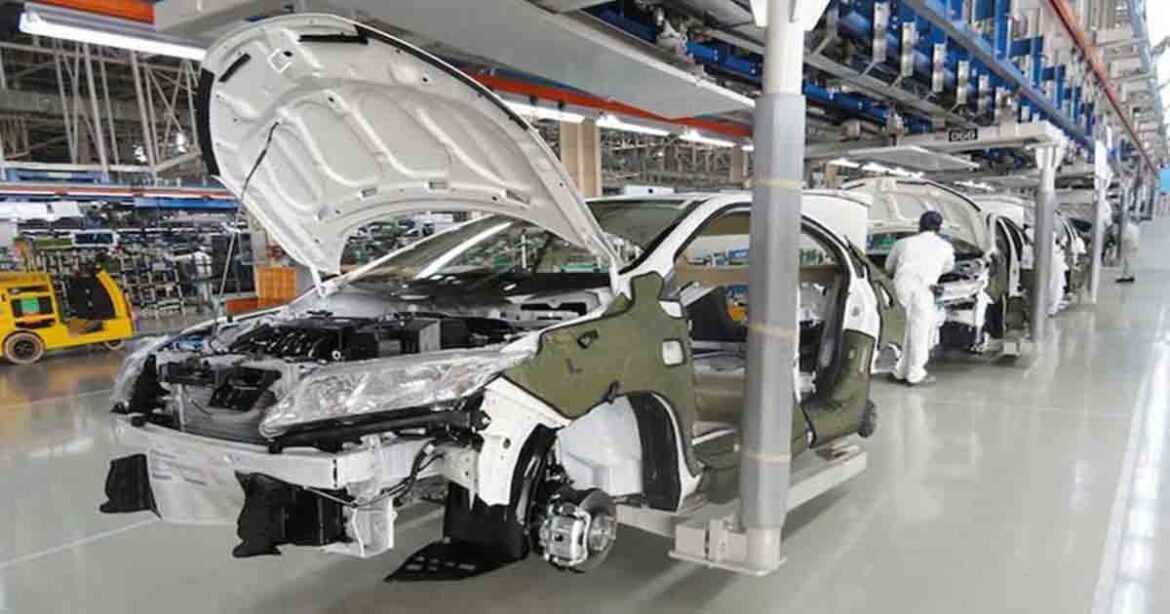
Automobiles were the standout performer, with production surging 57.77% for the fiscal year and 50.53% in June alone, cementing the industry’s position as the single biggest driver of the headline number. Car output alone contributed 1.56 percentage points to the annual growth figure, more than any other category tracked by the bureau.
The rebound in vehicle manufacturing follows a period of contraction triggered by import restrictions and currency depreciation that had squeezed the industry’s access to imported parts. Automakers have benefited from an easing of those constraints alongside a recovery in consumer demand.
Food production added the next-largest boost to the index, contributing 1.21 percentage points, followed by garments at 0.91 points and petroleum products at 0.72 points. Cement output rose 7.36% for the year and 9.76% in June, while other transport equipment climbed 42.36% over the 12 months.
Not every industry shared in the advance. Textiles, Pakistan’s largest manufacturing category by weight at 18.16% of the index, contracted 0.63% for the fiscal year, a reversal from 2.49% growth in the prior period. The decline shaved 0.11 percentage points off the overall figure. Within the category, cotton yarn output rose a modest 1.0%, while cotton cloth was roughly flat at 0.17% growth.
Pharmaceuticals posted the steepest annual decline among major sectors, falling 8.87% for the fiscal year and plunging 17.61% in June alone, the sharpest single-month drop in the data. Iron and steel products fell 7.84% for the year and tumbled 11.75% in June. Chemicals output dropped 2.53%, with chemical products down 3.51%.
Garments delivered a mixed picture, posting 5.49% growth for the full fiscal year even as output contracted 13.45% in June, illustrating the same month-to-month volatility evident in the broader index.
The bureau compiles the manufacturing gauge using data from source agencies including the Oil Companies Advisory Committee and the Ministry of Industries and Production. Sectors that expanded for the fiscal year included food, beverages, tobacco, wearing apparel, paper and board products, coke and petroleum products, rubber products, non-metallic mineral products, fabricated metal, computer and electronics products, electrical equipment, machinery and equipment, automobiles, other transport equipment, furniture and other manufacturing. Categories in decline spanned textiles, leather products, wood products, chemical products, pharmaceuticals and iron and steel products.
Copyright © 2021 Independent Pakistan | All rights reserved