By Staff Reporter
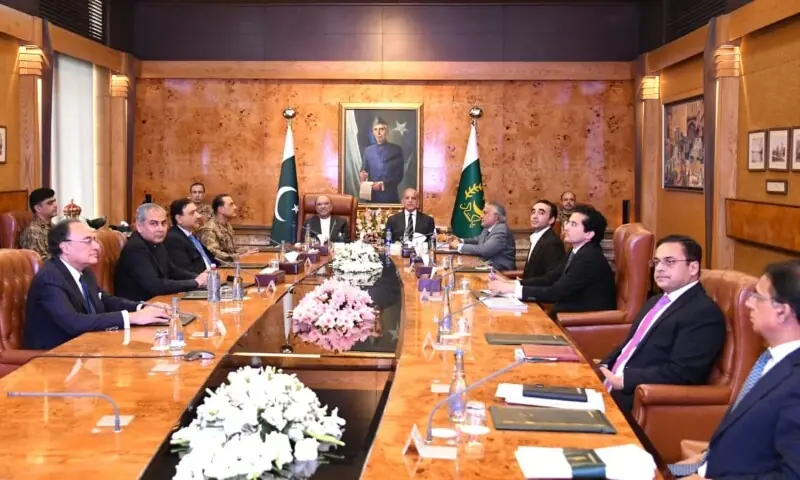
ISLAMABAD: President Asif Ali Zardari convened Pakistan’s most senior civilian and military officials on Thursday to chart a unified response to the economic and security strains triggered by the US-Israel war on Iran, emphasising national consensus and tighter coordination across government institutions as the conflict enters its second month.
The meeting at the Aiwan-i-Sadr, the presidential complex in Islamabad, came as Pakistan confronts supply disruptions in global oil markets that have driven up petroleum prices and threatened inflationary pressures across the economy. Officials reviewed the conflict’s ripple effects on the country’s energy security, food supplies and overall stability, according to a statement issued afterward by the President’s Secretariat.
Prime Minister Shehbaz Sharif, Chief of Army Staff and Chief of Defence Forces Field Marshal Syed Asim Munir, Deputy Prime Minister Senator Ishaq Dar and Pakistan Peoples Party Chairman Bilawal Bhutto Zardari — a former foreign minister — were among those present. Also attending were federal ministers Mohsin Naqvi, Muhammad Aurangzeb, Ali Pervaiz Malik and Ahad Khan Cheema, along with the finance secretary.
The meeting reflected the breadth of Pakistan’s power structure, drawing together the presidency, the elected government, the military high command and key political figures at a moment when the war, launched by US-Israeli actions on Feb. 28, has begun to test Islamabad’s delicate balancing act between Washington and Tehran.
According to the statement, participants stressed that policy decisions must place a premium on stability while safeguarding ordinary citizens’ interests. “The meeting underscored the importance of maintaining national consensus and strengthening institutional coordination in view of emerging regional challenges,” the statement said. Economic management, energy planning, food security and broader security considerations “must remain closely aligned to meet this challenging situation,” it added.
A central focus was the sharp fluctuations in global oil and gas supplies and prices. The ministers responsible for finance and petroleum briefed the group on steps already underway to stabilise domestic fuel costs, cushion the impact of higher prices on transportation, agriculture and industry, and impose fiscal discipline through austerity measures aimed at curbing government spending.
The statement noted that the broader regional situation — including the risk of a prolonged war spilling across borders — ranked among Islamabad’s foremost strategic concerns. Pakistan has already begun to feel the strain of fuel-supply disruptions linked to the Iran conflict, officials acknowledged. At the same time, the meeting highlighted the need for public cooperation. Participants called for a nationwide awareness campaign to reduce unnecessary fuel consumption, promote greater use of public transportation and encourage shared-ride systems as immediate, low-cost ways to ease pressure on energy resources.
The discussions underscored a recurring theme in Pakistani policymaking: the interplay between external shocks and domestic resilience. With food security explicitly on the agenda, officials appeared intent on preventing higher fuel costs from feeding into higher prices for staples such as wheat, rice and cooking oil — a perennial worry in a country where inflation remains a politically volatile issue.
The meeting’s emphasis on “coordinated national response” also signaled an effort to bridge any lingering differences between civilian and military leadership at a time of heightened regional tension. Field Marshal Munir’s presence alongside the prime minister and president reflected the military’s central role in shaping Pakistan’s security and foreign policy outlook.
Pakistan has intensified diplomatic maneuvering in recent weeks, positioning itself as a potential intermediary between Washington and Tehran in hopes of preventing further escalation. The government has repeatedly voiced concern that a wider conflict could destabilize the region and send new waves of refugees or militant activity toward its western border.
Thursday’s session produced no new policy announcements, but the presidential statement portrayed it as a foundational step toward a “unified policy approach” grounded in consensus. By publicly aligning the presidency, the Sharif government, the opposition-linked Bilawal Bhutto Zardari and the armed forces behind a single message, officials appeared to signal that Pakistan intends to face the crisis with internal cohesion rather than fragmented responses.
Copyright © 2021 Independent Pakistan | All rights reserved