By Staff Reporter
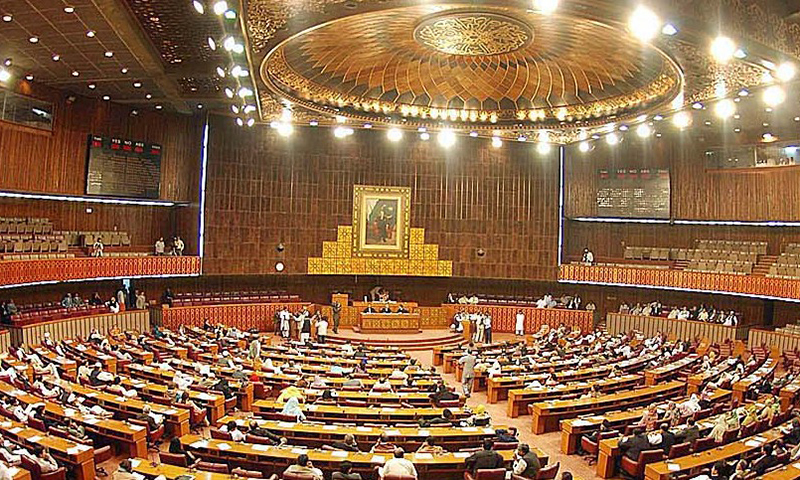
ISLAMABAD: In a raucous joint session of Parliament on Tuesday, lawmakers approved a long-delayed bill to create a national commission dedicated to protecting the rights of religious minorities, but only after excising a clause that had ignited fierce opposition over its potential implications for the Ahmadi community, a group long subjected to persecution by extremist elements in Pakistan.
The National Commission for Minorities Bill 2025, which seeks to create a dedicated body to protect and promote the interests of non-Muslim communities, was supported by 160 members and opposed by 79. The measure establishes a 16-member body to monitor and enforce constitutional safeguards for non-Muslims, including the power to investigate violations, intervene in judicial proceedings, inspect detention facilities, and recommend policies to combat discrimination.
Law Minister Azam Nazeer Tarar, who introduced the legislation, defended it against immediate outcry from opposition benches, particularly from the Pakistan Tehreek-e-Insaf (PTI) and the Jamiat Ulema-i-Islam—Fazl (JUI-F). “Neither the law and the Constitution, nor our conscience allows us to make a proposal that contradicts the Quran and Sunnah,” Tarar said, assuring skeptics of its alignment with Islamic principles. He described the bill as a long-overdue response to a 2014 Supreme Court judgment that called for such a commission, noting that the matter had languished for about 10 years before reaching the joint sitting. “The bill was delayed for 10 years and politics should not influence it,” Tarar said. “Its passage marks a historic step toward formalizing protections for minority rights in Pakistan.”
Defining minorities as “non-Muslims” under the Constitution, the minister emphasized inclusivity: “This is a commission for non-Muslims. Our Hindu, Christian and Parsi brothers are as good Pakistanis as we are.” He added that four amendments had been incorporated into the original draft, including changes proposed during the debate.
The session’s most heated exchanges centered on Clause 35, which originally stipulated that the act’s provisions “shall be in addition to and not in derogation of the provisions of any other law for the time being in force.” Opposition members argued that this could create conflicts with existing laws and potentially undermine safeguards for the Ahmadi community, also known as Qadianis, who were declared non-Muslims by a 1974 constitutional amendment and have faced systemic discrimination and violence from hardline Islamist groups.
JUI-F Senator Kamran Murtaza led the charge against the clause, warning that it might erode protections for Ahmadis. He proposed its complete omission, along with objections to Section 12, which grants the commission suo motu powers, the ability to act on its own initiative. “On one hand, you are taking away suo motu powers from courts. And on the other hand, you are giving this power to commissions,” Murtaza said, referring to the recent 27th Constitutional Amendment that curtailed the Supreme Court’s authority in this area.
If these provisions were removed, he added, “we could say that this [bill] is acceptable.” Tarar agreed to withdraw Clause 35, clarifying that “the Constitution states Ahmadis are non-Muslims.” He thanked JUI-F chief Maulana Fazlur Rehman for the amendments, underscoring that the law explicitly defines Ahmadis as non-Muslims.
Senator Noorul Haq Qadri echoed the sensitivities, stating, “PTI and JUI have no issue regarding Hindus, Sikhs, and Christians, but we are concerned about Ahmadis.” Pakistan People’s Party lawmaker Qadir Patel, while supporting the bill, cautioned against potential abuse: “No law should be enacted that could be misused, and accountability will be on the Day of Judgment.”
PTI chairperson Barrister Gohar Ali Khan questioned the bill’s procedural history, pointing out that it had been returned by President Asif Ali Zardari without assent due to objections. “It should be debated why the President did not give his assent to the bill,” Gohar said. He highlighted the president’s concerns, including the first-time definition of “minorities,” the removal process for commission members mirroring that of Supreme Court judges, the body’s authority to create and upgrade posts, unprecedented among commissions, and its allowance for an independent account.
JUI-F leader Maulana Fazlur Rehman broadened the criticism to the legislative process, lambasting the 27th Constitutional Amendment for failing to meet democratic standards and fostering social divisions. He contrasted it with the 1973 Constitution’s collaborative drafting under Zulfikar Ali Bhutto and warned against external influences. “Today, we are following the path of the Jews and Christians,” Rehman said, urging corrections to constitutional missteps. He also decried the lack of consultation with opposition parties and the omission of recommendations from the Council of Islamic Ideology, objecting to provisions on underage marriages and transgender rights in related amendments.
Senator Allama Raja Nasir Abbas joined the fray, framing the bill as an effort to expand rights but decrying broader violations. “We are here today to give some people their rights, to legislate so that they get more rights,” he said. Yet he lamented the state of democracy. “There is democracy, [and] you are presiding over a session where there is no opposition […] It is not a good sign.” As he veered into grievances about opposition suppression, Speaker Sadiq interrupted, directing him back to the bill.
Abbas also highlighted Pakistan’s pervasive human rights issues, questioning the haste in passing the legislation despite the long delay in heeding the Supreme Court. The commission’s structure includes two minority representatives from each of Pakistan’s four provinces, one from Islamabad nominated by the chief commissioner, three from existing human rights bodies, and senior officials from key ministries. The chairperson, requiring human rights expertise, must be at least 35 years old and appointed within 60 days by a bipartisan parliamentary committee; failing consensus, the prime minister decides. An additional 18-member Minority Council will include representatives from various faiths, including Hindus, Christians, Sikhs, Bahais/Parsis, and Muslims, with three-year terms appointed by the prime minister.
The bill empowers the commission to review laws for discriminatory effects, identify hate speech on social media, prepare parliamentary reports, and collaborate with international organisations. It defines minority rights under Article 20 of the Constitution, encompassing religious freedom and worship. Despite the amendments, including the removal of Clause 35 as proposed by Murtaza, the opposition’s reservations persisted, reflecting deep-seated tensions over minority definitions and institutional powers in a country where Ahmadis have endured targeted violence, blasphemy accusations, and social exclusion. Under Article 75(2) of the Constitution, the approved bill returns to the president for assent, which must be granted within 10 days or deemed given automatically.
Copyright © 2021 Independent Pakistan | All rights reserved