By Staff Reporter
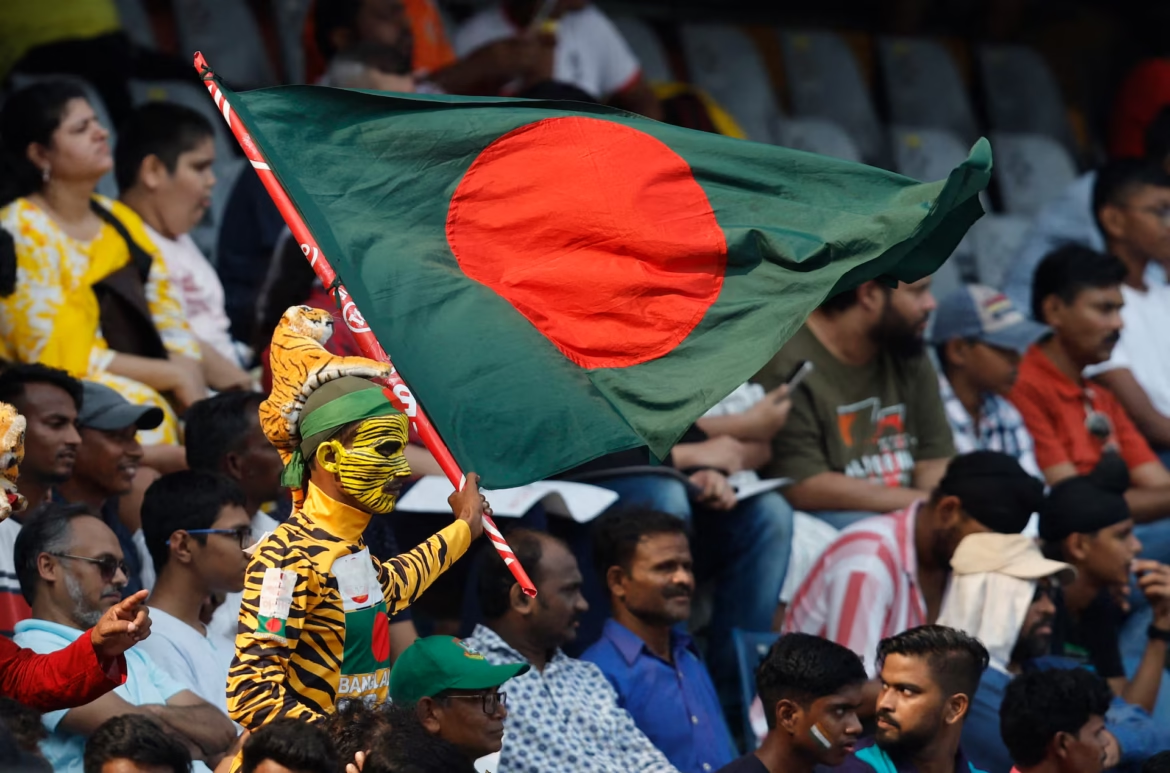
PESHAWAR: Pakistan Cricket Board (PCB) Chairman Mohsin Naqvi said on Tuesday that his recent meetings with officials from the Bangladesh Cricket Board (BCB) and the International Cricket Council (ICC) were aimed solely at securing respect for Bangladesh after its withdrawal from the T20 World Cup.
The comments came a day after Pakistan’s government reversed its decision to boycott the team’s group-stage match against arch-rival India, scheduled for Feb. 15 in Colombo, following intense negotiations involving the ICC, the two cricket boards, national leaders and intermediaries from Sri Lanka and the United Arab Emirates.
The standoff had threatened to disrupt the ongoing T20 World Cup, co-hosted by India and Sri Lanka, which began on Feb. 7 amid political tensions that led Bangladesh to pull out over security concerns in India.
Speaking to journalists in Peshawar, Naqvi addressed questions about conditions raised during his Sunday meeting with ICC and BCB officials. “We did not discuss anything apart from Bangladesh; our only purpose was to get Bangladesh respect, to highlight the injustice done to them,” Naqvi said. “And you saw that whatever demands Bangladesh made, they were accepted. That’s it.”
He added: “We had no personal interest in the meeting … our task was purely related to Bangladesh. The government made the decision on that [basis]. When their demands have been accepted, and it has been acknowledged that injustice was done to them, we are playing after that.”
The crisis erupted after Bangladesh refused to tour India, citing soured political relations between the Asian neighbours, and requested that its matches be shifted to Sri Lanka – a plea rejected by the ICC. Bangladesh was subsequently replaced by Scotland in the tournament, prompting Pakistan’s government on Feb. 1 to announce it would skip the India match in solidarity, instructing the PCB to ensure the team did not participate in that fixture while proceeding with others.
The ICC responded swiftly, stating that “selective participation is difficult to reconcile with the fundamental premise of a global sporting event where all qualified teams are expected to compete on equal terms per the event schedule.” It urged the PCB to weigh the “significant and long-term implications for cricket in its own country,” amid reports of back-channel talks to avert financial losses from the high-profile clash.
Sri Lanka’s cricket board appealed to Pakistan to reconsider, while BCB chief and ICC Deputy Chair Imran Khawaja flew to Lahore on Sunday for extended discussions with Naqvi. A day later, Sri Lankan President Dissanayake spoke by phone with Pakistani Prime Minister Shehbaz Sharif to press for participation in the India game, and BCB President Aminul Islam echoed the call.
Pakistan then withdrew its boycott, with the ICC announcing no penalties for Bangladesh and agreeing to let the country host an event before the 2031 Men’s Cricket World Cup as compensation.
Naqvi described Pakistan’s brief threat as a means to spotlight what it viewed as unfair treatment of Bangladesh and to ensure its concerns were addressed. “Our objective was only to ensure that Bangladesh was treated with dignity and that the injustice done to them was highlighted,” he told journalists. “You saw that whatever points Bangladesh raised were accepted. That’s it. We had no personal agenda of our own in this.”
The reversal clears the way for the marquee India-Pakistan encounter, a fixture that generates massive revenue and global interest but occurs only at neutral venues in multilateral events, as the nuclear-armed neighbours have not played bilateral cricket for over a decade due to political tensions.
Pakistan defeated the Netherlands, and the United States will face India in Colombo on Feb 15. The episode had overshadowed the tournament’s start, with Bangladesh standing firm on its withdrawal after the ICC denied its relocation request, leading to Scotland’s inclusion.
In a related development, authorities have approved plans to stage matches of the Pakistan Super League (PSL) cricket tournament in the northwestern city of Peshawar for the first time this year, following a high-level security review that also outlined measures to bolster governance and crack down on illicit activities in tribal districts.
The decision came during a meeting on Tuesday at the Corps Headquarters in Peshawar, where officials assessed the security situation in Khyber Pakhtunkhwa province before giving the green light for games in the 11th edition of the PSL, according to a statement from the meeting.
The PSL, Pakistan’s premier Twenty20 cricket competition, is set to run from March 26 to May 3, with preparations underway amid ongoing efforts to promote sports in regions long affected by militancy.
Interior Minister Naqvi attended the session alongside Khyber Pakhtunkhwa Chief Minister Sohail Afridi, the national security adviser, the Peshawar corps commander and senior civil and military officials.
In separate remarks to the media, Naqvi highlighted the province’s significant role in Pakistani cricket, noting that 60% of the national team’s players hail from Khyber Pakhtunkhwa. “We are working with KP on domestic cricket and will give good news for cricket so that the talent here is not wasted,” Naqvi said. “We will collectively bring good news for sports in Peshawar.”
Copyright © 2021 Independent Pakistan | All rights reserved