By Staff Reporter
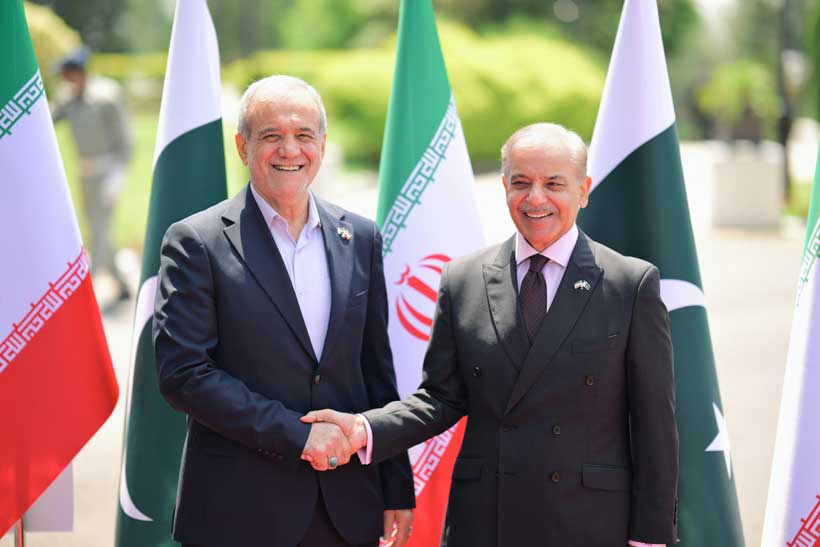
ISLAMABAD: Iranian President Masoud Pezeshkian will arrive in Islamabad on Tuesday for a state visit at the invitation of Prime Minister Shehbaz Sharif, Pakistan’s Foreign Office said, as Tehran and Washington began a 60-day push toward a final agreement to end months of conflict following the first formal round of US-Iran talks in Switzerland.
Pezeshkian, travelling with a high-level delegation that includes ministers and senior officials, will meet Pakistani President Asif Ali Zardari and hold formal talks with Sharif. The chairman of the Senate, the speaker of the National Assembly and Deputy Prime Minister and Foreign Minister Ishaq Dar will also call on the Iranian president, the Foreign Office said in a statement. It will be Pezeshkian’s second visit to Pakistan since assuming the presidency.
Iran’s state-run Islamic Republic News Agency separately quoted Habibollah Abbasi, director of public relations at the Iranian president’s office, saying that among the aims of the trip was “appreciation of Pakistani Prime Minister Shehbaz Sharif for his mediation between Iran and the United States,” along with high-level consultations and a review of bilateral economic cooperation.
The visit comes after Pakistan and Qatar on Monday claimed meaningful progress from the opening session of formal U.S.-Iran negotiations held at Bürgenstock, Switzerland — the first meeting convened under a Pakistan-brokered memorandum of understanding signed following joint US-Israeli strikes on Iran in February that shattered the two countries’ already fragile relations.
Sharif and Pakistan Army Chief Field Marshal Asim Munir, who attended the Bürgenstock talks alongside Qatari mediators, departed Switzerland for Islamabad on Monday, Sharif’s office said.
Roadmap and new mechanisms
In a joint statement, Pakistan and Qatar said the Bürgenstock session had produced “encouraging progress,” including agreement on a 60-day roadmap toward a final deal and the immediate launch of technical-level working groups.
A newly constituted High-Level Committee will provide political oversight of the process, while chief negotiators lead working groups focused on Iran’s nuclear programme, sanctions relief, monitoring and dispute resolution — issues that have bedevilled U.S.-Iranian relations for decades.
The mediators also announced a dedicated communication line to prevent “incidents and miscommunication” in the Strait of Hormuz, through which roughly a fifth of the world’s oil supply passes. A separate “de-confliction cell” involving Lebanon, facilitated by Pakistan and Qatar, was established to support a halt to military operations there as required under the memorandum.
Iranian Foreign Ministry spokesman Esmaeil Baqaei confirmed that Tehran, Washington and the mediators had agreed on executive mechanisms to oversee implementation of the accord and said expert- and technical-level talks would continue through the week at Bürgenstock. He cautioned, however, that substantive nuclear negotiations had yet to begin. “A very brief discussion took place regarding the nuclear issue, but there was no discussion of details,” he said.
Pakistan’s diplomatic moment
The Foreign Office framed the state visit in expansive terms, saying the two sides would “review the full spectrum of bilateral relations and explore new avenues to further deepen cooperation across diverse sectors, including trade, energy, border security, people-to-people exchanges, and regional connectivity.” The visit would also provide an opportunity to discuss “ongoing diplomatic engagements following the signing of the Islamabad Memorandum of Understanding,” it said.
“The forthcoming visit reflects the shared commitment of Pakistan and Iran to further deepen their historic and cultural ties and underscores their common aspiration for peace, stability, and sustainable progress in the region,” the statement added.
Sharif, in his first public remarks since the Bürgenstock session concluded, hailed the “successful conclusion” of the meeting and credited U.S. and Iranian leaders for their “continued commitment to constructive engagement.” He singled out Qatar for its “critical support” and Switzerland for hosting the talks.
In an unusually direct tribute for a sitting prime minister, Sharif reserved his most effusive praise for Munir, saying the army chief’s “untiring efforts” had been indispensable. “His dedication, commitment and perseverance are indeed commendable without which there would have been no progress,” Sharif wrote on X.
Fragile moment
Despite the diplomatic momentum, the path to a comprehensive settlement remains treacherous. The war in Lebanon between Israel and Hezbollah has repeatedly threatened to unravel ceasefire arrangements, though the country was reported relatively calm as of Sunday. Tehran and Washington retain deep disagreements over the scope and sequencing of any nuclear deal, and Iranian officials have been careful not to overstate what was achieved in Switzerland.
The Islamabad Memorandum of Understanding calls for the reopening of the Strait of Hormuz, a halt to hostilities and negotiations toward a broader settlement — a formidable agenda that previous U.S.-Iran diplomatic processes failed to advance.
Whether the 60-day deadline proves realistic will depend heavily on progress in the working groups now getting under way and on whether the Lebanon de-confliction cell can contain a conflict that has already strained the framework once.
Pakistan, for its part, is determined to press its advantage. “Pakistan will continue to play its honest and sincere role in advancing dialogue and diplomacy towards a peaceful and lasting resolution,” Sharif said.
Copyright © 2021 Independent Pakistan | All rights reserved