By Staff Reporter
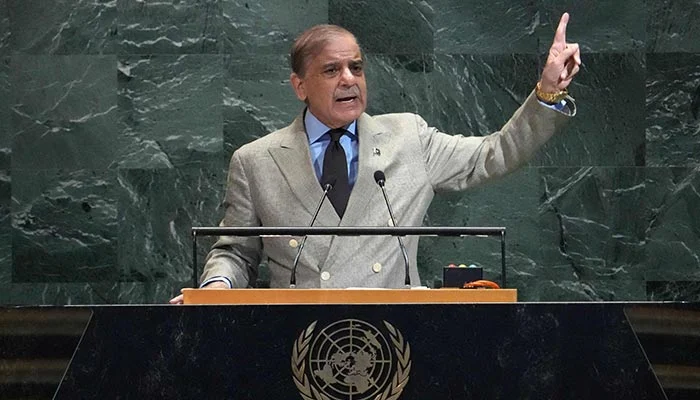
ISLAMABAD: In a forceful address to the United Nations General Assembly on Friday, Prime Minister Shehbaz Sharif condemned Israel’s actions in Gaza as “genocidal” and urged an immediate ceasefire, while extending an olive branch to arch-rival India for dialogue to secure lasting peace in South Asia.
Speaking at the 80th session of the UNGA, themed “Better Together: 80 Years and More for Peace, Development and Human Rights,” Sharif outlined a vision for multilateral cooperation amid escalating global conflicts, climate crises, and terrorism.
Sharif’s speech came against the backdrop of Israel’s nearly two-year war in Gaza, which has claimed over 65,000 Palestinian lives since October 2023, and a recent four-day military clash between Pakistan and India in May, the deadliest in over two decades.
His remarks blended defiance with diplomacy, reflecting Pakistan’s complex position as a nation grappling with regional tensions and global challenges.
A Call for Peace After Conflict with India
Sharif recounted Pakistan’s response to what he described as India’s “unprovoked aggression” in May, following a terrorist attack in occupied Kashmir’s Pahalgam that killed 26 tourists in April. India blamed Pakistan for the attack, a charge Islamabad has consistently denied.
“India sought to extract political gains from a human tragedy by spurning my sincere offer of an independent international investigation into the Pahalgam incident,” Sharif said. He accused New Delhi of attacking Pakistani cities and targeting civilians, prompting a response he framed as self-defence under Article 51 of the U.N. Charter.
“Our falcons took flight and etched their answer across the skies, resulting in seven of the Indian jets turned to scrap and dust—a decisive response,” Sharif said, praising the “stunning professionalism and bravery” of Pakistan’s armed forces under Field Marshal Asim Munir. “To the fair architect of this victory, to every officer and soldier, heirs of our martyrs—their names are forever engraved in glory.”
The brief but intense conflict, which killed nearly 70 people on both sides, ended with a ceasefire brokered by President Donald Trump on May 10.
Sharif lauded Trump’s “bold and vigorous leadership” for averting a broader war. “Had he not intervened timely and decisively, the consequences of a full-fledged war would have been catastrophic,” he said. “Who would have lived to tell what happened?” In recognition, Pakistan nominated Trump for the Nobel Peace Prize, a gesture Sharif called “the least we can do for his love of peace.”
Despite the victory, Sharif emphasised Pakistan’s desire for peace. “We have won the war, and now we seek to win peace in our part of the world, and this is my most sincere and serious offer before this assembly of the world nations,” he said.
He reiterated Pakistan’s readiness for “a composite, comprehensive, and result-oriented dialogue with India on all outstanding issues,” including the disputed region of Kashmir, where he vowed support for the Kashmiri people’s right to self-determination through a UN-backed plebiscite.
Sharif also criticiced India’s stance on the Indus Water Treaty, which governs the sharing of the Indus River system’s waters, vital for 80 percent of Pakistan’s agriculture. “India’s unilateral and illegal attempt to hold the Indus Water Treaty in abeyance defies the provisions of the treaty itself as well as the norms of international law,” he said. “To us, any violation of this IWT represents an act of war.”
Condemning Israel’s “Unspeakable Terror”
Turning to the Middle East, Sharif delivered a searing critique of Israel’s actions in Gaza and the West Bank, calling the Palestinian plight “one of the most heart-wrenching tragedies of our times.”
He described Israel’s campaign as a “genocidal onslaught” that has unleashed “unspeakable terror upon women and children in a manner not witnessed in the annals of history.” The prolonged occupation, he said, is a “stain on the global conscience and our collective moral failure.”
Sharif invoked the story of Hind Rajab, a Palestinian child killed in Gaza, to underscore the urgency of action. “We have all heard a trembling voice, a phone call that little Hind made as she struggled to stay alive under the Israeli onslaught and atrocities,” he said. “My agony, the agony of the entire Muslim Ummah and of all nations, that we failed Hind Rajab.”
Recalling his own experience carrying the coffin of a child, Irtiza Abbas, killed during the May conflict with India, he added, “The smallest coffins are the heaviest to carry.” Pakistan, Sharif affirmed, supports a sovereign Palestinian state with pre-1967 borders and Al-Quds Sharif (Jerusalem) as its capital. “Palestine can no longer remain under Israeli shackles; it must be liberated and liberated with full commitment and force.”
He also condemned Israel’s recent attack on Doha and its violations of other nations’ sovereignty, expressing solidarity with Qatar and supporting a peaceful resolution to the Ukraine conflict in line with the UN Charter.
Pakistan’s Fight Against Terrorism and Climate Crisis
Sharif highlighted Pakistan’s decades-long battle against terrorism, noting the loss of 90,000 lives and $150 billion in economic damage. “Please tell me, with a hand on your heart, what can be a bigger manifestation of our commitment to fight terrorism and erase it not only from Pakistan but from the face of the world?” he asked.
He cited recent attacks by groups like the banned Tehreek-e-Taliban Pakistan and the Balochistan Liberation Army’s Majeed Brigade, including the hijacking of the Jaffar Express, where 400 hostages were freed by Pakistani forces.
On climate change, Sharif described Pakistan’s disproportionate suffering despite contributing less than 1 percent of global emissions. He referenced the catastrophic 2022 floods, which caused $34 billion in losses, and this year’s “mega flood” that wiped out thousands of villages, killed over 1,000 people, and displaced millions.
“This is not fairness, this is not equality, this is not justice, this is not fair play,” he said, rejecting calls for Pakistan to take on more debt to recover. “We will be better off not borrowing loans, but standing on our own feet, working hard tirelessly with blood and sweat.”
A Vision for Multilateralism
Sharif framed Pakistan’s foreign policy as rooted in peace, mutual respect, and cooperation, guided by the principles of its founder, Quaid-i-Azam Muhammad Ali Jinnah. “Multilateralism is no longer an option; it is the need of the hour,” he said, calling for a revitalised UN to address global challenges.
He urged the assembly to make the 80th anniversary a turning point for cooperative multilateralism that delivers for all. “Let us make history and chart a future for the next 80 years, with the U.N. as an enduring hope for global good,” he concluded. “Let us truly strive to become better together.”
Copyright © 2021 Independent Pakistan | All rights reserved