By Staff reporter
ISLAMABAD: Prime Minister Shehbaz Sharif said on Wednesday that Pakistan had emerged as a pivotal force for stability in the Middle East, crediting its diplomatic intervention for bringing Iran and the United States to the negotiating table for the first time since 1979 and securing a ceasefire after talks hosted in Islamabad.
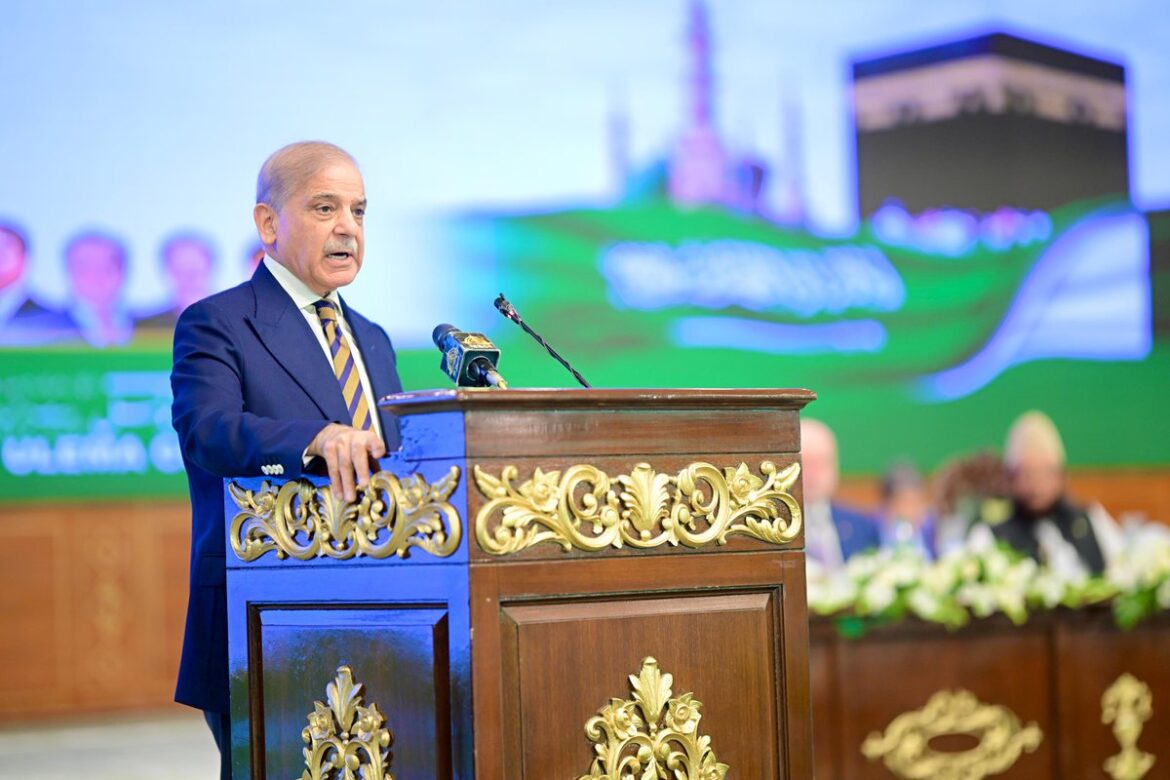
Addressing the 6th International Paigham-e-Islam Conference, Sharif also highlighted a landmark defense agreement signed with Saudi Arabia last September, saying the pact underscored Islamabad’s unshakable commitment to the security of the kingdom’s holy sites. The Strategic Mutual Defense Agreement, he said, formalizes decades of military cooperation and establishes a mutual pledge that any aggression against one nation would be treated as an attack on both.
“The protection, defense and security of the sacred land of the Two Holy Mosques is extremely important and dearer to us than our lives,” Sharif told the gathering of religious scholars and dignitaries. “The mutual defense agreements between the two brotherly countries affirm this iron resolve of ours.”
The remarks came amid heightened tensions across the region, where Pakistan has sought to leverage its longstanding relationships with both Riyadh and Tehran — as well as Washington — to ease conflicts. Sharif used much of his speech to detail Islamabad’s role in facilitating direct dialogue between Iran and the United States, which he described as unprecedented.
Pakistan, he said, had persuaded the leadership of both countries to engage after years of estrangement. The resulting talks, held in Islamabad on April 11 and 12, produced a ceasefire that both sides accepted at Pakistan’s invitation. “This reflects the trust the international community places in Pakistan,” Sharif said, adding that the country had performed “a significant service aimed at ensuring peace and stability in the region.”
He expressed confidence that continued Pakistani efforts would help produce a lasting truce. Sharif singled out Saudi Crown Prince Mohammed bin Salman for special praise, calling him “my very dear brother” and crediting him with playing “his full role” and “a complete role” in supporting the negotiations. He also thanked China, Turkey and other friendly nations for their backing, and commended Deputy Prime Minister and Foreign Minister Ishaq Dar and Chief of Army Staff Field Marshal Syed Asim Munir for their work in convening the parties.
The prime minister framed the conference itself as a reflection of Muslim unity, or Ummah, and urged the assembled religious scholars, or ulema, to use their influence to promote harmony. He called on them to deliver sermons that foster national cohesion regardless of sectarian differences and to stand firmly against terrorism and any attempts to divide the Muslim world.
Pakistan’s own national unity, Sharif said, had held firm through recent challenges. He reiterated Islamabad’s unwavering support for the people of Palestine and Indian-occupied Jammu and Kashmir, saying the country would continue to back their aspirations for independence.
The defense pact with Saudi Arabia, signed in September 2025, has deepened an already close alliance built on military training exchanges, joint exercises and intelligence sharing. Sharif described bilateral relations as having reached “new heights,” particularly in defense cooperation, and reiterated that safeguarding the Haramain Sharifain — the holy sites in Mecca and Medina — remains “a matter of faith” for Pakistan.
At the close of the conference, Sharif distributed shields to several prominent figures in recognition of their service to the Muslim Ummah. The speech offered a comprehensive picture of Pakistan’s foreign policy priorities under Sharif: deepening strategic ties with its wealthiest Gulf partner while positioning itself as a trusted mediator in one of the region’s most intractable rivalries.
Copyright © 2021 Independent Pakistan | All rights reserved