By Staff Reporter
ISLAMABAD: Finance minister said the country is accelerating efforts to tap diversified funding sources, including green bonds and sukuk, as it seeks to build resilience against climate change and speed its shift to cleaner energy.
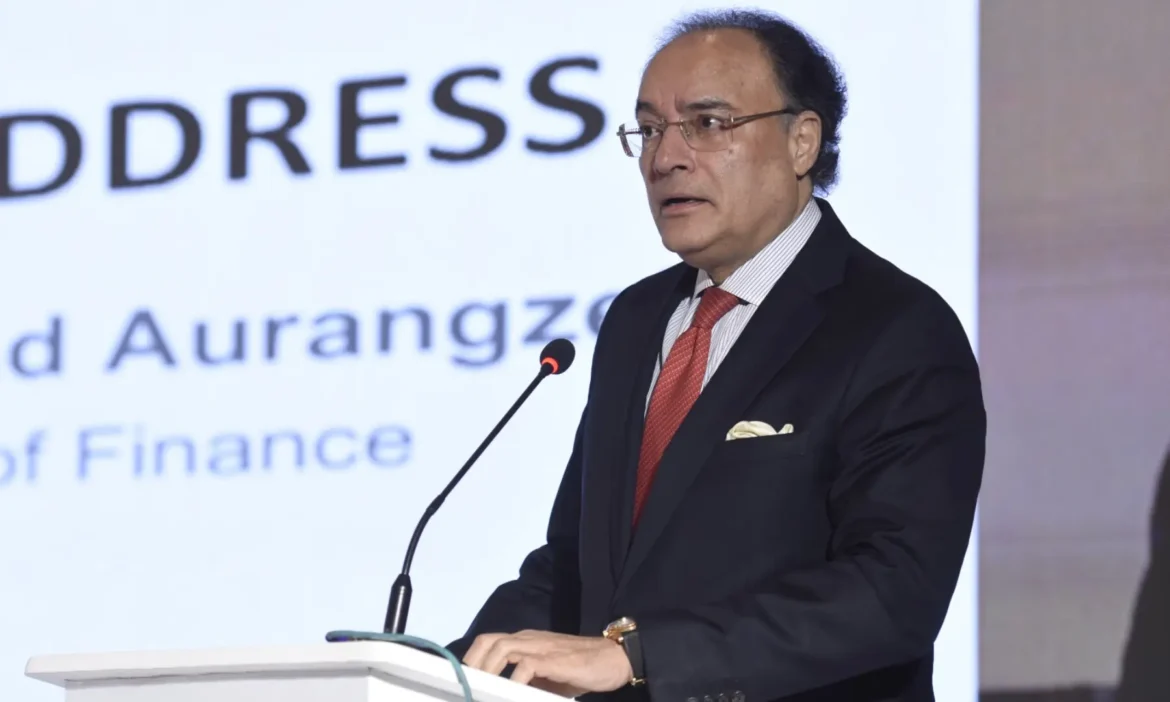
Muhammad Aurangzeb told a climate conference in Islamabad on Wednesday that Islamabad has secured access to roughly $600 million to $700 million in climate finance and is prioritizing practical deployment of those funds over debates about much larger theoretical shortfalls. The government is also preparing to issue its first Panda bond later this month, a roughly 250 million renminbi-equivalent transaction that would mark a fresh foray into Chinese capital markets.
“Discussions about hundreds of billions of dollars in gaps are academic at this stage,” Aurangzeb said, urging officials and stakeholders to focus instead on making the most of resources already in hand. The minister stressed a pragmatic approach: diversifying the funding base through green bonds and locally issued green sukuk while moving beyond the maintenance of commercial reserves to the creation of strategic ones.
The comments come as Pakistan, one of the countries most vulnerable to extreme weather, grapples with the dual challenge of financing reconstruction after devastating floods and overhauling an energy system still heavily reliant on imported fossil fuels. Aurangzeb highlighted ongoing assistance from multilateral lenders, including an expected $200 million from the International Monetary Fund and support from the Asian Development Bank.
He pointed to China’s experience as a model, noting that the world’s second-largest economy now accounts for nearly 40% of global green-bond issuance. International experts, he added, are helping Pakistan build a credible pipeline of green investment projects and an accelerator framework to bring them to market. Aurangzeb said scaling up solar, wind and hydropower capacity remains central to the strategy, alongside energy-efficiency programs, promotion of electric vehicles, targeted subsidies and risk-sharing mechanisms. The goal, he said, is to reduce dependence on fossil fuels while channeling domestic savings — mobilized through Pakistan’s capital markets rather than bank lending — into sustainable projects.
“Pakistan must strengthen its domestic capital markets and reduce overdependence on bank financing,” the minister said, emphasizing greater reliance on indigenous resources to fund the transition. The remarks show a broader shift in Islamabad’s approach to climate finance. Rather than waiting for massive new pledges that have so far failed to materialize at the scale many developing nations hoped for, the government is focusing on immediate, executable instruments. Green sukuk, which comply with Islamic finance principles, are seen as particularly promising given Pakistan’s large Muslim population and the growing global appetite for sharia-compliant sustainable debt.
The Panda bond issuance, if completed as planned, would add to a string of recent efforts to broaden Pakistan’s investor base beyond traditional Western and Gulf lenders. It would also signal deepening financial ties with Beijing at a time when Pakistan is already one of the largest recipients of Chinese infrastructure financing under the Belt and Road Initiative.
Aurangzeb’s address stopped short of providing fresh details on the size or timing of specific green-bond deals, but officials familiar with the planning have indicated the government aims to test the market with relatively modest inaugural transactions before scaling up. The minister’s emphasis on execution over aspiration reflects the fiscal constraints facing Prime Minister Shehbaz Sharif’s administration. Pakistan is still negotiating the final contours of its latest IMF program while trying to service a heavy external debt load. In that context, every dollar of climate finance that can be drawn down quickly carries outsized importance.
Still, analysts caution that even the $600 million to $700 million now accessible represents only a fraction of the investment needed to meet Pakistan’s Nationally Determined Contribution under the Paris Agreement or to rebuild infrastructure damaged by recent floods. The real test, they say, will be whether the government can translate today’s available funds into bankable projects fast enough to attract follow-on private capital. Aurangzeb acknowledged the challenge, saying the support of international experts in shaping a green investment pipeline would be critical to closing that gap over time.
Copyright © 2021 Independent Pakistan | All rights reserved