By Staff Reporter
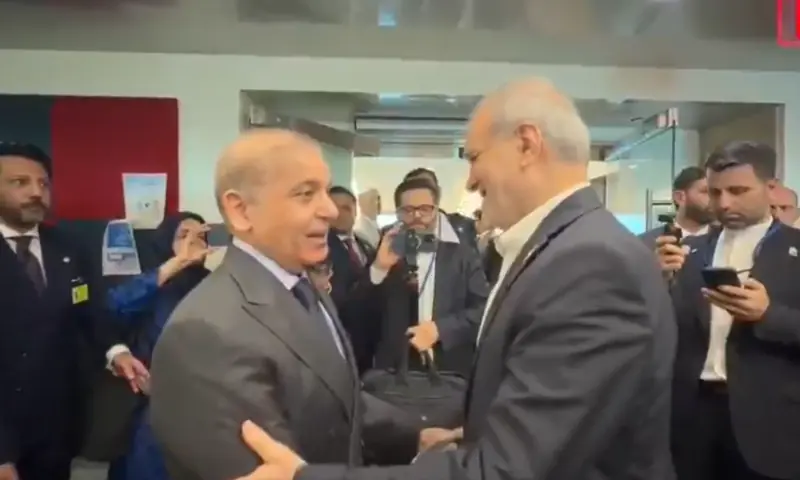
ISLAMABAD: Prime Minister Shehbaz Sharif sat down with Iran’s president, Masoud Pezeshkian, in New York on Thursday, resuming a diplomatic effort that has become one of the few remaining threads connecting Washington and Tehran after months of war, air strikes and a naval blockade that shows no sign of lifting.
The meeting, held on the sidelines of the 81st session of the United Nations General Assembly, was the second encounter between the two leaders in as many months, and came only two days after Donald Trump told the same assembly hall that he faced a stark choice over Iran: strike a deal once America’s midterm elections were out of the way, or “annihilate the Islamic Republic” and “drive them into hell”.
According to the Prime Minister’s Office, Sharif was accompanied by his deputy prime minister and foreign minister, Ishaq Dar, defence minister Khawaja Asif, and special assistant Tariq Fatemi, while Pezeshkian brought his foreign minister, Abbas Araghchi. The two sides, Islamabad said, were to discuss Pakistan-Iran relations and “the situation in the region” — diplomatic language that, in practice, has come to mean one thing: how to stop a war that has now dragged on for seven months from spreading further.
Speaking afterwards, Sharif offered a rare piece of public reflection on the failed agreement that briefly seemed to have ended the fighting in June. He recalled that he, Trump and Pezeshkian had all put their names to the Islamabad Memorandum, only for the deal to unravel in ways nobody had anticipated. “We have not lost hope,” he said, adding that Pakistan remained committed to lowering tensions between Washington and Tehran and would continue to act as a sincere and honest mediator.
It is a role Islamabad has leaned into with unusual persistence. Since the 14-point memorandum collapsed on 17 June, Pakistan’s army chief, Field Marshal Asim Munir, has worked his own channels with the American administration, while officials have made repeated trips to Tehran to keep some form of contact alive. Diplomatic sources in New York this week suggested a division of labour has quietly emerged: Qatar is said to be handling the more immediate shuttle diplomacy between American and Iranian officials, while Pakistan works a parallel track directly with Tehran, the two efforts running alongside each other as the region’s diplomats try to stop the latest contacts from falling apart the way the June deal did.
A defiant address, then a softer signal
The backdrop to Thursday’s meeting is a war that has grown steadily larger in scope since Washington and Israel launched their assault on Iran at the end of February — and a diplomatic picture that has become harder, not easier, to read.
On Tuesday, it was Trump who set the tone, telling world leaders he had a “big decision” to make: agree a deal with Tehran that would let the country “rebuild and create a far greater country than it ever was before”, or annihilate it “quickly”, denying it any “chance of survival” or “hope of future greatness”. He predicted a deal would come “right after the election”, accusing Iranian leaders of waiting to see how his party fared in November’s midterms before committing to anything.
Pezeshkian, addressing the assembly for the first time since the war began, gave no ground in return. Iran, he said, had been struck but had not “bent at the knee”. He singled out Trump directly, telling him that Iran was ready for dialogue and negotiation, but not on the basis of threats. Notably, he made no direct mention of the stalled talks in a speech otherwise built around defiance — a choice that will not have gone unnoticed among the mediators trying to coax both sides back to a negotiating table.
A blockade still squeezing trade, and an economy under pressure
The toll of the stand-off on regional shipping remains visible in the numbers. Preliminary data on Thursday showed just ten commodity vessels transiting the Strait of Hormuz on Wednesday — an improvement on the seven that passed through a day earlier, but still well short of the ten-day moving average of roughly 17. Before the war began at the end of February, the strait was handling something closer to 125 large commercial vessels a day, carrying around a fifth of the world’s daily supply of crude oil and liquefied natural gas. Traffic through the nearby Bab el-Mandeb Strait has held up rather better, with 27 vessels making the crossing on Wednesday.
Washington, meanwhile, has been explicit that financial pressure is now doing as much work as its naval blockade. The US Treasury secretary, Scott Bessent, said on Wednesday that sanctions under “Operation Economic Outcast” had shut down somewhere between 80 and 90 percent of Iran’s external flights, and joked — pointedly — that he wondered how Iran’s own delegation to the UN would get home. He described Washington’s approach as a three-pronged campaign of military strikes, naval blockade and financial strangulation, aimed at forcing one of three outcomes: a split within Iran’s leadership, an uprising among its population, or a negotiated settlement in which Tehran keeps its word. “If there is a deal,” he said, “I guarantee you they’re going to stick with it.”
The secretary of state, Marco Rubio, pushed a similar argument on Wednesday, telling reporters in New York that Iran had badly misjudged how the American system works if it believed the midterms would tie the president’s hands. Congress, he said, mattered, but the presidency retained “extraordinary powers” over sanctions and the use of force, and Trump viewed Iran’s nuclear programme as a matter of national security rather than domestic politics — one on which the costs of inaction would only grow “substantially higher” over time.
Warnings of a wider war
Away from the diplomatic track, the language coming out of Tehran has hardened. An adviser to Iran’s supreme leader, Ayatollah Mojtaba Khamenei, warned this week that any fresh attack by the United States or Israel could see the war widen further still — potentially into the Indian Ocean. The adviser noted that the conflict had already spread from the Gulf and the Strait of Hormuz into the Red Sea, and said Iran’s forces had prepared for worse.
That expansion is already visible in the campaign being waged by Yemen’s Houthi movement, which has stepped up missile and drone attacks on Saudi Arabia in recent days. A Saudi-led coalition said on Thursday it had intercepted six ballistic missiles aimed at the cities of Taif and Yanbu, while Greek security sources told Reuters that a Patriot air-defence battery operated by Greek personnel — deployed in the kingdom since 2021 to help protect its energy infrastructure — had separately shot down a ballistic missile and a drone over the wider Yanbu area. It was, security sources said, the fifth time the Greek-run system had been used in combat since the war began, a quiet marker of how deeply European forces have now been drawn into defending Gulf energy sites. Saudi Arabia’s civil defence agency issued and then lifted a string of emergency warnings across Makkah, Taif, Jeddah and the northern region of Tabuk, without specifying the nature of the threat or reporting any casualties.
The attacks have not gone unnoticed by Saudi Aramco. Its chief executive, Amin Nasser, told Nikkei Asia on Thursday that any disruption to the kingdom’s oil operations could be restored “within days”, but confirmed the company was actively examining a fourth and fifth export route beyond its three existing ones — a hedge, in effect, against further Houthi strikes on its infrastructure. Yemen’s internationally recognised government said separately that its forces had repelled a Houthi attempt to push towards the road linking the southern provinces of Aden, Taiz and Lahj, inflicting what it described as heavy losses.
Iran’s grievances with Europe, and a diplomatic broadside at Canada
Pezeshkian used his time in New York this week for more than his set-piece speech. In a meeting with the European Council president, António Costa, he argued that European governments had confused inaction with neutrality during the war, and suggested they had diminished their own influence by aligning too closely with Washington. He was particularly critical of Europe’s handling of the so-called snapback mechanism tied to the 2015 nuclear deal, and referenced comments from Nato’s secretary-general about European assistance to the US during the conflict, calling for the bloc to rethink its position. Mr Costa, in turn, pressed Iran to resume cooperation with the International Atomic Energy Agency, end strikes on its neighbours, and restore full freedom of navigation through the Strait of Hormuz — a call he repeated publicly on Wednesday.
Tehran also opened a sharper front with Ottawa this week. Iran’s foreign ministry spokesman, Esmaeil Baghaei, accused Canada’s prime minister, Mark Carney, of recasting Trump’s threat to annihilate Iran as merely “the language of war” — a framing he dismissed, in a lengthy post on X, as illusion and hypocrisy that history would not indulge for much longer.
Practical consequences of the standoff are also mounting closer to home. Iran’s Students News Agency reported on Thursday that all flights operated by Iranian carriers to the United Arab Emirates had been suspended since midnight, while a flight from Tehran to Dushanbe was forced to turn back after Turkmenistan declined to grant the aircraft permission to cross its airspace — a small but telling sign of how isolated Iran’s aviation sector has become as the sanctions regime tightens.
For all the show of defiance on both sides this week, what stands out is how much quiet effort is still going into keeping a diplomatic channel open at all. Pakistan’s role — modest in scale, persistent in application — reflects a wider truth about this stage of the war: neither Washington nor Tehran appears ready to walk away from the negotiating table entirely, even as both continue to posture as though they might.
Copyright © 2021 Independent Pakistan | All rights reserved