By Staff Reporter
ISLAMABAD: Prime Minister Shehbaz Sharif on Thursday reaffirmed his country’s commitment to bolstering trade ties with the European Union through the GSP+ scheme, as Islamabad grapples with potential fallout from India’s new free trade agreement with the bloc.
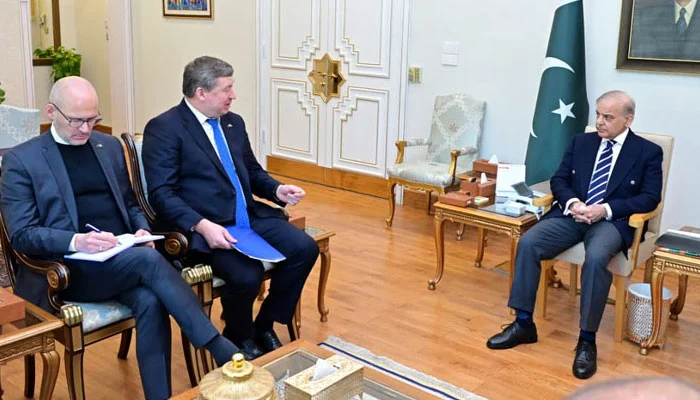
Sharif made the remarks during a meeting with the EU’s Ambassador to Pakistan, Raimundas Karoblis, in the capital, according to a statement from the Prime Minister’s Office. The Generalized Scheme of Preferences Plus (GSP+) grants Pakistan duty-free access to the EU market on about two-thirds of tariff lines in exchange for implementing 27 international conventions on human rights, labour rights, good governance and the environment.
“The prime minister emphasised upon the critical role of the GSP+ scheme in enhancing trade between Pakistan and the EU, and said the government of Pakistan is committed to working closely with the EU on mutually beneficial trade enhancement initiatives, especially through the GSP+,” the statement said. Sharif also welcomed the ambassador and expressed satisfaction with the seventh round of Pakistan-EU Strategic Dialogue held in Brussels in November last year.
He reiterated Pakistan’s dedication to strengthening cooperation with the EU across a range of areas, including trade, investment, development, security, migration and climate change. Karoblis, in turn, thanked Sharif for the warm reception since his arrival in Pakistan and assured him of continued efforts to deepen relations in all fields. The ambassador conveyed greetings from EU leaders and said the bloc would maintain close engagement with Pakistan on trade matters under GSP+, as well as through initiatives like the inaugural EU-Pakistan Business Forum set for April.
The EU awarded GSP+ status to Pakistan in 2014, leading to a 108% surge in Pakistani textile exports to the bloc thanks to zero tariffs. In October 2023, the European Parliament voted unanimously to extend the scheme for another four years until 2027 for qualifying developing countries, including Pakistan. According to the EU’s GSP Convention Compliance Database, Pakistan has ratified all 27 required conventions, with the most recent being the International Covenant on Civil and Political Rights in 1976 and the Convention against Torture and Other Cruel, Inhuman or Degrading Treatment or Punishment in 1987, both ratified in 2010.
The EU’s monitoring of Pakistan focuses on 13 priority areas, such as enforced disappearances, torture prevention, freedom of expression, freedom of belief and minority rights. Last month, the EU acknowledged Pakistan’s advancements in adhering to the 27 conventions under the GSP+ framework.
The discussions come against the backdrop of India’s freshly inked free trade deal with the EU, announced this week, which provides Indian exporters broad tariff-free entry to the European market. Pakistan’s foreign office noted awareness of the agreement and affirmed that Islamabad views its EU trade ties as mutually advantageous.
However, Pakistani exporters and financial analysts have raised alarms that the deal could undermine Pakistan’s competitive edge under GSP+, where many exports enter the EU duty-free, compared to Indian textiles and apparel that previously faced duties up to 12%.The development arrives at a vulnerable time for Pakistan’s export sector. Shipments climbed 5% to $32.1 billion in the last fiscal year but dropped 9% to $15.2 billion in the first half of the current year through December, per data from the Pakistan Bureau of Statistics.
Separately, the EU has expressed unease over a recent court ruling in Pakistan that sentenced human rights activist Imaan Zainab Mazari-Hazir and her husband Hadi Ali Chattha to prison terms totaling 17 years each under the Prevention of Electronic Crimes Act for social media posts. EU spokesperson for Foreign Affairs and Security Policy Anouar El Anouni said in a post on X that the convictions contravened freedom of expression and the independence of lawyers. “The conviction of human rights lawyers Imaan Mazari and Hadi Ali Chattha over social media activity goes against freedom of expression and independence of lawyers,” he said. Anouni added that these principles are essential to democratic systems and form part of Pakistan’s international human rights obligations under frameworks like GSP+. “These are not only key democratic principles but also part of [Pakistan’s] international human rights commitments,” he said. According to the 22-page verdict, the pair received five years’ imprisonment and a Rs5 million fine each under Section 9 of the act, plus 10 years and a Rs30 million fine each under Section 10.
Copyright © 2021 Independent Pakistan | All rights reserved