By Staff Reporter
ISLAMABAD: Pakistan’s ruling party moved a step closer to a supermajority in the Azad Jammu and Kashmir assembly Monday, as a newly elected independent lawmaker announced he was joining its ranks, a defection that party officials said would help push their seat count toward two-thirds of the legislature.
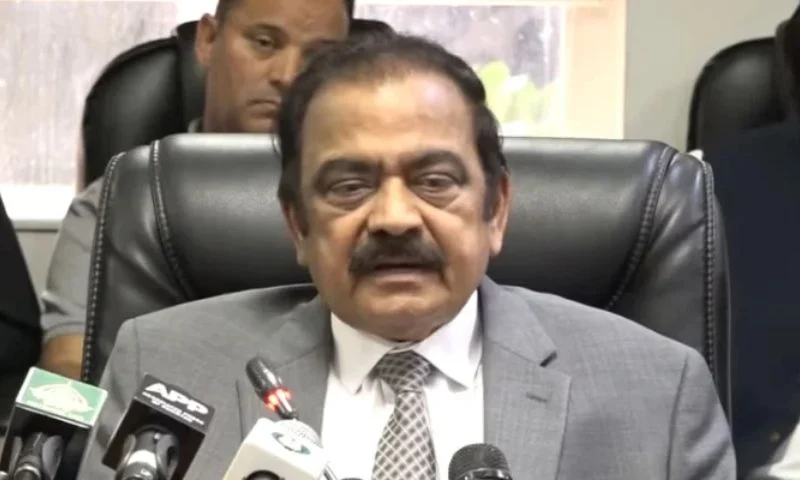
Rana Sanaullah, adviser to the prime minister on political affairs, told reporters at the AJK Council Secretariat that Sajid Iqbal Abbasi, who won the LA-14 seat on the Jammu Kashmir Awami Dast-o-Bazu Party’s ticket, had agreed to align with the Pakistan Muslim League-Nawaz. Abbasi defeated Sardar Attique Ahmed Khan, the Muslim Conference president and a former prime minister of the region, in the Bagh West constituency.
The PML-N had already won 25 of the AJK assembly’s directly contested seats, according to Sanaullah, and he predicted that number would climb to roughly 33 once reserved seats are allocated — enough, he said, to secure a two-thirds majority in the 53-member body.
“Sajid Iqbal Abbasi has become part of the PML-N team for the development and progress of AJK,” Sanaullah said, adding that the party was grateful for his decision to join.
Sanaullah was joined at the podium by Tariq Fazal Chaudhry, the federal minister for parliamentary affairs; Shah Ghulam Qadir, the PML-N’s AJK president; and Chaudhry Tariq Farooq, the party’s secretary general in the region.
Abbasi, addressing reporters alongside Sanaullah, thanked the PML-N leadership for what he called its confidence in him and credited voters in his constituency with delivering what he described as the largest mandate in AJK’s history.
The elections, held in phases because of security concerns identified by the region’s election commission, left the Pakistan Peoples Party as the PML-N’s leading rival, with 12 seats. PPP officials have alleged rigging and other electoral irregularities, allegations the PML-N has not directly addressed. Voting in seven constituencies has yet to take place because of the security situation on the ground.
Sanaullah said his party intended to make good on its campaign commitments and would ensure the incoming AJK assembly could exercise its full constitutional authority. He named law and order as the new government’s top priority and said the party would model its development agenda in the region on programs it has run in Punjab.
The adviser also addressed the sit-ins that have continued in parts of AJK, characterizing the demonstrators as “our brothers” who retained the right to protest peacefully. He estimated that 99 percent of those participating were doing so for patriotic reasons, while acknowledging that a small minority — by his estimate, 1 to 1.5 percent — might be aligned with what he called “provocative elements.”
He accused the banned Jammu Kashmir Joint Awami Action Committee of seeking to delay the elections outright, and said the government had wanted all political stakeholders to proceed together through the process. The AJK government outlawed the group on June 5 under the Anti-Terrorism Act, citing alleged ties to terrorism, a designation imposed shortly before the committee had planned a June 9 demonstration calling for the elimination of 12 assembly seats reserved for refugees who fled Indian-administered Kashmir after 1947.
“Kashmiris are as much owners of Pakistan as Pakistanis,” Sanaullah said.
Party unveils governing agenda, calls for end to post-election rancor
Separately Monday, Farooq, the PML-N’s secretary general in AJK and an MLA-elect, laid out a governing roadmap for the party’s incoming administration and appealed to rival parties to set aside the bitterness of the campaign now that voting has largely concluded.
In a statement, Farooq called on political leaders, party workers and voters across the spectrum to pursue election-related grievances through constitutional and legal channels — including election tribunals — rather than allow the disputes to harden into prolonged confrontation.
“Elections are an essential part of democracy; differences of opinion and competition are natural, but after the elections, we have to move forward together,” Farooq said.
He noted that polling in seven constituencies in the Poonch Division remains on hold because of law and order concerns and other circumstances he described as unavoidable, and said he expected those races to proceed once conditions stabilize. He called Poonch a significant part of the region’s history and its association with Pakistan, saying its residents had made lasting sacrifices both in the broader Kashmir freedom movement and in service of Pakistan’s national defense.
Farooq argued that the true test facing any political party was not simply winning power but governing well. “The government is not of any one party, group, region or voter, but of the entire people of Azad Jammu and Kashmir,” he said, adding that its central obligations should be delivering relief, justice, employment, education, health care and improved public services.
Among his stated priorities for the incoming government: strengthening governance, pursuing institutional reforms, improving the effectiveness of development programs, and confronting the problems facing the region’s young people. He described youth unemployment, and the frustration it has produced, as the most pressing challenge AJK faces, and called for renewed attention to the region’s universities, colleges, hospitals and other public institutions.
“We must examine why our youth are disillusioned, why our institutions are failing to meet public expectations, and how these problems can be addressed through immediate and practical solutions,” he said.
Farooq said the PML-N intended to build a government in AJK that he described as people-oriented, democratic and responsible, consistent with the direction set by Nawaz Sharif, and called for closer coordination among the AJK government, the region’s political parties and the federal government on matters related to the Kashmir dispute.
He urged politicians and party workers to channel their disagreements into what he termed democratic strength rather than division, and to stay unified around the core interests of the state, its people and the broader Kashmir movement.
“Let us not turn political differences into hostility, let us not transform electoral competition into permanent confrontation,” he said. “Whatever had to happen during the elections has happened.”
Farooq also said administrative and district boundaries should not be allowed to divide the region’s residents, arguing that the prosperity, stability, development and dignity of people in Poonch, Muzaffarabad, Mirpur and elsewhere in AJK were bound together.
“The time has come for us to move beyond politics, promote unity, improve governance, give hope to our youth and provide relief to the people,” he said.
Copyright © 2021 Independent Pakistan | All rights reserved