By Staff Reporter
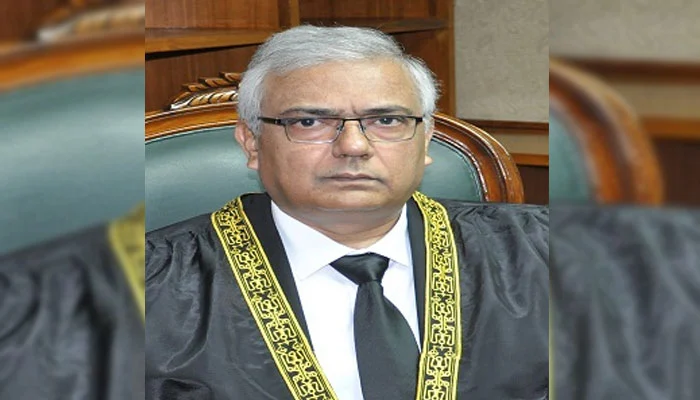
ISLAMABAD: President Asif Ali Zardari on Thursday appointed Justice Aminuddin Khan as the first chief justice of Pakistan’s newly created Federal Constitutional Court, moving swiftly to implement a sweeping constitutional overhaul that has already prompted the resignation of two senior Supreme Court judges in protest.
The appointment, announced in a notification from the Ministry of Law and Justice, came just hours after Zardari signed the 27th Constitutional Amendment into law and less than a day after Justice Mansoor Ali Shah and Justice Athar Minallah stepped down from the Supreme Court, citing objections to the changes.
Justice Khan, 65, who ranks fourth in seniority on the current Supreme Court, will be sworn in on Friday at the Presidency in a ceremony attended by chief justices and judges of the superior courts as well as senior government officials. The notification stated that the president made the appointment under clause (3) of Article 175A, read with Article 175C, of the Constitution, and that it will take effect from the date Justice Khan takes oath.
Born in Multan in 1960, Justice Khan is a second-generation lawyer. He earned his law degree from University Law College, Multan, in 1984 and began practice under his father, Khan Sadiq Muhammad Ahsan. He was enrolled as an advocate of the Lahore High Court in 1987 and of the Supreme Court in 2001. For a decade he worked at Zafar Law Chambers in Multan before his elevation to the high court bench in 2011, where he heard civil cases on the Multan and Bahawalpur benches.
He was appointed to the Supreme Court in 2019, taking oath from the then-chief justice, Asif Saeed Khan Khosa. Last November he was named head of the Supreme Court’s short-lived constitutional bench. Colleagues and court records describe him as a low-profile, methodical judge whose thousands of civil-law decisions have rarely been overturned on appeal. During his career he assisted prominent lawyers including Mian Nisar Ahmed and Umar Ata Bandial, the former chief justice.
The Federal Constitutional Court, created by the 27th Amendment, will initially consist of seven members: Justice Khan and six others. Four are expected to be drawn from the existing Supreme Court, Justices Hasan Azhar Rizvi, Musarrat Hilali, Aamer Farooqi, and Naeem Akhtar Afghan (commonly referred to as Justice Baqar Najafi) are the names under active discussion, while two will come from the high courts. Justice K.K. Agha of the Sindh High Court and Justice Rozi Khan Barrech, the current chief justice of the Balochistan High Court, are the leading candidates. The exact initial strength will be fixed by presidential order; any later increase will require an act of Parliament. Judges of the new court will serve until age 68—three years longer than the current Supreme Court retirement age of 65.
Government officials said the court is intended to ease the Supreme Court’s crushing caseload, speed the resolution of constitutional petitions, and bolster public confidence in the judiciary. The idea of a separate constitutional court is not new: it was first proposed in the 2006 Charter of Democracy signed by the Pakistan Peoples Party and the Pakistan Muslim League-Nawaz, the two parties that pushed the 27th Amendment through Parliament this week. The same concept surfaced during negotiations over last year’s 26th Amendment but was dropped after opposition from the Jamiat Ulema-e-Islam (Fazl) and other groups.
The rapid implementation of the amendment, passed by both houses of Parliament and signed into law on Thursday, has deepened divisions within the judiciary and drawn sharp criticism from lawyers’ groups and opposition parties, who warn that it undermines judicial independence. The resignations of Justice Shah, who was next in line to become chief justice under the previous seniority system, and Justice Minallah, a vocal defender of civil liberties, underscored the intensity of the backlash.
Copyright © 2021 Independent Pakistan | All rights reserved