By Staff Reporter
ISLAMABAD: Prime Minister Shehbaz Sharif arrived on Saturday in the eastern Chinese city of Hangzhou to begin a four-day official visit to China, the first stop in a trip timed to the 75th anniversary of diplomatic relations between Islamabad and Beijing and aimed at advancing the second phase of the China-Pakistan Economic Corridor.
Zhejiang province Vice Governor Xu Wenguang greeted Sharif at Hangzhou Xiaoshan International Airport, joined by China’s ambassador to Pakistan, Jiang Zaidong, and Pakistan’s ambassador to China, Khalil Hashmi. Sharif was accompanied by a senior delegation that included Deputy Prime Minister and Foreign Minister Ishaq Dar, Planning Minister Ahsan Iqbal, Information Minister Attaullah Tarar, IT Minister Shaza Fatima Khawaja, and Special Assistant to the Prime Minister Tariq Fatemi.
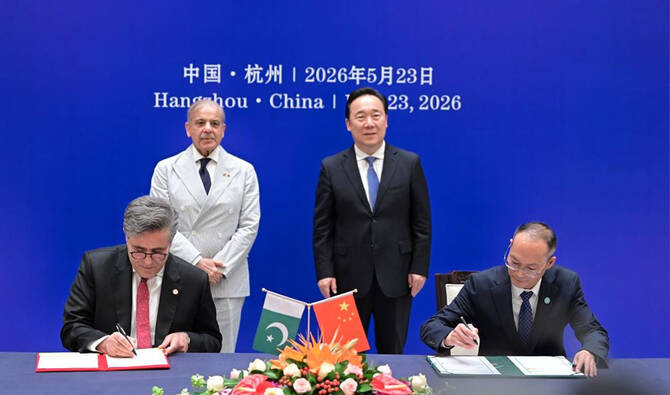
Within hours of landing, Sharif met Zhejiang Communist Party Secretary Wang Hao. The two sides signed two cooperation documents: a memorandum establishing a sister-province relationship between Pakistan’s Punjab province and Zhejiang, and an agreement to create a China-Pakistan Joint Technology Research Center at Hangzhou Normal University. The pacts are intended to promote collaboration in trade, investment, agriculture, education, tourism, culture, and people-to-people exchanges, while the research center will focus on academic cooperation, applied research, and technology transfer.
According to a statement from Sharif’s office, the prime minister told his hosts that Pakistan attaches high importance to ties with Zhejiang, particularly in the digital economy, e-commerce, information technology, telecommunications, agriculture, renewable energy, advanced manufacturing, and skills development. He praised the province’s development model and referred to Chinese President Xi Jinping’s philosophy on environmental governance, noting that Zhejiang offers an example of how ecological conservation, green development, and high-quality economic growth can reinforce one another.
Sharif is scheduled to chair the Pakistan-China B2B Investment Conference in Hangzhou, focused on information technology and telecommunications, battery energy storage systems, and agriculture. He will also witness the exchange of additional agreements and memorandums of understanding between Pakistani and Chinese companies, hold discussions with chief executives of major Chinese firms, and visit the headquarters of Alibaba Group.
The Foreign Office in Islamabad described the visit as carrying special significance as the two countries mark 75 years of diplomatic relations. “It will provide an opportunity to reaffirm the abiding strength of the Pakistan-China all-weather strategic cooperative partnership and advance the shared vision of building an even closer Pakistan-China community with a shared future,” the ministry said in a statement.
After his stay in Hangzhou, Sharif will travel to Beijing for meetings with President Xi Jinping and Premier Li Qiang. The two sides are expected to review bilateral cooperation across political, economic, and strategic domains, with particular emphasis on the high-quality development of CPEC, trade and investment, industrial cooperation, agricultural modernization, information technology, science and technology, and people-to-people exchanges. Sharif will also attend a reception hosted by the Chinese People’s Association for Friendship with Foreign Countries to commemorate the anniversary of diplomatic ties.
In a post on X shortly after his arrival, Sharif expressed gratitude for the welcome and said Pakistan looked forward to expanding practical cooperation with Zhejiang across multiple sectors. He reiterated his commitment to “further strengthening the enduring bond of friendship” between the two nations.
Foreign Office spokesperson Tahir Andrabi told reporters in Islamabad on Friday that discussions with Chinese leaders are also expected to address the US-Iran conflict and broader Middle East tensions. Pakistan and China have maintained close coordination on the standoff, he said, recalling a five-point principle agreed upon during Dar’s visit to China last month that was later issued as a joint statement.
The visit comes as both governments seek to broaden cooperation beyond traditional infrastructure under CPEC 2.0, placing greater weight on technology, green development, digital connectivity, and industrial collaboration. Pakistani officials have described the trip as an opportunity to deepen political trust, strengthen strategic coordination, expand practical cooperation, and consolidate the longstanding friendship between the two countries.
Copyright © 2021 Independent Pakistan | All rights reserved