By Staff Reporter
ISLAMABAD: Pakistan Tehreek-e-Insaf, the opposition party led by the imprisoned former prime minister Imran Khan, disavowed on Saturday threats made against the country’s top military leader during a demonstration in Britain, saying the remarks had “no connection” to the party and did not reflect its ideology.
In a strongly worded statement, Sheikh Waqas Akram, the party’s central information secretary, said the woman who delivered the speech at the protest held no position within PTI and had no affiliation with the party. He emphasized that PTI had never endorsed such “irresponsible and inflammatory statements” from any office-bearer. “The views expressed, the language used, and the tone adopted in the speech do not reflect PTI’s official stance, political ideology, or vision,” Akram said.
“PTI, as a matter of principle, strongly opposes violence, hate speech, incitement, inflammatory rhetoric, and the use of unethical or indecent language in political discourse,” he added. “PTI firmly believes in democratic, constitutional, and peaceful political struggle, and does not endorse or support any individual or group engaging in conduct contrary to these values.”
The party’s British chapter had earlier deleted a video of the protest from its social media account, describing the remarks as “metaphorical” and saying the removal was done “in an abundance of caution to prevent potential misunderstanding, and legal safeguarding of the individual and her rights.” “Although we do not believe the individual incited violence, the post was deleted,” the chapter said in a statement on X.
It alleged that Pakistanis at home and abroad faced “unprecedented repression,” and pointed to “public frustration” stemming from the prolonged detention of Khan and his wife, Bushra Khan, in “inhumane and undignified prison conditions, as endorsed by the UN special rapporteur on torture.” “Concerns about their health and well-being are real and the cause of anxiety and anguish for his family, party members and millions of supporters all around the world,” it added.
“While this global concern is understandable and completely valid, PTI does not endorse unlawful behavior of any kind,” the chapter said. “Independent citizens are also advised to measure their remarks to avoid any misunderstandings.” “PTI remains firmly committed to non-violence and the rule of law, in accordance with the guidance of Imran Khan,” it continued, expressing hope that the individual in question “will not be subjected to any act falling under transnational repression and the British government will ensure her safety, well-being and her right to due process.”
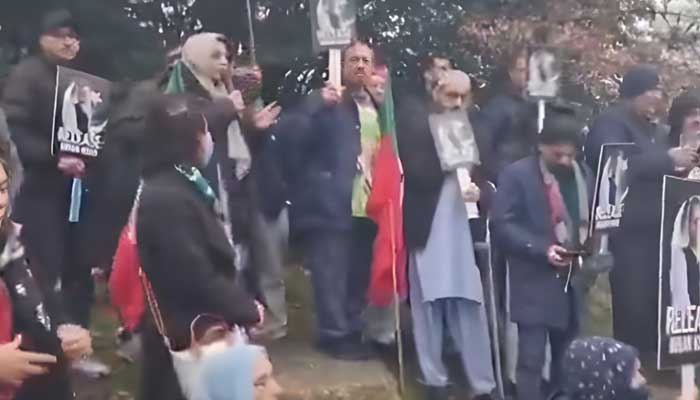
The video, posted Dec. 23 on PTI UK’s official X account, depicted demonstrators outside the Pakistani consulate in Bradford openly threatening the military leadership while surrounded by people holding PTI flags. Officials said the threats targeted Field Marshal Syed Asim Munir, the chief of defence forces, including explicit references to violence like a car bomb.
The episode prompted Pakistan’s government to summon Matt Cannell, the acting British high commissioner, on Friday to deliver a demarche. Pakistan formally asked Britain to identify, arrest, investigate and prosecute those using U.K. soil to “issue direct threats” against its military leadership. “Such threats constitute a clear violation of international norms and are considered a serious offence under the UK’s Terrorism Act 2006.” United Nations Security Council Resolution 1373 obliges all states to prevent terrorism, incitement to violence and any form of support for such acts.
Tahir Hussain Andarabi, a Foreign Office spokesman, confirmed the action, saying the demarche was issued after “provocative statements were made against Pakistan’s civil and military leadership from British soil.” He urged the UK to “hold responsible elements accountable in accordance with the law.”
A spokesman for the British High Commission said the UK had advised Pakistan to share evidence with its police. “Where a foreign government believes a crime has been committed, they should provide all relevant material to their UK police liaison,” the spokesman said. “Any material that appears to break UK law will be reviewed by the police and may lead to a criminal investigation.” The UK emphasized that its police operate independently.
Two ministers of state from the ruling Pakistan Muslim League-Nawaz, Tallal Chaudhry for interior and Bilal Azhar Kayani for finance, told a private television chnnnals that the government had written to UK authorities seeking action against the “provocative” statements. Chaudhry said the government “expected it to act in accordance with its laws and justice system” and that Pakistan had the right to pursue legal recourse against those “targeting its institutions.”
He noted past complaints about social media being used to “incite hatred against state institutions and political figures.” “The footage of the incident is available,” he said. “This is not a political matter, nor one related to freedom of speech.” “What’s concerning is the specific mention of a car bomb blast, making it a targeted issue; it is not something generalised, it seems to be carefully planned,” Chaudhry said. “It appears as if there is a larger plan involved, and Pakistan has raised these concerns.” He hoped Britain would comply but added that if not, “Pakistan has other options as well.”
Kayani said the “head of the armed forces had been threatened” and called the episode “unacceptable” and “unfortunate.” “We have repeatedly said that PTI spreads violence and threats under the guise of politics, justifies threats, and misuses freedom of speech.” He accused the PTI of having “crossed a limit” by “threatening the army chief with murder under the guise of a political protest.” “That’s not politics … it’s unacceptable.”
He labeled the PTI a “national security threat,” citing past events like the May 9, 2023, riots and alleged use of provincial police to attack soldiers. “Whether on May 9, using KP police to attack soldiers, and threatening the army chief … if that’s not a national security threat, what is?” he asked. On potential further steps, Kayani said Pakistan would press Britain for an immediate investigation while keeping other legal avenues open.
Fawad Chaudhry, a former PTI leader now part of the National Dialogue Committee working to reduce political tensions, welcomed the UK chapter’s deletion as “undoubtedly a positive step and a wise decision.” “It will greatly contribute to de-escalating tensions among all parties involved,” he wrote on X. “With such constructive measures, we can pave the way for a conducive atmosphere for dialogue. Let us foster an environment of mutual respect and resolve our differences in a manner befitting a great nation like Pakistan.”
Earlier this month, Interior Minister Mohsin Naqvi announced plans to repatriate YouTubers from Britain accused of targeting state institutions. On Dec. 4, Naqvi met with Jane Marriott, the British high commissioner, and submitted extradition requests for Shahzad Akbar, a former aide to Khan, and YouTuber Adil Raja, charging them with “spreading anti-Pakistan propaganda.” Asked about attacks on the army chief, Naqvi said: “The state is clear. We will not spare them.”
Copyright © 2021 Independent Pakistan | All rights reserved