By Staff Reporter
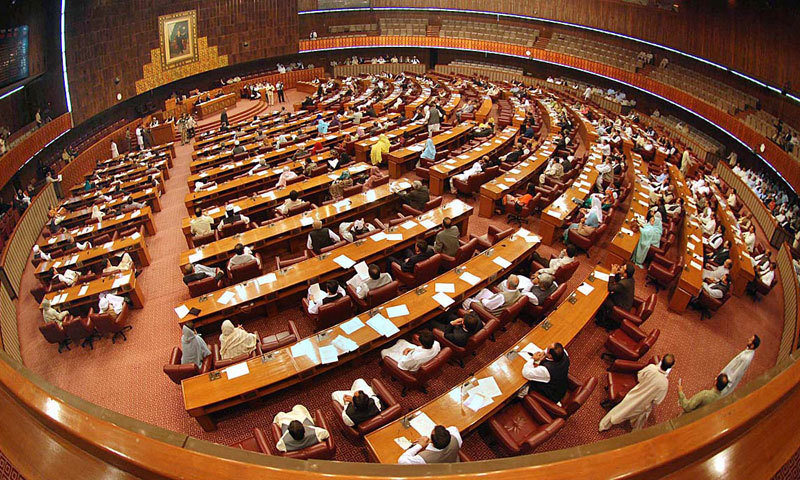
ISLAMABAD: The opposition Pakistan Tehreek-e-Insaf (PTI) party of former prime minister Imran Khan staged a heated protest in the National Assembly on Wednesday over the disqualification of over a dozen of its lawmakers by the Election Commission of Pakistan (ECP), following their convictions by anti-terrorism courts in Punjab for cases tied to the May 9 violence.
The government, however, distanced itself from the decision, insisting the convictions stemmed from a lawful judicial process. The session was dominated by the fallout from the disqualifications, which saw PTI members unseated from both national and provincial assemblies after court rulings linked to May 9, 2023’s unrest, during which military installations were targeted.
The opposition entered the house clutching portraits of the disqualified lawmakers, demanding a discussion on the issue. But National Assembly Speaker Ayaz Sadiq rebuffed their request, stating that points of order were not permitted during Question Hour.
Frustrated, PTI members walked out, forcing a suspension of proceedings due to a lack of quorum. When the session resumed, PTI interim chairman Gohar Ali Khan took the floor, decrying what he called an assault on his party’s democratic rights. “The PTI’s seats are being snatched through courts,” he told the house, warning that such convictions and disqualifications posed a grave threat to the democratic process.
He argued that the ECP had overstepped its mandate by disqualifying lawmakers before their convictions had reached finality, a move he described as unprecedented. “This is the first time in history that key opposition leaders have been disqualified,” Khan said, adding that the May 9 violence was being used as a prolonged pretext to target PTI members. While condemning the unrest, he questioned, “How long will this incident be used to send lawmakers packing?”
Law Minister Senator Azam Nazeer Tarar countered the opposition’s claims, stressing that the government had no hand in the judicial outcomes. “This is a lawful process. Objections can be raised, but the forum to do so is also the court,” he told lawmakers. Tarar pointed to the case of Jamshed Dasti, who secured interim relief from the Lahore High Court after his own disqualification by the ECP, as evidence that the judiciary remained the proper avenue for redress. “Parliament is not the forum to decide the merits of ongoing prosecutions,” he added, urging respect for the constitutional framework and judicial independence.
After the session adjourned, PTI lawmakers spilled outside the Parliament House, raising slogans against the convictions and staging a protest to amplify their grievances.
The day’s proceedings also exposed cracks within the ruling coalition, as lawmakers from the Pakistan People’s Party (PPP) and the Pakistan Muslim League-Nawaz (PML-N) clashed over the frequent use of presidential ordinances. The dispute erupted before two recently promulgated ordinances were tabled for endorsement.
PPP leader Syed Naveed Qamar voiced strong objections, calling the practice an abuse of constitutional provisions. “This whole process is anti-democratic and against the spirit of the Constitution,” he remarked, noting that successive governments had misused the mechanism meant for exceptional circumstances.
The criticism raised eyebrows, given that PPP leader President Asif Ali Zardari is responsible for issuing the ordinances. In response, Federal Minister for National Food Security Rana Tanveer Hussain, from the PML-N, defended the practice. “The process is in line with the Constitution, and no ordinance has unnecessarily been promulgated,” he said, brushing off concerns with an assurance that “the heavens will not fall” over the issue.
Hussain added that the house and its committees retained the power to suggest amendments. Under Article 89 of the Constitution, the president may promulgate ordinances when neither the Senate nor the National Assembly is in session, provided circumstances demand immediate action.
Copyright © 2021 Independent Pakistan | All rights reserved