By Staff Reporter
ISLAMABAD: Leaders of Pakistan Tehreek-e-Insaf, the party founded by the imprisoned former Prime Minister Imran Khan, sharply criticised remarks by a top military spokesman that labeled Khan a national security threat, warning that such accusations risked further eroding democracy and unity in a country already strained by political turmoil and recent constitutional changes.
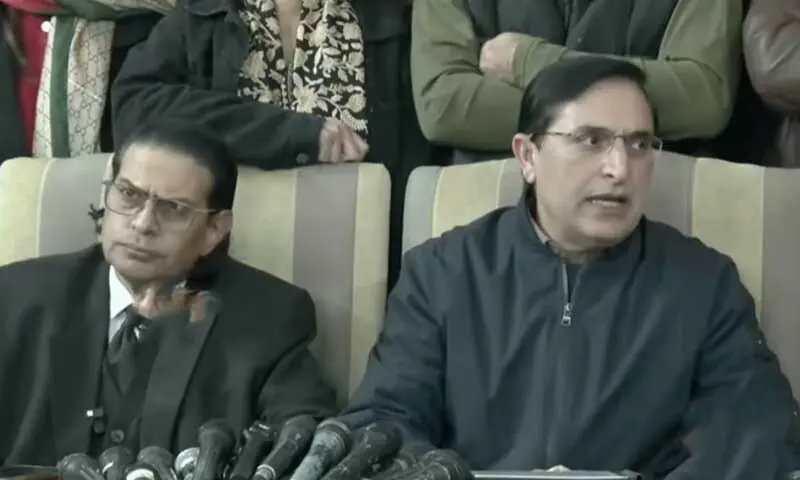
In a pointed news conference on Saturday at Khyber Pakhtunkhwa House in Islamabad, party officials described the military’s comments as “ridiculous” and “unfortunate,” invoking historical parallels to past efforts by the establishment to sideline popular leaders. The response came a day after Lt. Gen. Ahmed Sharif Chaudhry, the director general of the military’s Inter-Services Public Relations, accused Khan of fomenting “anti-army” rhetoric that had escalated into a matter of national security.
“Do not drive away the people of Pakistan, they stand with Imran Khan and the PTI,” said Salman Akram Raja, the party’s secretary general. “Imran Khan is not a national security threat. He has kept the people united.”
Raja, addressing reporters alongside other senior figures, emphasised that Khan had rejected divisive narratives based on ethnicity or sect, aligning instead with a unified vision of Pakistan supported by the party’s base. He cautioned against any attempts to marginalise Khan, known in political shorthand as “minus Imran Khan,” arguing that such moves could fracture national interests.
“For God’s sake, don’t do this,” Raja said. “You will not be able to minus Imran Khan, but God forbid if you do, it will be very difficult to keep this country’s interests united. If you attack KP and remove its elected government to install an unelected setup, then you yourselves will be responsible for the conditions that follow.”
The remarks underscored growing tensions between the PTI and the powerful military establishment, which has long played an influential role in Pakistani politics. Raja termed General Chaudhry’s press conference “unfortunate” and declined to directly rebut the specific charges against Khan, insisting instead on broader context.
“Today we are being told that the country’s most popular leader is a national security threat, which is ridiculous, but this has not been said for the first time,” he said. Drawing on history, Raja referenced the military’s actions against former Prime Minister Benazir Bhutto in the 1990s, when institutions deemed popular leaders threats and sought to remove them. “The institutions decided again and again that any popular leader of the people is a national security threat and it is necessary to remove them from the scene, but this did not happen,” he said. “You cannot remove them from the hearts of the people through your decisions. The nation has always been aware and there is a reason it is standing behind Imran Khan. We are not mad, we know who has always been in control in this country.”
Raja traced a pattern in Pakistan’s turbulent political history, where shifts from democracy toward authoritarianism under military rule promised prosperity but delivered weakness. He cited past dictatorships, noting that rulers “always left it weaker than before” despite claims that the country required firm control rather than democratic institutions.
Questioning the PTI’s critics who portray the party as inexperienced, Raja asked whether forced development through power had ever succeeded, pointing to previous eras of military governance. He called for a “grand dialogue” involving the nation to avoid repeating mistakes. “There will be no change, and we will go backwards,” he warned.
The secretary general also decried the recent passage of constitutional amendments, which critics say have subdued the judiciary more severely than under past military regimes. He highlighted censorship under laws like the Prevention of Electronic Crimes Act, citing the cases of lawyers Imaan Mazari and Hadi Ali Chattha, who faced inquiries and trials for speaking out.
Despite the PTI’s readiness for talks, Raja stressed respect for the people of Khyber Pakhtunkhwa province and its chief minister. “Don’t put the future of the country or KP at stake in this battle of narratives,” he said. “This is a very sensitive area, take the people along in the conditions that are there at the moment and the state of terrorism. The PTI is the biggest force in the country that can take it towards betterment.”
In a rare self-critique, Raja addressed the party’s social media supporters who have urged more aggressive action. “We are sitting because the country is dear to us and we don’t want discord in the country,” he said, adding that the PTI would act only for the nation’s benefit. “It is very easy to respond to the brick with a stone but we will not do it because the country’s benefit is not in this.”
Asad Qaiser, a former speaker of the National Assembly and PTI lawmaker, echoed the concerns, focusing on the impact in Khyber Pakhtunkhwa. “There is great anger and heightened emotions in our province,” he said. “Your words should have been appropriate. We think such words should be desisted from and will also demand that they are retracted because a whole society and province think it has been disrespected.”
Barrister Gohar Ali Khan, the PTI chairman, struck a conciliatory note while condemning the military’s language as “inappropriate and wrong.” He called the episode “unfortunate for democracy,” particularly from a senior officer targeting a major party, its leadership, and the provincial chief minister. “There is an enemy of ours who would be pleased by press conferences against each other,” Gohar Khan said, alluding to external threats benefiting from internal divisions. He warned that “the beginning of any great destruction is always due to a few inappropriate words,” urging restraint and positive steps.
Gohar called for easing tensions, allowing unrestricted meetings with Khan on Tuesday, and avoiding politicisation of his family visits. “There is still time for tone to be eased and for steps to improve the current situation,” he said. Without change, he added, “then it won’t be minus-one, but minus-everyone, which should not happen.”
Opening the briefing, Gohar described it as “unusual” and non-confrontational, aimed at clarifying facts amid accusations. He highlighted the PTI’s status as Pakistan’s largest party, with Khan enjoying support from 70 percent of the nation. “It is necessary to tell the people what has happened to us in the recent past,” Gohar said. “From 180 seats, we were reduced to 91 seats, and now we are left with 76. Reserved seats were taken and there was violence against women and children. The injustices against us are a tale of their own.”
Despite these setbacks, he said, the party endured for democracy’s sake, praising the military’s role and affirming that both Pakistan and its army belong to the people. The recent amendments had raised hopes for improvement, but Friday’s military briefing was “deeply disappointing,” reducing the PTI to pleading for basic access to Khan. “All that we endured was for the sake of democracy and the country,” Gohar said, “but we say, if such conditions continue and such treatment with each other continues, then democracy will be the one to face the biggest loss.”
Copyright © 2021 Independent Pakistan | All rights reserved