By Staff Reporter
LAHORE: After an 18-year prohibition that stemmed from deadly accidents involving razor-sharp kite strings, the Punjab government on Tuesday lifted its ban on kite flying, paving the way for the revival of the ancient Basant festival under a stringent new regulatory framework.
The move, enacted through the Punjab Regulation of Kite Flying Ordinance 2025 and promulgated by Governor Sardar Saleem Haider Khan, aims to balance cultural tradition with public safety. It generally prohibits kite flying across the province but empowers the government to permit it at designated places and on specific days, such as during Basant Panchami, the spring festival marking the fifth day of the lunar month of Magh.
Basant, a celebration of impending crop prosperity, the arrival of spring and good luck, has deep roots in Punjab’s history. In the 19th century, Maharaja Ranjit Singh hosted an annual Basant fair and incorporated kite flying as a central element. The practice evolved into a cherished tradition, particularly in Lahore, the regional epicentre of the festival, though it has long been observed in other parts of Punjab, including on the Indian side of the border.
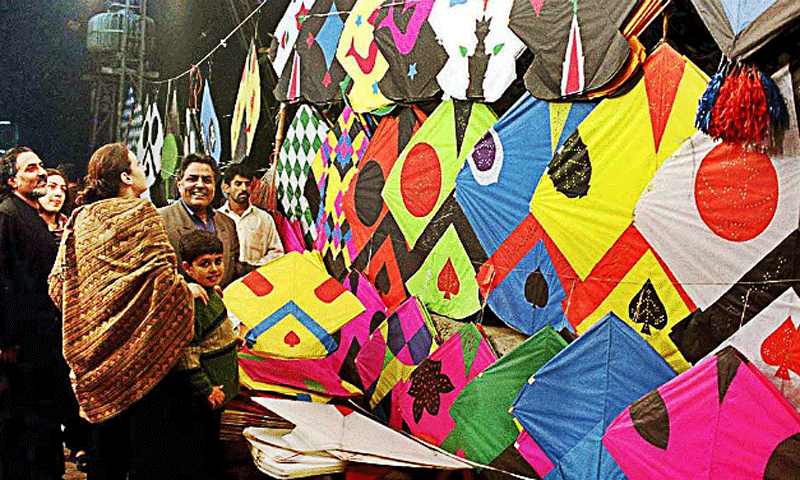
Over the decades, Basant spread nationwide, transforming city skies into vibrant tapestries of colourful kites in myriad shapes and sizes, flown from rooftops and manoeuvred with strings often coated in thin shards of glass to sever competitors’ lines. The festival’s darker side led to its abrupt halt in 2007, when the Punjab government imposed a blanket ban amid a surge in fatalities and severe injuries.
Motorcyclists and their passengers were especially at risk, vulnerable to nearly invisible stray strings that could slice throats or cause catastrophic falls while navigating the narrow lanes of Lahore’s Walled City. These strings, laced with glass or metal, inflicted multiple critical wounds on bikers, prompting widespread outcry and the eventual prohibition on both kite flying and celebratory gunfire.
Under the new ordinance, the government has introduced a series of measures to mitigate these dangers. Teenagers under 18 are barred from participating in kite flying, with a fine of Rs50,000 imposed for the first violation and Rs100,000 for subsequent ones. In cases of nonpayment, action will be taken against the father or guardian. Violators of the broader rules face imprisonment for three to five years and fines up to Rs2 million. To ensure traceability, every kite must bear a QR code identifying its seller or manufacturer.
Kite flying associations must register with the district’s deputy commissioner, as must shopkeepers dealing in kite materials, who will also be linked to QR codes. Manufacturing is restricted to thread-based strings only; the use of metallic, chemical-coated or sharp strings is strictly forbidden, with severe legal consequences for those found in violation.
Manufacturers, traders and sellers of permissible kite flying materials are required to register with the deputy commissioner or an authorised officer, upon payment of a fee. The ordinance also includes provisions for whistle-blowers to report infractions, aiming to deter potential offenders through enhanced enforcement.
The ordinance’s statement of objects and reasons underscores its dual purpose: to uphold the general ban while allowing regulated kite flying and to establish registration systems for associations and suppliers. Though promulgated by the governor, the measure requires approval from the provincial legislature to become permanent law. An attempt to table it in the Punjab Assembly on Wednesday was thwarted when the session adjourned to Thursday due to a lack of quorum. Once passed, it is expected to enable shopkeepers to resume selling kites legally.
Copyright © 2021 Independent Pakistan | All rights reserved