By Staff Reporter
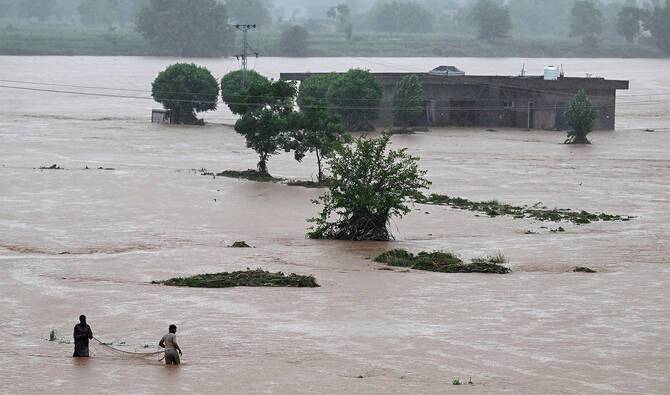
LAHORE: Punjab is racing against time to evacuate thousands from flood-prone areas as monsoon rains swell the region’s eastern rivers to dangerous levels, while in the rugged north of Gilgit-Baltistan, communities devastated by earlier glacial and flash floods remain cut off, grappling with shortages of food, water, and shelter.
The twin disasters, unfolding across Pakistan’s diverse terrain, expose the nation’s vulnerability to climate-driven crises and the challenges of delivering timely aid to remote and urban areas alike.
In Punjab, the Provincial Disaster Management Authority (PDMA) has issued a stark warning of “high to very high” flooding in the Chenab, Ravi, and Sutlej rivers, with urban flooding threatening the densely populated divisions of Rawalpindi, Lahore, and Gujranwala.
Since Saturday, more than 24,000 people have been relocated from low-lying areas along the Indus, Chenab, Ravi, and Sutlej rivers, according to Farooq Ahmad, spokesperson for Rescue 1122, Punjab’s emergency response agency. The evacuations, spanning the districts of Kasur, Okara, Pakpattan, Bahawalnagar, Vehari, and Narowal, were triggered by a high flood alert prompted by India’s warning of increased water releases from its dams.
“These rivers are already experiencing low to high flooding due to torrential monsoon rains in their catchment areas,” Ahmad said, adding that more rain is expected over the next 48 hours. The crisis is particularly acute along the Sutlej River, where a high-level flood warning has been issued for the Harike section, with upstream and downstream areas already inundated.
Authorities expect water flows in the Sutlej and adjacent rivers to rise further, driven by heavy rainfall and potential spillway releases from Indian dams. Hydrological data shows the Sutlej at Ganda Singh Wala in a high flood state, with medium flooding at Sulemanki. On the Chenab River, medium flood levels have been recorded at Marala and Khanki. The Indus River, by contrast, is at low flood levels at Kalabagh and Chashma, with normal flows at Tarbela and Taunsa.
Reservoir levels are also a concern. Tarbela Dam is at full capacity, while Mangla Dam is at 76 percent. Across the border, India’s Bhakra, Pong, and Thein dams are at 80, 87, and 85 percent capacity, respectively, raising fears that additional releases could worsen downstream flooding.
The National Emergencies Operation Centre (NEOC) has issued a specific alert for the Ravi River, citing a medium-level flood threat over the next 48 hours. Sustained moderate to heavy rainfall in the river’s catchment areas and associated nullahs has driven inflows at Thein Dam to 1,717 feet. As of Monday, the Ravi at Kot Naina was discharging 64,000 cusecs, potentially causing “low to medium” floods at Jassar within 24 hours.
The NEOC warned that continued rainfall and additional spillway releases could escalate the situation to high flood levels by August 27. To manage the looming threat, the PDMA has directed district administrations in Lahore, Sahiwal, Multan, Bahawalpur, and Dera Ghazi Khan to remain on high alert.Deputy commissioners in Kasur, Okara, Pakpattan, Vehari, Bahawalnagar, Lodhran, Bahawalpur, Multan, and Muzaffargarh have been instructed to prepare for potential flooding.
A PDMA fact sheet detailed recent rainfall across Punjab: Narowal recorded 27mm in the last 24 hours, Sialkot 5mm, Kasur 4mm, Lahore and Gujranwala 3mm each, and Gujrat and Khanewal up to 1mm.
Hundreds of miles north, in the mountainous region of Gilgit-Baltistan, the aftermath of earlier glacial and flash floods has left communities in a state of despair. In Ghizer district, residents of several tehsils have been isolated for four days after a five-kilometer stretch of the Gilgit-Shandur Road was submerged by a glacial flood that formed an artificial lake in Raushan village.
Mohammad Karim, a local resident, painted a grim picture of the situation. “Three hundred houses damaged by the flash flood have been submerged by the lake, and villagers in Hakis, Thangi, and Raushan remain without basic necessities,” Khan told Dawn newspaper. He said residents lack electricity, potable water, housing, and medical facilities, with no government relief in sight. “We’ve been uprooted from our homes, but still no help has come.”
The isolation extends to other parts of Ghizer, including Khalti, Daen, and Chaturkhand, where residents face similar deprivations. In Nagar district’s remote Hisper Valley, communities have been marooned for nearly a month after floods and landslides washed away roads. The Karakoram Highway near Hassanabad in Hunza has been blocked for three weeks, forcing traffic onto an alternative route. The Haramosh and Bagrot valleys in Gilgit also remain inaccessible, leaving residents cut off from supplies and services. In densely packed areas like Danyor, Sultanabad, and Mohammadabad in Gilgit, the lack of water has reached critical levels.
The Gilgit-Baltistan Disaster Management Authority (GBDMA) is working to restore access. Director General Zakir Hussain said the National Highway Authority has deployed machinery to clear the Shandur road, and formal approval has been secured for an alternative route. “Under the project, a bypass will be constructed, and the road will be connected to the main highway through a bridge,” Hussain said, emphasizing that work is progressing rapidly.
Copyright © 2021 Independent Pakistan | All rights reserved