By Staff Reporter
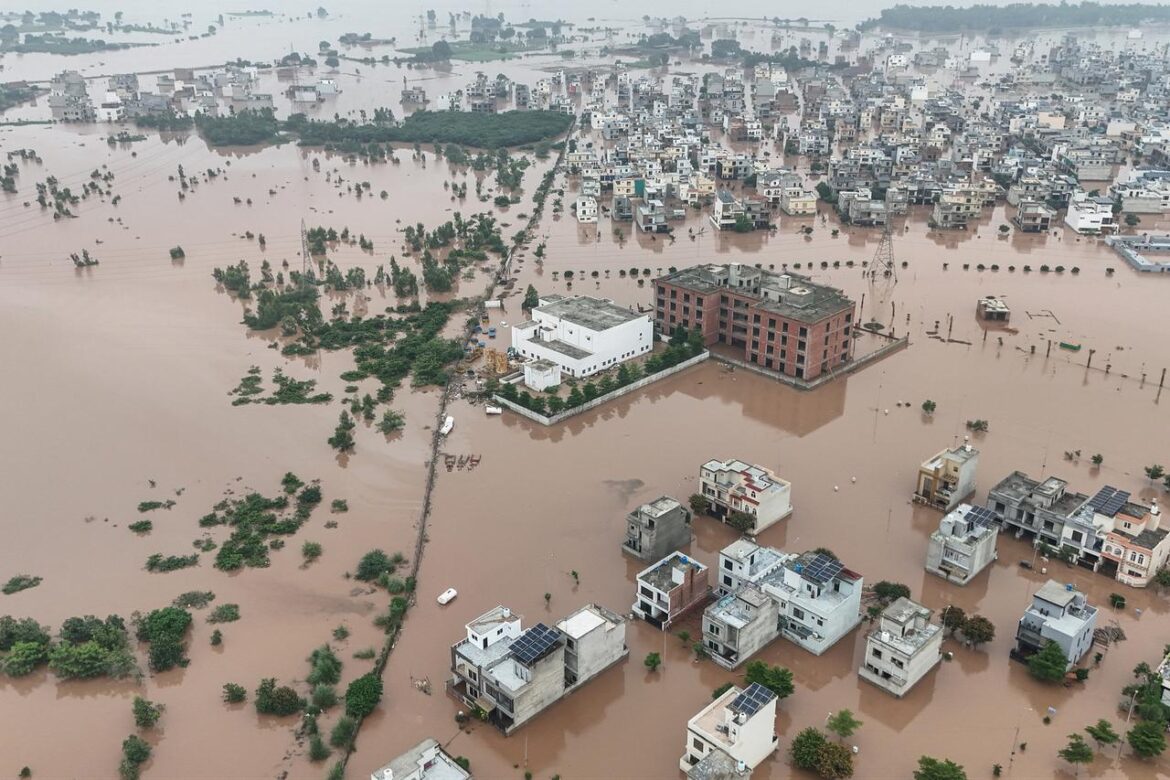
ISLAMABAD: Floodwaters driven by relentless monsoon rains and releases from upstream dams in India have killed at least 30 people and affected more than 1.5 million others in Pakistan’s Punjab province this week, submerging over 2,300 villages and prompting the largest evacuation effort in the region’s recent history, officials said Saturday.
The deluge has inundated vast stretches of the country’s most populous and agriculturally vital province, overwhelming rescue operations and displacing nearly half a million residents to higher ground. With rivers still swelling, authorities warned that the crisis could soon spread southward along the Indus River, potentially endangering millions more in Sindh province.
Nationwide, the monsoon season has claimed more than 830 lives since June 26, according to the National Disaster Management Authority (NDMA).
“Due to severe flooding in rivers Ravi, Sutlej and Chenab, 2,308 villages have been affected,” Punjab Relief Commissioner Nabeel Javed said in a statement from the provincial disaster management authority (PDMA).
In Punjab’s capital, Lahore, officials confirmed two deaths from lightning strikes amid recent thunderstorms, contributing to the province’s toll of 30 fatalities.
“A total of 1.516 million people have been impacted while 481,000 trapped residents were rescued to safer places,” Javed said.
Authorities have established 511 relief camps, 351 medical camps and 321 veterinary camps in the hardest-hit districts. Some 405,000 animals have been relocated to safer areas.
“Compensation for citizens’ losses will be ensured under the instructions of the Punjab chief minister,” Javed said, noting that assessments of agricultural damage are underway.
At Punjab’s request, the NDMA dispatched aid to severely affected districts like Sialkot and Narowal. “NDMA has provided 500 ration bags each for flood-hit areas of Sialkot and Narowal,” the agency said. “A convoy of eight trucks has been sent carrying relief goods … while more consignments are planned for Wazirabad, Hafizabad, Chiniot and Jhang in the coming days.”
Punjab Chief Minister Maryam Nawaz Sharif described the response as the “biggest evacuation and rescue operation in our history.”
“We are facing a situation we haven’t faced in decades. There has been a continuous effect due to non-stop rainfall,” she said in a briefing. “Our neighbour, India, opened their spillways and all that water came into our rivers, overflowing them.”
Sharif outlined a five-tier response plan, starting with evacuations. “All commissioners and DCs performed timely evacuations; containing this level of flooding with all resources was not humanly possible,” she said.
“We have evacuated and transported around 600,000 people in Punjab, who were moved from inundated areas. Around 450,000 animals have been evacuated as well,” she added.
Sharif urged heightened preparedness in at-risk districts like Jhang, Muzaffargarh, Multan and Okara. “Their preparedness needs to be airtight and they need to be ready for rescue,” she said, directing officials to use barges for transporting large herds of cattle.
Forecasts from the Flood Forecasting Division (FFD) on Saturday indicated exceptionally high water levels persisting at Ganda Singh Wala on the Sutlej River and Balloki on the Ravi, with the Chenab at Trimmu expected to reach similar peaks within 24 hours. The Panjnad headworks could see very high floods by Sept. 3, and the Indus at Guddu by Sept. 5.
“Exceptionally high flood level will continue in river Sutlej at Ganda Singh Wala,” the FFD bulletin warned, adding that the Chenab at Trimmu was on track for the same within a day.
PDMA Director General Irfan Ali Kathia told reporters in Lahore that 303,000 cubic feet per second (cusecs) of water were flowing at Ganda Singh Wala, where the army and local officials had evacuated 20 villages overnight. More than 175,000 cusecs were recorded at Head Marala on the Chenab, with dangerous levels anticipated at Head Islam in the next day.
The floods coincide with the ninth spell of monsoon rains, which the Meteorological Office expects to last until Sept. 2. Heavy downpours included 81 millimeters in Mandi Bahauddin, 63 mm in Hafizabad, 50 mm in Jhelum and 47 mm in Sialkot over the past 24 hours.
Pakistan has long accused India of exacerbating floods by releasing excess water during peak monsoons. The PDMA noted India’s Bhakra Dam at 84 percent capacity, Pong at 94 percent and Thein at 92 percent, heightening fears of additional surges into Punjab’s rivers.
In neighboring Sindh, hot and humid conditions prevail, but scattered thunderstorms are forecast for districts including Jacobabad, Kashmore, Ghotki, Khairpur, Kamber Shahdadkot, Sanghar, Umerkot and Tharparkar, according to the Pakistan Meteorological Department.
The Indus River at Guddu and Sukkur barrages is already at medium flood stage, with very high levels projected soon.
Sindh Senior Minister Sharjeel Inam Memon warned that up to 1.6 million people in 1,657 villages could be impacted if waters breach into the province.
Speaking to reporters Saturday, Memon said the government has mobilized resources and is implementing preemptive measures. Ministers and district officials are actively monitoring the situation on the ground.
The alert follows Punjab’s inundation, where swelling rivers — fueled by rains and Indian discharges — have left vast areas underwater.
In Sindh, 551 sites have been designated for relief camps, with 192 rescue boats on standby. Some 273,000 families across 167 union councils could be affected, Memon said, adding that floodwaters might enter the province between Sept. 2 and 3.
He reported current flows: 351,000 cusecs at Guddu barrage (capacity 1.2 million cusecs), 289,000 at Sukkur (900,000 capacity) and 251,000 at Kotri (600,000 capacity). “At present, the data indicate no alarming situation, and if no further heavy rains occur, conditions may remain under control,” he said.
Memon stressed no immediate risk to cities and discouraged speculation. He said the province is handling the threat independently, without needing army support.
Residents in riverine “katcha” areas are being alerted, as they best understand local water patterns. “When the water level rises, residents voluntarily move to pucca (settled) areas or stay with relatives,” he said.
Additionally, 300 livestock camps have been prepared, and 15 riverside districts are under vigilant surveillance.
“Pakistan is among the countries most affected by climate change. Construction must never take place within riverbeds,” Memon said, pledging updates on barrage flows every three hours.
Copyright © 2021 Independent Pakistan | All rights reserved