By Staff Reporter
ISLAMABAD: Pakistan said on Thursday that it has deployed forces inside Saudi Arabia under a bilateral defence treaty signed a year ago, and said it would honour both that pact and a new three-way alliance with Riyadh and Ankara “in intent and spirit” — but pointedly refused to spell out what would trigger Pakistani troops going into action against Yemen’s Houthi rebels.
The statement, made almost in passing at a weekly press briefing in Islamabad, is an acknowledgement that Pakistani soldiers are on Saudi soil under the Strategic Mutual Defence Agreement (SMDA) concluded in September last year, and it comes at the most dangerous moment in the kingdom’s confrontation with the Houthis since the war in Yemen began.
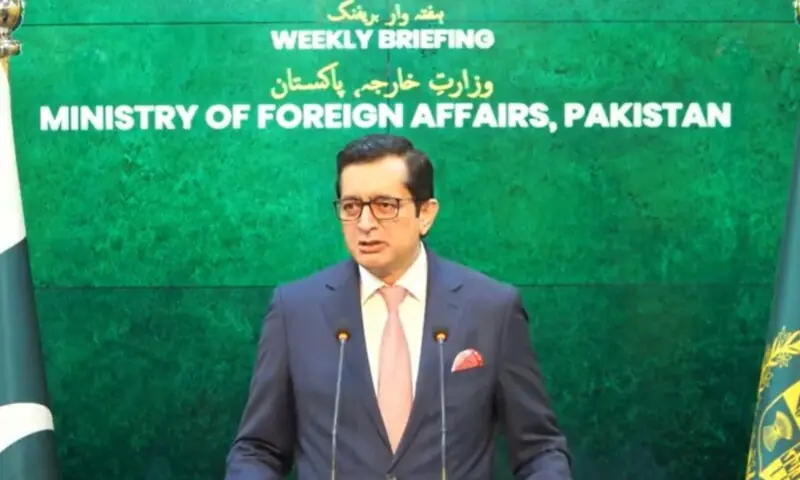
“Pakistan is committed in intent and spirit to implement the SMDA as well as the Makkah Joint Defence Agreement,” the Foreign Office spokesman, Sajjad Haider Khan, told reporters. “However, when, how, where and what force will be used against what objectives, in which modes and matters — operational confidentiality requires some discreteness.”
Pressed on whether Islamabad had devised any mechanism for thwarting Houthi attacks on Saudi Arabia, Khan would go no further. On the deployments themselves he was similarly clipped. “On SMDA, of course it was signed last year. There were some deployments also of forces there. And since it’s an operational matter, I would not comment beyond that.”
The briefing followed an incident that has convulsed the Muslim world. Saudi Arabia said its air defences destroyed a drone launched by the Iran-aligned Houthis south of Mecca on Tuesday evening, before it could penetrate the restricted airspace above Islam’s holiest city. The Saudi-led coalition fighting the rebels accused them of deliberately targeting Mecca, provoking condemnation across the region. The Houthis rejected the account outright, dismissing it as a “lie”.
An attack on one
The Makkah Joint Defence Agreement, signed last month by Pakistan, Turkey and Saudi Arabia, contains the clause that matters: an attack on any one of the three signatories is to be treated as an attack on all three. It is, on paper, a collective security guarantee of the kind Nato members have invoked only once in three-quarters of a century, and it now sits over a conflict in which drones are being shot down within reach of the Kaaba.
Khan was at pains to lower the temperature. The accords were intended to strengthen regional peace and stability, he said, and the trilateral pact was “purely defensive in nature”.
“It is neither directed against any country nor constitutes formally as a new bloc,” he said. The agreement, he argued, had formalised cooperation that already existed between three long-standing partners, and aimed to deepen “training and capacity building, exchange of best practices, learning from mutual experiences in defence technologies and research, as well as collectively deter any acts aimed at destabilising the regional security”.
“Our partnership with Saudi Arabia and Turkiye in the area of security and defence is well recognised,” he added.
The Gate of Tears
Islamabad has spent months positioning itself as an honest broker in the war between the United States and Iran, now in its seventh month with no diplomatic breakthrough in sight. It hosted rare direct talks between Washington and Tehran and helped broker an interim peace deal in June, an achievement that collapsed within weeks as both sides resumed strikes across the Middle East.
Asked about recent conversations between Pakistan’s defence forces chief, Field Marshal Asim Munir, and the Iranian leadership, Khan reached for the language of mediation rather than alliance.
“Pakistan has for a long time been sharing this perspective that we would like to have peace and stability, because this is in the interest of not only Pakistan, Iran, but the entire region and beyond our region also,” he said. “Our discussions basically revolve around bringing peace and stability through dialogue and diplomacy and not through coercive measures.”
He described the situation around the Bab al-Mandab strait as “exceptional… a serious matter, of serious concern”, and said the Houthis “must stop their activities also”.
Known in Arabic as the Gate of Tears, Bab al-Mandab sits at the southern mouth of the Red Sea, linking it to the Gulf of Aden and the Indian Ocean. Roughly 100km long and just 30km across at its narrowest point, it separates Yemen from Djibouti and Eritrea on the Horn of Africa. Houthi forces have pushed along Yemen’s Red Sea coast towards the chokepoint, raising fears for commercial shipping and energy supplies already squeezed by disruption to the Strait of Hormuz.
Collision at sea
If the Gulf were Pakistan’s only problem, this week would still be a difficult one. Instead, Islamabad has spent it trading protests with New Delhi over a collision between Indian and Pakistani warships, the first overt military friction between the nuclear-armed neighbours since their armed confrontation in May last year. Both summoned each other’s senior diplomat.
Pakistan’s foreign ministry said the incident happened on Tuesday while a Pakistan Navy vessel was taking part in SEASPARK-26, its biennial exercise, inside Pakistan’s exclusive economic zone. An Indian ship, it said, carried out “aggressive manoeuvres in dangerously close proximity of Pakistani naval ship”, resulting in contact between the two hulls. Islamabad called it a serious violation of international law and of the 1991 bilateral agreement on Advance Notice on Military Exercises, Manoeuvres and Troop Movements.
“Pakistan calls upon India to act responsibly, avoid provocative actions and ensure strict compliance with international law and bilateral commitments to preserve regional peace and stability,” Khan said.
Borders, visas and a trip to New York
The spokesman also confirmed that Pakistan and China had operationalised the Pakistan-China Boundary Joint Commission on 16 September, with an inaugural meeting at the foreign ministry in Islamabad. Co-chaired by senior officials from both sides, it will cover border management, joint surveys, trade facilitation and people-to-people links.
India has questioned the legality of the body, which derives from the Sino-Pakistan Boundary Agreement of 2 March 1963. Khan rejected what he called “baseless and illegally untenable assertions”, insisting the 1963 agreement remained valid and calling it “a mockery of international law” for India to raise legality at all. New Delhi, he said, should “carry out its own introspection” over Indian-administered Kashmir “instead of advancing fictitious territorial claims”. Of China he said: “Not only our neighbour but an all-weather strategic cooperative partner. Our ironclad ties have withstood the test of time.”
He also dismissed reports that Pakistani Sikh pilgrims had been prevented from boarding a flight at Faisalabad International Airport en route to Gurdwara Sri Hemkund Sahib in India, calling the coverage a “malicious media campaign”. The visas, he said, had been issued by the Indian High Commission without Pakistan’s knowledge and fell outside the 1974 bilateral protocol governing pilgrimages to shrines in both countries. India, he said, had barred its own Sikh pilgrims from travelling to Pakistan in 2025, and the Kartarpur corridor remained shut from the Indian side. Pakistan, he said, would welcome pilgrims “as and when India allows them”.
Prime Minister Shehbaz Sharif will lead Pakistan’s delegation to the 81st session of the UN General Assembly in New York next week, accompanied by Deputy Prime Minister and Foreign Minister Ishaq Dar and several cabinet colleagues. The general debate opens on 22 September, when leaders and senior representatives of all 193 member states begin addressing the assembly from its green marble podium.
Sharif will press the case for “dialogue, diplomacy, restraint and peaceful resolution of disputes”, the spokesman said, and set out Pakistan’s positions on sustainable development, climate change, counterterrorism, Islamophobia, global economic pressures, UN reform and the concerns of the Global South. He will also raise Palestine — Islamabad backs an independent Palestinian state with Al-Quds Al-Sharif as its capital — and the treatment of Muslims in Indian-administered Kashmir, alongside bilateral meetings with world leaders and the UN secretary-general.
It is a long agenda for a country that has just confirmed its soldiers are stationed in a kingdom now under drone attack, and that has declined to say what, exactly, would make them fight.
Copyright © 2021 Independent Pakistan | All rights reserved