By Staff Reporter
ISLAMABAD: Pakistan’s second monsoon spell of the season is overwhelming drainage systems in Punjab provinces and severing road links across the mountainous north, with the national disaster authority reporting a rising death toll and officials in three provinces now on high alert.
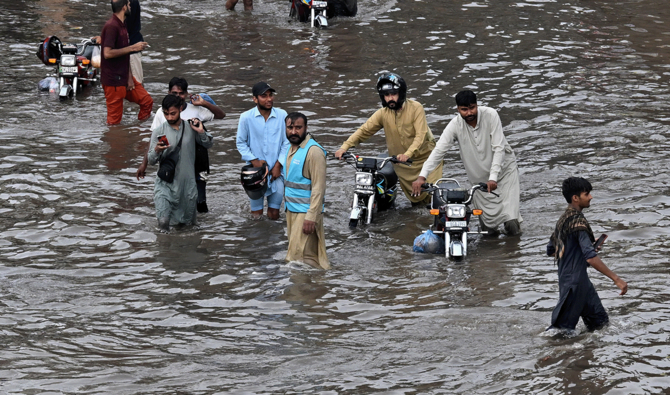
In Lahore, the provincial capital, three to four feet of standing water swallowed major roads, underpasses and residential streets on Thursday after the city recorded 343 millimetres of rain over 48 hours. More than 130 locations across the city were left waterlogged, according to the Provincial Disaster Management Authority (PDMA), which had already warned of urban flooding before the rain fell.
Some 900 miles to the north, in Gilgit-Baltistan, the damage took a different but no less severe form. Flash floods and landslides tore away roads and bridges connecting remote valleys, leaving thousands of people, including tourists, stranded, while entire villages were cut off from one another and from emergency services.
Underpasses shut, sinkholes open across Lahore
The Ghazi Underpass and Masjid Chowk Underpass were among those forced to close as water rose beneath them, with traffic diverted to alternate routes through Z Block and other side streets. Around two feet of water accumulated along the stretch from Defence Mor to A Block Checkpost in Defence Housing Authority (DHA), while movement slowed to a crawl on the roads linking Lalak Jan Chowk to LUMS, Watain Chowk to LUMS, and Masjid Chowk to Ghazi Chowk.
Beyond DHA, standing water was reported in Harbanspura, on Mall Road, Cooper Road, and around Lakshmi Chowk and Chouburji Chowk, where Wasa crews worked to clear the backlog.
The rain also opened up the ground itself. Sinkholes roughly ten square feet wide appeared on three or four roads, among them Canal Road, Johar Town Main Boulevard and Bhekay Wala Mor, causing sections of carriageway to give way. Traffic police cordoned off each site and rerouted vehicles once Wasa teams arrived. A further sinkhole resurfaced on Khayaban-i-Firdousi, where barriers went up as a precaution.
For many residents, the flooding was not simply an inconvenience but a return of a problem they say has never been properly fixed. Water entered homes in low-lying neighbourhoods, and several people said no help had come to drain it — leaving them to bail out their own houses and streets. Cars stalled in flooded roads, forcing drivers to inch through the water or avoid main routes altogether for fear of breaking down. Residents pointed to blocked sewer lines and drainage capacity that has not kept pace with the city’s growth, despite yearly promises of monsoon preparedness.
Wasa Lahore managing director Ghufran Ahmed toured the worst-hit areas, including Mall Road, Cooper Road, Lakshmi Chowk and Chouburji Chowk, and said all disposal stations were running at full capacity, with extra machinery and staff sent to flooded points. He said more than 21 emergency relief camps had been set up, and that a round-the-clock control room was tracking the situation through over 200 cameras positioned across the city, including inside underpasses.
Lahore’s deputy commissioner, retired Capt Ali Ijaz, visited Harbanspura and other affected areas and said most major roads had been cleared in what he described as record time, with remaining low-lying pockets expected to follow shortly.
Chief Traffic Officer Syed Abdul Raheem Sherazi ordered sinkholes cordoned off and alternate routes signposted, and stationed officers outside underpasses to manage diversions. “Rain duty with commitment, professionalism and public safety is their top priority,” he said of his officers.
The PDMA said Punjab has recorded 21 deaths and 154 injuries in rain-related incidents so far this monsoon season, including 15 people killed in building collapses, two in lightning strikes, three by electrocution and one by drowning, with at least 38 houses partially damaged. Director general Umar Abbas Mela told district administrations to remain on high alert against the risk of urban and flash flooding, and urged residents to keep away from weak buildings, low-lying ground and power infrastructure during heavy rain. Authorities have asked residents to report waterlogging to Wasa’s helpline, 1334.
The Punjab figures form part of a far larger national picture. Pakistan’s nationwide monsoon death toll since 26 June has risen to at least 72, the National Disaster Management Authority (NDMA) said in a report on Wednesday, underlining the scale of a season that has now struck the country’s flattest plains and its highest mountains within the same week.
Bridges swept away as Gilgit-Baltistan is cut off
In Gilgit-Baltistan, the Pakistan Meteorological Department has forecast further rain and warned of glacial lake outburst floods until 26 July. Floods have already blocked the Karakoram Highway, Babusar Road, Baltistan Road, Naltar Highway, Ghizer-Shandur Road and Astore Valley Road, among other routes linking outlying communities.
The region’s disaster management authority said the Karakoram Highway was blocked at multiple points between Dassu and the Hunza and Nagar districts, hampering relief convoys trying to reach communities already isolated by washed-out roads.
In Skardu, flooding along the Tormak Nallah in Rondu subdivision destroyed at least three major bridges, including the Malan Bridge, severing a key link. Floodwater also damaged roads, bridges, farmland, crops and other infrastructure across Kharmang, Ghanche and Shigar districts, while suspension bridges and power houses were damaged in Haramosh.
Power and water supplies were knocked out and communications disrupted in Astore, Tangir, Thore and other parts of Diamer, where drinking water schemes, irrigation channels and flood embankments were also destroyed. Dozens of families in Losala village in Astore, in Thore Valley and in Tangir have been left homeless.
In Ghizer district, two houses suffered partial damage and vulnerable communities were moved to safer ground as a precaution. River erosion has damaged farmland and trees in Yasin Valley, Sheliabad and Amit, and both the Ghizer-Shandur and Ghizer-Gilgit roads remain closed. In Gilgit’s Jutal area, rising water in the Hunza-Nagar River has put eight households at risk. Authorities have urged tourists and other travellers to avoid non-essential journeys in the region.
The disaster authority said Rescue 1122 and district administrations were working together to move affected families to safety and to distribute tents, food, medicine and clean drinking water.
Gilgit-Baltistan’s Chief Minister, Amjad Hussain, ordered departments and district officials to remain on permanent alert and directed the food and health departments to keep supplies of rations, water, tents and medicine moving into affected areas. He also ordered heavy machinery mobilised to begin emergency repairs to roads and bridges and told commissioners and deputy commissioners to inspect the ground themselves and file daily reports to his secretariat.
“Rehabilitation of the victims and all possible assistance will be ensured by utilising all available resources,” he said, adding that the regional government would not abandon residents during the crisis.
Hussain travelled separately to Islamabad to meet the chairman of the NDMA, Lieutenant General Inam Haider Malik, where he was briefed on the authority’s efforts to strengthen early warning systems and emergency response nationally and in Gilgit-Baltistan specifically. General Malik told him that glaciers in the region were now being tracked individually using satellite monitoring, with each assigned a unique code to follow its movement and assess risk.
Hussain described the region’s glaciers as Pakistan’s largest natural freshwater reserve and said their protection had to remain a national priority, alongside closer coordination between his government and the NDMA. He said climate change was “a reality” for Gilgit-Baltistan, which he called one of the regions most exposed to glacial lake outburst floods, flash flooding and landslides, and called for the issue to be given greater weight at national policy forums.
Sindh braces for more rain
Further south, the PDMA in Sindh issued a province-wide alert on Thursday ahead of rain and thunderstorms expected until 25 July. Director general Syed Salman Shah said the Pakistan Meteorological Department had forecast widespread rain driven by strong monsoon currents moving in from the Arabian Sea, and that district administrations and emergency agencies had been told to prepare.
Heavy rain is expected in isolated parts of Hyderabad, Tharparkar, Umerkot, Mirpurkhas, Badin, Sanghar, Tando Muhammad Khan, Tando Allahyar, Matiari, Jamshoro and Shaheed Benazirabad, with lighter rain forecast for Ghotki, Kashmore, Jacobabad, Shikarpur, Sukkur and Khairpur. Larkana, Naushahro Feroze and Thatta are expected to see rain and thunderstorms over the next two days. Karachi is forecast to remain warm and humid with partial cloud cover and the possibility of isolated drizzle.
Mr Shah warned that strong winds and lightning could threaten weak structures, power poles, solar panels and billboards, and said the authority had readied dewatering pumps and identified areas at risk of urban and flash flooding in advance. “If the situation arises in any area, dewatering machinery will be immediately shifted to the affected locations,” he said, urging residents to avoid unnecessary travel, stay clear of power lines and unsafe buildings, and follow official guidance as the rain continues.
Copyright © 2021 Independent Pakistan | All rights reserved