By Staff Reporter
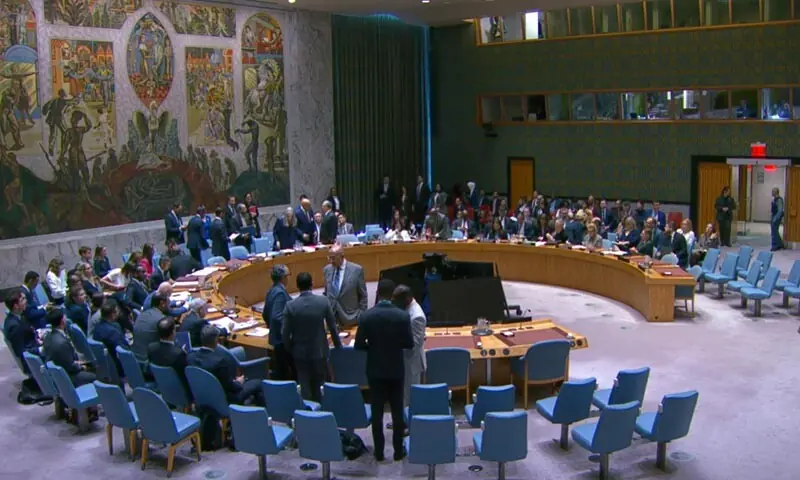
ISLAMABAD: Russia and China vetoed a Security Council resolution on Tuesday that called for coordinated international action to protect commercial shipping in the Strait of Hormuz and demanded that Iran immediately halt its attacks on merchant vessels and civilian infrastructure.
The measure, drafted by Bahrain in close coordination with other Gulf Cooperation Council states and Jordan, received 11 votes in favor but fell to the veto power of the two permanent members. Pakistan and Colombia abstained. The countries voting in favor were Bahrain, the Democratic Republic of the Congo, Denmark, France, Greece, Latvia, Liberia, Panama, Somalia, the United Kingdom and the United States.
The resolution had undergone six revisions during weeks of negotiations aimed at bridging differences among council members. Earlier versions had invoked Chapter VII of the U.N. Charter, which could have opened the door to the authorization of force, but that language was dropped after objections from Russia, China and several non-permanent members. Even in its final, more limited form, the text failed to win over Moscow and Beijing, which argued that it did not adequately address the underlying regional dynamics.
The Strait of Hormuz, a narrow chokepoint between the Persian Gulf and the Gulf of Oman, carries a substantial share of the world’s oil shipments. Iran has effectively closed the waterway in the wake of the U.S.-Israeli war against the Islamic Republic, disrupting global energy flows and raising the risk of further escalation. In its final version, the resolution “strongly encourage[d] States interested in the use of commercial maritime routes in the Strait of Hormuz to coordinate efforts, defensive in nature, commensurate to the circumstances,” to ensure safe navigation.
It explicitly cited the possibility of escorting merchant and commercial vessels and endorsed steps “to deter attempts to close, obstruct or otherwise interfere with international navigation through the Strait of Hormuz.” The text also called for respect for international law and required the secretary-general to report to the council within seven days — and every 30 days thereafter — on attacks and provocations affecting commercial shipping.
Bahrain’s foreign minister, Abdullatif bin Rashid Al Zayani, told the council that Gulf states “regret” the failure to adopt the measure. “The draft resolution has not been adopted, owing to the negative vote of a permanent member of the Council,” he said. He added that the Security Council “should shoulder its responsibility,” describing the text as a modest step toward restoring freedom of navigation. Al Zayani called on Iran to “fully comply with its obligations, rather than launching attacks against neighbouring countries.”
Pakistan’s ambassador to the United Nations, Asim Iftikhar, said his country’s position reflected a broader diplomatic push to contain the conflict. “Our objective is clear — a permanent end to hostilities, containing the expansion of this conflict and preventing any further loss of civilian life or destruction of critical infrastructure,” he told the council. Pakistan has been “actively engaged in diplomatic efforts towards that end in concert with its partners in the region and beyond,” he said.
Last week, China and Pakistan announced a five-point initiative that includes a sequenced road map for an immediate halt to hostilities, the launch of inclusive peace talks, the protection of civilians and critical infrastructure, the restoration of maritime security in the Strait of Hormuz, and a firm reaffirmation of the U.N. Charter and international law as the basis for any lasting settlement.
China’s ambassador to the United Nations argued that the council should not adopt the resolution at a moment when the United States “threatens the survival of a civilisation,” saying such a step would send the wrong message.
Copyright © 2021 Independent Pakistan | All rights reserved