By Staff Reporter
ISLAMABAD: Saudi Arabia’s Delta Energy signed an agreement with Pakistan’s state-owned Inter State Gas Systems to explore about $30 billion of gas infrastructure, including a pipeline from Afghanistan to the Indian border that would cross two frontiers largely closed to trade.
The programme would assess a pipeline entering Pakistan through its western border and running toward Gwadar, a port on the Arabian Sea in the south-west, the companies said in a statement on Tuesday. It would also consider an extension to the eastern border, along with LNG facilities, gas processing and storage, and export terminals.
A separate leg would run from Chaman, on the Afghan border, across Pakistan toward Fazilka on the Indian frontier. Delta called the route a “core strategic commitment” and said it would require formal engagement and agreements with Pakistani and Indian authorities.
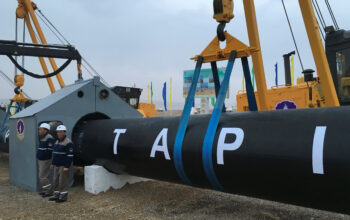
Delta named Afghanistan’s Kashk gas concession and other Afghan resources as potential supplies. It said the programme is separate from the Turkmenistan-Afghanistan-Pakistan-India pipeline and does not depend on Turkmenistan.
The agreement is a framework for evaluating the projects. It is not a final investment decision or a commitment to finance or build them. The $30 billion is the proposed scale of the programme, not secured funding.
The obstacles are as much political as financial. Plans for other pipelines meant to bring gas into Pakistan have been delayed for years. Trade across the Afghan frontier has been largely halted since clashes in October 2025, and nine months of closure had cost the two countries more than 400 billion rupees, trade representatives said. Pakistani airstrikes hit Afghanistan’s Khost province in September. Foreign Minister Ishaq Dar said on Monday that Kabul must address its neighbours’ security concerns, particularly terrorism.
The eastern leg faces a similar problem. The border with India is shut, trade is suspended and New Delhi still holds the Indus Waters Treaty in abeyance. Delta already has a footprint in Afghanistan. On Sept. 7 it signed a $200 million contract with the Taliban government in Kabul to explore the Kushk-Tirpul basin in the western provinces of Herat and Badghis, with an eight-year exploration period and a 25-year term. Afghan Mines and Petroleum Minister Hedayatullah Badri said Afghanistan “will become self-sufficient” once output starts. Delta also signed a framework to study a 700-kilometer pipeline from near Guzara in Herat to near Spin Boldak in Kandahar, which it said could need about $10 billion over a decade. Spin Boldak sits across the border from Chaman.
The Kabul ceremony drew attention in Washington. Zalmay Khalilzad, a former US special envoy, attended, and the State Department said he “does not represent the United States government.” The department urged American companies to use extreme caution when considering business with Taliban-ruled Afghanistan. Treasury guidance says non-US companies that conduct certain transactions with sanctioned groups can themselves face penalties, a consideration for any lender or contractor.
Delta has chased a trans-Afghan pipeline before. In the mid-1990s, during the Taliban’s first period in power, it joined Unocal in a consortium to build a line from Turkmenistan through Afghanistan to Pakistan. That project was cancelled after Unocal withdrew, with regional instability proving too great a challenge.
Pakistan’s need for new supply is pressing. Imported LNG supplied about one-fifth of the country’s gas consumption between July 2025 and March 2026. Qatar provided 99% of its LNG imports last year. Shipments from Qatar were suspended completely from March 2 after Iranian attacks and disruption in the Strait of Hormuz. Authorities began rationing household gas to cooking hours in September, and the country needs nine LNG cargoes in December alone.
That is a sharp reversal. Pakistan began 2026 with a surplus, having persuaded Qatar to cancel cargoes and reopened local wells after cutting production to ease pipeline pressure. The gas sector’s circular debt stood at about 3.3 trillion rupees by early this year, which limits the state’s ability to fund projects of this size.
Copyright © 2021 Independent Pakistan | All rights reserved