By Staff Reporter
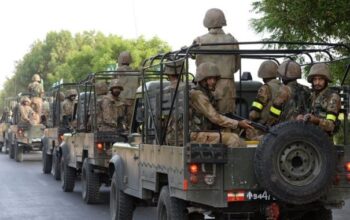
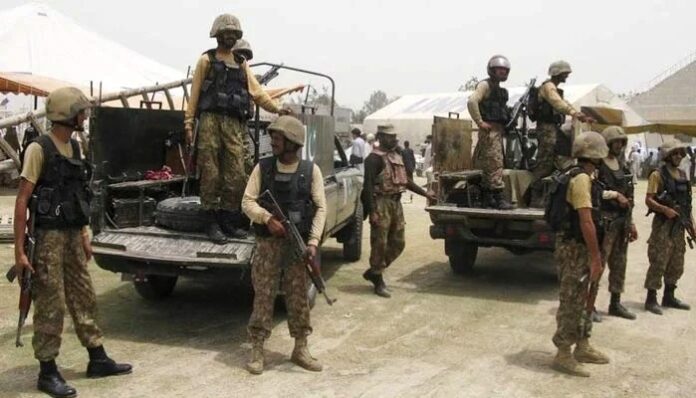
ISLAMABAD: Security forces killed 10 militants during a sanitisation operation in the southwestern district of Zhob, the military said Thursday, part of an expanding counterterrorism effort in a region plagued by cross-border attacks.
The Inter-Services Public Relations, the military’s media wing, said the Wednesday action followed an intelligence-based operation the day before in the same district in which eight India-sponsored militants were neutralised. In the follow-up sweep, forces tracked militants along multiple routes and engaged them in a firefight, the statement said. “After an ensuing fire exchange, ten Indian-sponsored khwarij were sent to hell,” it added, using language the Pakistani military routinely employs for its enemies.
The slain militants belonged to Fitna al Khwarij, the term the state uses for the banned Tehreek-i-Taliban Pakistan, which Islamabad describes as an Indian proxy. Weapons, ammunition and explosives were recovered from the site, and the militants had been involved in numerous terrorist activities in the area, the statement said.
Sanitization operations were continuing to root out any others hiding in the district, it added. The broader campaign, carried out under the banner of “Azm-e-Istehkam” and endorsed by the Federal Apex Committee on the National Action Plan, would proceed at full pace “to wipe out the menace of foreign sponsored and supported terrorism from the country,” the ISPR said.
Prime Minister Shehbaz Sharif offered public praise for the forces, according to a statement carried by the state-run Associated Press of Pakistan. He said they were “achieving major successes against terrorism” in line with the Azm-i-Istehkam vision, and that “the entire nation was standing with the army in the fight against terrorism.” “We are determined to eliminate all kinds of terrorism from the country,” Sharif said.
The latest killings come against a backdrop of rising militant activity in Pakistan’s northwestern Khyber Pakhtunkhwa and southwestern Balochistan provinces, both of which share a long, porous border with Afghanistan. The uptick began after the Taliban regained control of Afghanistan in 2021, Pakistani officials have repeatedly said. On Saturday, Pakistan carried out airstrikes on seven terrorist camps and hideouts belonging to Fitna al Khwarij, its affiliates and the Islamic State–Khorasan group along the border, killing more than 80 militants, according to security sources. The strikes targeted sites in Afghanistan’s Nangarhar, Paktika and Khost provinces and were launched in response to recent suicide attacks inside Pakistan.
Tensions between Islamabad and Kabul flared into open border clashes in October 2025 after Afghan Taliban forces and affiliated militants launched what Pakistan described as unprovoked attacks on Pakistani border posts. More than 200 Taliban and allied militants were killed in the fighting, while 23 Pakistani soldiers died, the military reported at the time. Multiple rounds of talks between the two countries have failed to produce an agreement, largely because of the Afghan Taliban regime’s unwillingness to act against terrorist groups using its territory. Islamabad accuses Afghanistan of allowing militants safe haven and India of backing such groups
Mineral-rich Balochistan has also faced a separate low-level insurgency for years. Ethnic Baloch separatist groups accuse the Pakistani state of exploiting the province’s resources while denying locals a fair share. The government rejects those claims and points to development projects aimed at improving conditions for residents. The military’s Thursday statement underscored that the counterterrorism campaign would not let up. Sanitization operations in Zhob were intended “to eliminate any other India-sponsored Kharji found in the area,” it said, signaling that further action was expected.
Copyright © 2021 Independent Pakistan | All rights reserved