By Staff Reporter
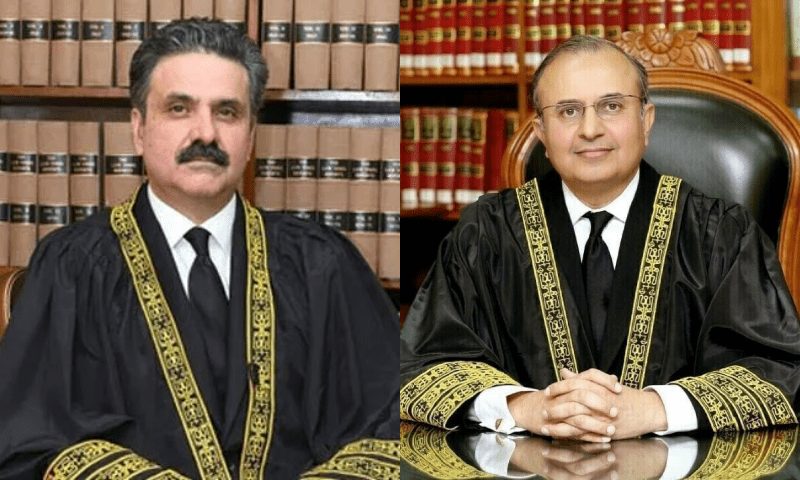
ISLAMABAD: Pakistan’s senior puisne Supreme Court justice, Mansoor Ali Shah, has accused Chief Justice Yahya Afridi of bypassing statutory procedures, stifling judicial deliberation, and imposing controls that threaten the court’s independence, according to a sharply worded letter made public on Friday.
The letter, dated Thursday, was written “reluctantly” by Shah to fulfill an “unavoidable institutional duty,” driven by Afridi’s “persistent and complete indifference” to his repeated, unanswered communications. Shah criticised the chief justice’s silence as “not merely discourteous” but a breach of “the collegial traditions of this court and … institutional courtesy without which a constitutional court cannot function.”
As the court prepares for a new judicial year starting on Monday, Afridi is set to host a conference to review his reforms and set priorities. Shah called on him to address the issues publicly at the forum to “reassure the judges of this court, the bar and the public we serve that your vision of reform is grounded in collegiality, transparency, and fidelity to the Constitution.”
Shah raised six questions, described as “pressing institutional concerns” that “strike at the heart of independence,” emphasizing they were not personal grievances but “institutional concerns borne of experience and responsibility.” He expressed hope that Afridi would use the conference for “institutional renewal by answering these questions,” noting that “the nation” seeks “clarity” from the chief justice.
Shah asked why the Practice and Procedure Act Committee has not met to fulfill its statutory duties; why the Supreme Court Rules 1980 were revised without full court deliberation; why a policy on dissenting opinions was adopted through individual opinions — a process Shah called “unheard of” — instead of open discussion; why a General Standing Order on leave imposes restrictions inconsistent with judicial independence; why petitions challenging the 26th Amendment remain unscheduled before the original full court; and whether Afridi is fostering judicial independence or “enforcing compliance to turn this court into a regimented force rather than a constitutional court of free and equal judges.”
Shah detailed each concern with legal precision. The Supreme Court (Practice and Procedure) Act, 2023, was enacted to end unilateral bench formations by mandating collective case allocation. Yet, since Afridi assumed office in October 2024, “not a single official meeting of the PaPA Committee has been convened,” Shah wrote. “Bench formation and cause lists are being issued unilaterally … Rosters are circulated for signatures, expecting members to endorse them blindly without discussion.”
As a committee member, Shah said he has had “no opportunity to participate in its work as mandated by law,” calling this a “direct violation of the act.” He questioned why junior judges often sit on three-member benches while seniors are confined to two-member ones and why significant cases bypass senior benches, suggesting “independent judges are being sidelined … for reasons of control.”
Shah dismissed minutes of five purported committee meetings on the court’s website as “mere discussions about the chief justice’s travel schedule,” uploaded against a majority decision despite his dissent for transparency. He stopped signing rosters, he said, because “the genie of the ‘one-man show’, which Parliament sought to bury through legislation, has been released once again.” Despite an increase in judges, the court’s backlog remains at 57,455 cases, implying expansion was “less about addressing pendency and more about altering its internal balance, thereby diluting the independence” of existing judges.
The revision of the Supreme Court Rules 1980, the first in four decades, warranted a full court meeting, Shah argued, not approval by circulation, a method suited for routine matters. Afridi’s approach “deprived the court of collective wisdom and diminished judicial dialogue,” reflecting “a preference for unilateral authority.” Similarly, Shah criticized the policy on releasing dissenting opinions, adopted by having the registrar solicit individual views, a process with “no legal or institutional basis” unless authorized for minor issues. This “secretive tick-box exercise” bypassed the “richness of open deliberation” essential for “judicial democracy,” he said.
The General Standing Order of July 29, 2025, marked the first time the court described judges as “whole-time” at the state’s disposal, language Shah called “wholly alien” to a constitutional court. The order limits foreign leaves to five categories, exceeding the Presidential Order of 1997, and denies leave arbitrarily “to enforce compliance and control,” Shah said, preventing judges from speaking at international forums. He condemned a requirement for judges to disclose residential addresses and contacts as akin to “surveillance,” citing the U.S., U.K., and South African supreme courts, which lack such mandates. “A judiciary under watch ceases to be a judiciary; it becomes an extension of bureaucracy,” he warned. Shah attributed this to the registrar, a retired civil servant, imposing a “command and control” logic unfit for judges, who are “guardians of the people’s liberties.”
Shah noted that petitions challenging the 26th Amendment, which implicate the court’s independence, have been delayed for nearly a year. They must be heard by the original full court, excluding post-amendment judges, he insisted. Until resolved, the court’s and Afridi’s legitimacy “hangs in the balance,” rendering initiatives “institutionally fragile.” “True leadership lies not in managing compliance but in ensuring that the court rises above suspicion as the fearless guardian of the Constitution,” he concluded.
Copyright © 2021 Independent Pakistan | All rights reserved