By Staff Reporter
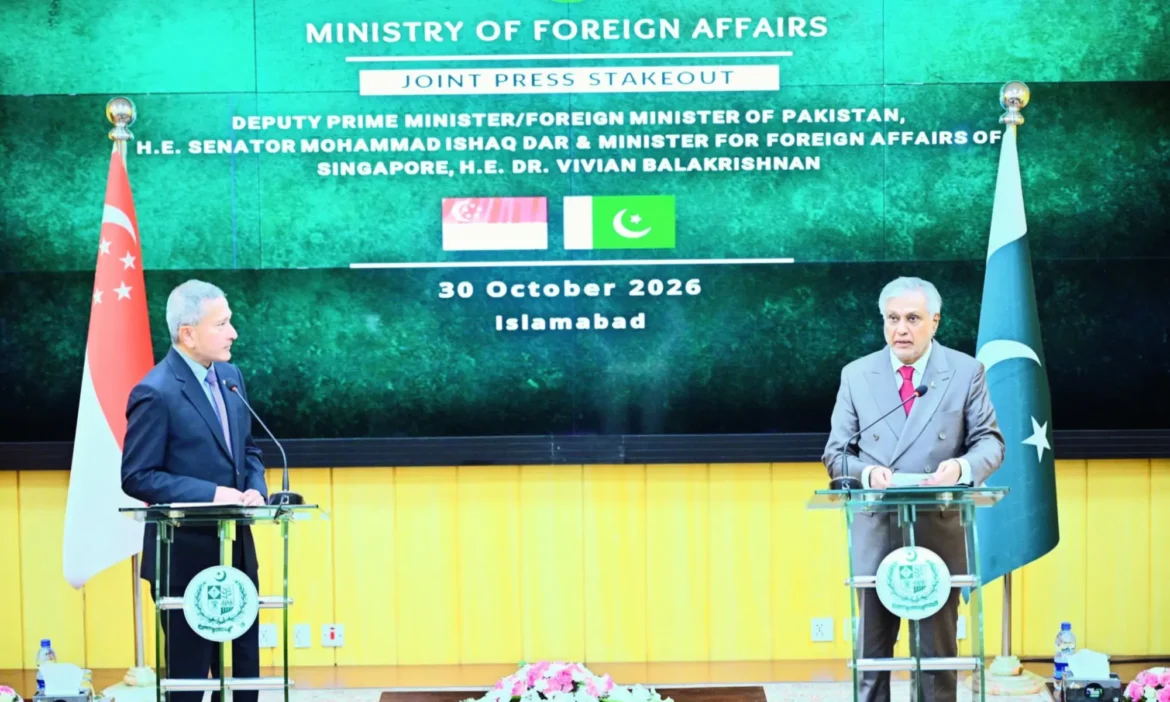
ISLAMABAD: Singapore’s foreign minister has publicly thanked Pakistan for its mediation in the Gulf crisis, telling his counterpart in Islamabad on Friday that “if you succeed, it’s good for all of us”.
Dr Vivian Balakrishnan was speaking at a joint press briefing with Deputy Prime Minister and Foreign Minister Ishaq Dar, at the end of the first visit to Pakistan by a Singaporean foreign minister in more than two decades. The trip coincides with the 60th anniversary of diplomatic relations between the two countries and comes ahead of Singapore’s chairmanship of the Association of Southeast Asian Nations (Asean) in 2027.
Dr Balakrishnan commended Dar for “the incredibly valuable role that Pakistan is playing”. He said most of the energy passing through the Gulf was headed east, to South Asia, Southeast Asia and Northeast Asia, and described Pakistan’s part as “unique but very constructive and valuable”.
Pakistan is a key mediator between the US and Iran. It hosted high-level talks between the two sides in Islamabad in April, and brokered an interim deal in June to end the conflict. The truce did not last, but Islamabad has kept its mediation channel open.
The diplomacy remains fragile. US envoy Tom Barrack told CNN on Thursday that Washington and Tehran were “very close” to agreeing on a pause in hostilities, and credited Qatar and Pakistan with helping to create the opening. A senior Iranian official has described the latest ideas relayed through Qatar as “unacceptable”, and there are reports of concern that the US and Israel could resume major strikes on Iran after the US midterm elections on 3 November if talks fail.
Dr Balakrishnan said international law was critical to both Singapore and Pakistan. Singapore, he said, was “an island city state” whose trade volume was three times its GDP, which made the maritime domain essential. He pointed to the 1982 UN Convention on the Law of the Sea, which sets out freedom of navigation and overflight, “especially in straits used for international navigation”, as a right and not one granted “by the grace of littoral powers”.
“This is of acute importance to us, and we are very, very heartened that Pakistan stands in exactly the same position on this issue with us,” he said.
Dar said the talks had covered the impact of regional tensions on maritime trade, adding that secure sea routes and uninterrupted supply chains were “essential to trade and economic stability”. He said Pakistan remained engaged with regional and international partners to encourage dialogue and diplomacy, which he called the “only viable means to resolve outstanding challenges”.
Trade “ought to be much higher”
Dr Balakrishnan named three areas of cooperation, beginning with trade, where he said both sides were “working furiously to get the homework done”.
Diplomatic ties were so good, he said, that “it makes it even more obvious that our trade relations, and looking at the numbers and the data, ought to be much higher”. He called for stronger links between small and medium-sized businesses, saying owners “need to know each other” and understand the opportunities and risks in both Southeast and South Asia. He also identified carbon markets as a “fertile opportunity”, a way to draw investment into Pakistani projects that cut emissions while supporting sustainable development.
Dar said the two sides had agreed to exchange business delegations and build stronger links between their chambers of commerce. They also discussed reopening the Pakistan Trade and Investment Office at the Pakistan High Commission in Singapore, which he described as “a testament to Pakistan’s resolve to promote stronger B2B ties”. The two also discussed the possible resumption of direct flights between the countries. In opening remarks at delegation-level talks, Dar suggested Pakistan’s Board of Investment could work with its Singaporean counterpart.
The second area was disaster management. Mr Dar and Dr Balakrishnan exchanged a memorandum of understanding between Pakistan’s National Disaster Management Authority and the Singapore Civil Defence Force.
Dr Balakrishnan said climate change made disasters “a current and clear threat”, and that Pakistan’s extensive experience of large-scale floods and other extreme weather meant Singapore “can learn” from it. He said the agreement could lead to cooperation on early warning systems, sharing of best practice, search and rescue, and joint training and exercises. “Disasters do not respect boundaries, do not have passports,” he said.
The third area was people-to-people ties, with education at the centre. Dr Balakrishnan said he welcomed deeper cooperation between Nanyang Technological University and the National University of Singapore and Pakistan’s National University of Sciences and Technology, adding: “This is just the beginning.”
He said the world was entering “a new industrial revolution” driven by AI and digital technologies, and that young people needed skills “not for yesterday’s jobs, but for tomorrow’s jobs”. Dar said the two sides had also discussed cooperation in research, innovation, human resource development, agriculture and climate.
Dar used the briefing to set out Pakistan’s positions on two long-running disputes. On Palestine, he said he had expressed concern over the expansion of illegal settlements and efforts to alter the status of the West Bank and Al-Quds Al-Sharif, and stressed the need for unhindered humanitarian aid to Gaza. He reiterated Pakistan’s support for an independent, sovereign, viable and contiguous Palestinian state based on pre-June 1967 borders, with Al-Quds Al-Sharif as its capital.
He said he had also briefed Dr Balakrishnan on the importance of a “just, durable and peaceful settlement” of the Jammu and Kashmir dispute in line with UN Security Council resolutions. Singapore’s response to either point was not part of the statements issued.
Meetings with prime minister and army chief
Dr Balakrishnan met Prime Minister Shehbaz Sharif, who praised Singapore’s “remarkable economic transformation”, according to the Prime Minister’s Office. The two discussed expanding trade and investment in the digital economy, fintech, infrastructure, logistics, small businesses and services.
He also called on Field Marshal Asim Munir, Pakistan’s Chief of Defence Forces and army chief, at General Headquarters in Rawalpindi. The military’s media wing said they discussed regional security and ways to strengthen bilateral cooperation. Dr Balakrishnan, it said, praised the professionalism of Pakistan’s armed forces and acknowledged its contribution to regional peace.
Dr Balakrishnan noted that Pakistan was among the first countries to recognise Singapore after independence in 1965. He said the two governments were in “constant communication, far more than people realise”.
Looking ahead, he said Singapore’s Asean chairmanship, alongside Pakistan’s chairmanship of the Shanghai Cooperation Organisation, would present “another set of opportunities” for the two regional blocs. Dar said the two sides had agreed to hold regular political consultations and to promote high-level exchanges, having recognised “considerable untapped potential” in the relationship.
Pakistan’s Foreign Office said both sides had agreed to build on the momentum of the visit and ensure timely follow-up.
Copyright © 2021 Independent Pakistan | All rights reserved