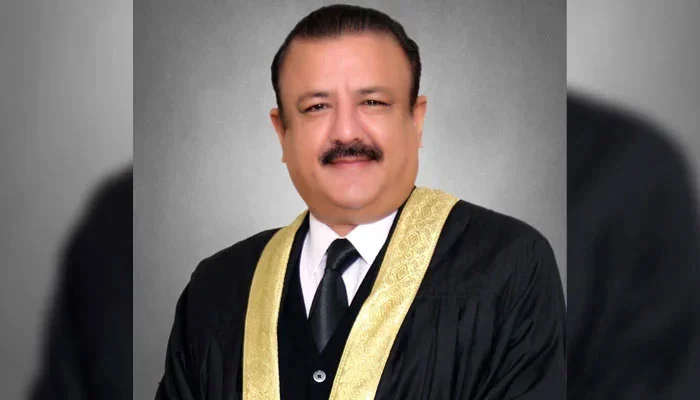
By Staff Reporter
ISLAMABAD: The Supreme Court on Monday suspended an order from the Islamabad High Court that had barred one of its judges from performing judicial duties, a decision that swiftly restored the jurist to the bench and laid bare deepening tensions within the country’s judiciary over administrative authority and allegations of political interference.
The five-member Constitutional Bench, led by Justice Aminuddin Khan and including Justices Jamal Khan Mandokhail, Muhammad Ali Mazhar, Syed Hasan Azhar Rizvi and Shahid Bilal Hassan, acted on an appeal filed by Justice Tariq Mehmood Jahangiri of the Islamabad High Court.
The bench suspended the Sept. 16 restraining order, which had sidelined Jahangiri pending a review of his law degree’s validity, and adjourned further proceedings until Tuesday at 9:30 a.m. In a short order, the court issued notices to the attorney general for Pakistan and the advocate general for the Islamabad Capital Territory, noting that the matter involves constitutional interpretation under Order XXVII-A of the Civil Procedure Code.
“We have heard Munir A. Malik, counsel for the petitioner, who has relied upon judgment of this court reported as ‘Malik Asad Ali and others versus Federation of Pakistan through secretary, Law, Justice and Parliament Affairs, Islamabad, and others’ (PLD 1998 Supreme Court 161),” the order stated.
It added that the counsel argued a writ of quo warranto is maintainable against a superior court judge but that no interim order can be passed. “States that he has challenged interim order passed by the high court; therefore, we issue notice to the respondents. Respondent No. 1 is present in court. Waives notice.” The additional attorney general, representing the federation, also waived notice. “In the meanwhile, operation of the impugned order is suspended,” the order concluded.
The Islamabad High Court responded promptly, revising its duty roster to reinstate Jahangiri for Tuesday’s proceedings. He had been excluded from the court’s sitting schedule since the suspension, while his four colleagues — senior puisne Judge Mohsin Akhtar Kayani, and Justices Babar Sattar, Sardar Ejaz Ishaq Khan and Saman Raffat Imtiaz — resumed their benches after attending Monday’s hearing.
Those five judges entered the Supreme Court’s premises through the general reception area, forgoing the reserved entry for judges and lawyers, a gesture that highlighted their status as ordinary litigants in the dispute. All five have separately petitioned the Supreme Court, challenging the administrative powers wielded by Islamabad High Court Chief Justice Sardar Mohammad Sarfraz Dogar, which they allege have been used to erode the judicial independence of high court judges.
The controversy traces to a Sept. 16 writ petition filed by advocate Mian Dawood under Article 199 of the constitution, seeking a writ of quo warranto to question “by what authority” Jahangiri holds office. A two-judge division bench of the Islamabad High Court, headed by Chief Justice Dogar and including Justice Mohammad Azam Khan, issued the interim order barring Jahangiri from judicial functions until the Supreme Judicial Council resolves a related complaint against him.
Dawood’s petition centred on the validity of Jahangiri’s LLB degree from the University of Karachi, which the university formally cancelled last week. In a notification dated Sept. 25, the university’s syndicate approved Resolution No. 6 on Aug. 31, 2024, upholding the Unfair Means Committee’s recommendation. “Justice Jahangiri was found guilty of using unfair means and has been barred for three years from admission to any university or college, as well as from appearing in any university examination,” the notification said. The university further clarified that Jahangiri had never been enrolled as a student at Islamia Law College in Karachi in 1989.
The clashes reflect broader strains in Pakistan’s judiciary, where judges have increasingly accused chief justices of overreach in administrative roles, amid a politically charged environment. The Supreme Judicial Council’s upcoming session could amplify these rifts, as it probes multiple complaints against judges.
Copyright © 2021 Independent Pakistan | All rights reserved