By Staff Reporter
ISLAMABAD: Pakistan’s deputy prime minister and foreign minister expressed guarded optimism Tuesday that his country’s intensive diplomatic campaign could still produce a negotiated end to the six-week-old conflict between the United States and Iran, even as renewed fighting broke out the previous day in the strategically vital Strait of Hormuz.
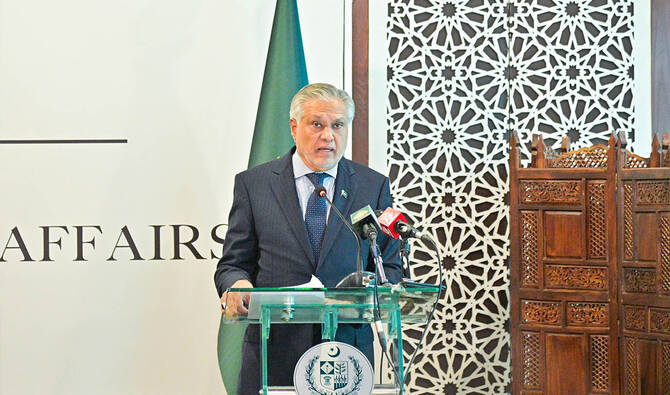
Speaking to foreign ambassadors and the diplomatic corps here, Ishaq Dar described ending the war as both Pakistan’s “goal and aim” as facilitator and mediator, and warned that the fighting had already inflicted significant damage on the global economy. “Whatever has happened so far, it has already dented a global GDP to a great degree,” he said. “This is the need for the region. This is the need for the globe. This is the need for the economy of the world.”
Dar’s remarks came hours after Iranian Foreign Minister Abbas Araghchi credited Pakistan’s “gracious effort” with helping to advance talks and reiterated that there is “no military solution” to the crisis. They also followed Prime Minister Shehbaz Sharif’s strong condemnation of Iranian missile and drone strikes on civilian infrastructure in the United Arab Emirates, in which Sharif expressed “full solidarity” with the Emirati leadership and people and warned that any escalation would undermine regional stability.
The latest violence shattered a tenuous calm that had held since Pakistan brokered a two-week ceasefire on April 8, barely six weeks after the conflict erupted on Feb. 28 with US-Israeli strikes on Iran. That agreement paused more than a month of intense fighting that had killed thousands across the region and virtually closed the Strait of Hormuz, the narrow chokepoint through which a large share of the world’s oil and fertilizer supplies pass.
On Monday, President Donald Trump announced a new US operation, dubbed “Project Freedom,” aimed at escorting stranded tankers and other merchant vessels through the strait. The move provoked an immediate Iranian response. US forces destroyed six Iranian small boats, cruise missiles and drones, the Pentagon said, while Iran fired missiles at US ships and launched attacks on the UAE, including a strike on an energy facility in Fujairah that injured three Indian workers.
Defense Secretary Pete Hegseth described the American operation as temporary and said the April 8 ceasefire was still formally in effect. Iran’s parliament speaker, Mohammad Baqer Qalibaf, countered in a social media post that continued breaches by the United States and its allies had made shipping through the strait “unbearable” for Washington “while we have not even begun yet.”
Pakistan, which has positioned itself as an “honest facilitator and mediator,” has worked for weeks to create space for direct negotiations. Dar told diplomats that Islamabad has engaged roughly 120 foreign counterparts since the war began and has maintained constant contact with global stakeholders. The country’s efforts culminated in rare direct talks between American and Iranian officials in Islamabad on April 10 and 11 — the first such face-to-face discussions in 47 years — which Dar described as having reached an “advanced level.” “We still hope that it will eventually and hopefully very soon conclude,” he said of the Islamabad Talks. Pakistan has continued to press both sides for a lasting truce since the ceasefire, he added, while stressing that it cannot publicly disclose details of its shuttle diplomacy because “a facilitator and mediator is expected to be very discreet.”
“So obviously it takes two to tango,” Dar said in televised comments. “We are doing our best and we are very hopeful that God willing, Pakistan will succeed with the efforts.” The objective, he said, is to end the conflict “in a dignified manner. It should be a win-win.”
The renewed hostilities Monday also drew a sharp response from Pakistan’s government. In a post on X, Sharif said: “Pakistan stands firmly with our Emirati brothers and sisters as well as with the Government of the United Arab Emirates at this difficult time.” He added: “It is absolutely essential that the ceasefire be upheld and respected, to allow necessary diplomatic space for dialogue leading to enduring peace and stability in the region.”
The UAE’s foreign ministry described the strikes as “a dangerous escalation and an unacceptable transgression” and said the country reserved its “full and legitimate right” to respond. Iranian state television said the attacks on the UAE were carried out in retaliation for “US military’s adventurism.” Araghchi later dismissed Trump’s maritime initiative as “Project Freedom is Project Deadlock.”
Fujairah, the target of Monday’s strike, has become critical to UAE oil exports during the conflict. Located on the Gulf of Oman beyond the Strait of Hormuz, it is the terminus of the Abu Dhabi Crude Oil Pipeline, allowing crude to reach global markets without traversing the blocked waterway. A previous drone attack on the port on March 14 had already triggered fires and temporarily suspended some oil-loading operations.
Dar noted that Pakistan’s mediation has been acknowledged internationally and said Islamabad remains committed to acting as a bridge between Washington and Tehran. The entire consultative process, he said, is aimed at ending the Middle East conflict as quickly as possible.
Copyright © 2021 Independent Pakistan | All rights reserved