By Staff Reporter
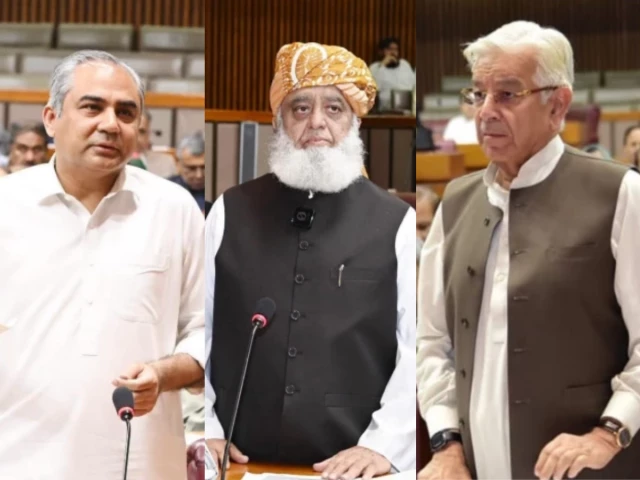
ISLAMABAD: Defence and interior ministers used both houses of parliament on Thursday to deny that this week’s talks in Tehran involved a defence pact, then turned on Maulana Fazlur Rehman, the religious party leader who has become one of the loudest critics of the federal takeover of Khyber Pakhtunkhwa (KP).
Khawaja Asif told the National Assembly that no pact was being negotiated in the Iranian capital and that Pakistan’s own defence was not discussed, which was why he had stayed at home. “No defence agreement was being negotiated in Tehran,” he said. Mohsin Naqvi, who did travel, told the Senate that Prime Minister Shehbaz Sharif had sent him.
The Tehran remark that provoked them was a sideline in a longer speech. On Wednesday, Rehman, who leads the Jamiat Ulema-i-Islam-Fazl (JUI-F), told the lower house that “a defence pact is taking shape in Iran” while the defence minister sat in the chamber. To laughter and desk-thumping, he asked whether the interior minister was “required there as well”. The main thrust of his address was that the government had misused the constitution by imposing governor’s rule and an emergency in KP, and that power had changed hands “by force”. He blamed Asif for failing to protect the constitution and parliament.
Both ministers answered the Tehran jibe first. Most of what followed was about KP and about the JUI-F leader himself.
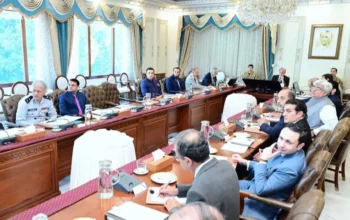
The meeting in Tehran was held on Monday and lasted about two hours. Pakistan, Saudi Arabia and Turkey, the three signatories to the Makkah defence pact, met Iranian President Masoud Pezeshkian and senior Iranian officials. Field Marshal Asim Munir, Pakistan’s army chief and chief of defence forces, sat alongside Saudi Defence Minister Prince Khalid bin Salman and Turkish intelligence chief Ibrahim Kalin. An AFP photograph of the talks shows Naqvi at the table. The participants agreed to “continue their dialogue to bolster cooperation among the four regional nations, including in the areas of regional peace and security”.
The talks took place against concern over Yemen’s Houthi attacks on Saudi Arabia, the security of the Strait of Hormuz and the prospect of renewed US and Israeli military action against Iran. Saudi Arabia said the visit was meant to support mediation by Qatar and Pakistan. Media reports said the agenda included a possible regional non-aggression framework, the resumption of US-Iran negotiations and the US naval blockade of Iranian ports. There was no immediate sign that any agreement had been reached. Iranian foreign ministry spokesman Esmaeil Baghaei said Field Marshal Munir had proposed the meeting during a visit to Tehran the previous week.
Asif said the field marshal went “as a messenger of peace” and had “assumed a role for Pakistan” after last year’s conflict with India, one of “peace and dialogue”. He said Pakistan had since signed two defence agreements, the Makkah pact and the Badr memorandum of understanding, and that he was involved in both as defence minister. Tehran, he said, was “not the defence ministry’s mandate” and he was “not needed” there. He added that the army chief had helped avert a deterioration over Yemen and that peace “may emerge in the coming days or week”.
The dispute underneath
The row over Tehran is the latest chapter in a confrontation that began three weeks ago. On Sunday 11 October, President Asif Ali Zardari signed a proclamation, on the prime minister’s advice, imposing an emergency and governor’s rule in KP, the province former prime minister Imran Khan’s PTI party had governed since 2013. The decision came days after the PTI began a long march towards Islamabad to demand the release of Khan, and after talks between the party and the government collapsed. The government cited the provincial administration’s “deliberate disengagement” from the fight against terrorism. Chief Minister Sohail Afridi and seven other PTI leaders were taken into protective custody. Ministers said the arrangement would initially last six months.
Until that Sunday, Rehman was a go-between. Local media reported that he had worked to reduce tensions between the federal and KP governments. He had advised the government to avoid governor’s rule and an emergency. In his National Assembly speech this week he gave his own account of the final hours. He said the prime minister had asked him to get the PTI to call off its march. He said Deputy Prime Minister Ishaq Dar then phoned twice on 11 October, the second time to say the cabinet would not agree and wanted governor’s rule imposed “at all costs”. The accounts of Thursday’s sittings do not show either minister answering that version of events.
Rehman’s criticism has reached the army’s role. On 20 October he rejected the government’s case for the takeover as baseless, questioned what repeated military operations had achieved, and alleged that the real aim was control of the province’s mineral wealth. He also said force was being used at the behest of powerful quarters, a phrase widely understood in Pakistani politics to mean the military establishment. He has alleged too that agreements with the United States were meant to open Pakistani resources to American investment. The JUI-F said it would send no member to the interim council set up to run the province.
The government rejects the mineral claim. Parliamentary Affairs Minister Tariq Fazal Chaudhry said on Wednesday that governor’s rule would last six months and that the emergency covered only a few districts hit by terrorism, then told Rehman to choose between the Pakistani state and the Pakistani Taliban.
Seen against that, Asif’s Thursday speech was a defence of the army chief’s diplomacy as much as of his own absence. He said opponents could say what they liked about the government but should not target its foreign and defence policies, and accused Rehman of “targeting our diplomatic efforts”. The two arguments overlap in one man. Field Marshal Munir is the figure the government credits with the Tehran initiative, and he heads the army whose operations in KP Rehman has questioned.
Blackmail” and “disgusting”
Asif called Wednesday’s speech “blackmail” and said that had the JUI-F been given a share of power in KP after the takeover, it would not have been delivered. Sitting in opposition, he said, was “a more respectable approach, rather than sitting with people who will blackmail you”. He listed Rehman’s past: membership of governments with every major party, service under General Pervez Musharraf, a spell as opposition leader and a decade chairing the Kashmir Committee. Of the committee he asked what had been achieved, and of Rehman’s offer to mediate with Kabul, “Were you the foreign minister?” Asif described the way Rehman became opposition leader as the product of a political deal. He said he did not “delete the past” himself, and added: “I am the only politician who has apologised for his past.”
When JUI-F members interrupted, he warned that he could reveal what they did under the PDM government. “They have turned religion and politics into a source of income,” he said. Told that some women lawmakers were defending Rehman, he said: “The Maulana now needs women’s support. He is unable to find a man.”
In the Senate, Naqvi said “a campaign has been going on against me for some time” and that he went to Tehran “to handle the ongoing crisis in Iran”. Rehman “did not know that this [trip] was not related to defence”, he said. “I do not go out of my own volition. I have been especially tasked by the prime minister sahib.”
He said his “heartfelt respect” for the JUI-F chief had ended over a remark about spitting on the state that he attributed to him. “For them, the state is like a mother until the day they can squeeze it dry,” he said. He claimed JUI-F figures had urged the government before governor’s rule to “rid us of them” and said he would prove it. He offered no evidence in the chamber, according to accounts of the sitting.
JUI-F Senator Kamran Murtaza objected repeatedly to Naqvi’s language. Presiding Officer Shahadat Awan expunged the word “disgusting”, used about earlier JUI-F remarks on institutions, and urged Murtaza to sit. Abid Sher Ali of the PML-N stood and shouted a reply until State Minister for Interior Tallal Chaudhry and the presiding officer told him to sit. Naqvi then addressed the JUI-F benches directly: “Now, you will not get jobs in the state. Now you will not get money from the state, nor will you get tickets from the state.” The party, he said, was “continuously crossing the line”.
The attack repeats one he made on 16 October. He said then that a party head was upset at being denied a role in KP’s new set-up and the governorship, and had depended on the establishment for decades. Rehman replied that seeking the governorship would be an insult to him and that he would demand the prime minister’s office instead.
Copyright © 2021 Independent Pakistan | All rights reserved