By Staff Reporter
One month after the United States and Israel began their joint assault on Iran, the question that matters most is not whether American power has inflicted damage. It has. The question is whether that damage has brought the United States any closer to the decisive outcome President Donald Trump once described as both necessary and inevitable.
A Pew Research Center survey published last week captured the domestic mood with dispiriting clarity. Sixty-one percent of Americans disapprove of Trump’s handling of the conflict; only 37 percent approve. The numbers track almost exactly with Trump’s broader approval rating, suggesting that opinions on the war are driven more by partisan reflex than battlefield developments. Seven in 10 Republicans support the White House’s conduct; barely one in 10 Democrats do. Yet even among Trump’s backers, a quieter unease is spreading: the sense that the United States may be winning the battles while steadily losing the larger contest.
By any conventional measure of attrition, the campaign has been punishing. Several top Iranian political and military leaders have been killed, including Supreme Leader Ayatollah Ali Khamenei. Iran’s air force and navy have been largely destroyed, its nuclear program set back years, its ballistic-missile forces degraded, and Hezbollah subjected to intense bombardment. On the ledger of raw destruction, the United States and Israel have imposed far heavier costs on Iran than Iran has managed to impose in return.
But the Islamic Republic still stands. Its regime has not collapsed. Its capacity to disrupt global trade and commerce remains intact. Tehran never imagined it could defeat the American military. Its strategic aims were always more modest: to survive, to disrupt, and to demonstrate that any attempt to break the regime would carry a price the world might refuse to pay. By those standards, Iran is succeeding—most notably by shutting the Strait of Hormuz without inflicting lasting damage on the United States itself.
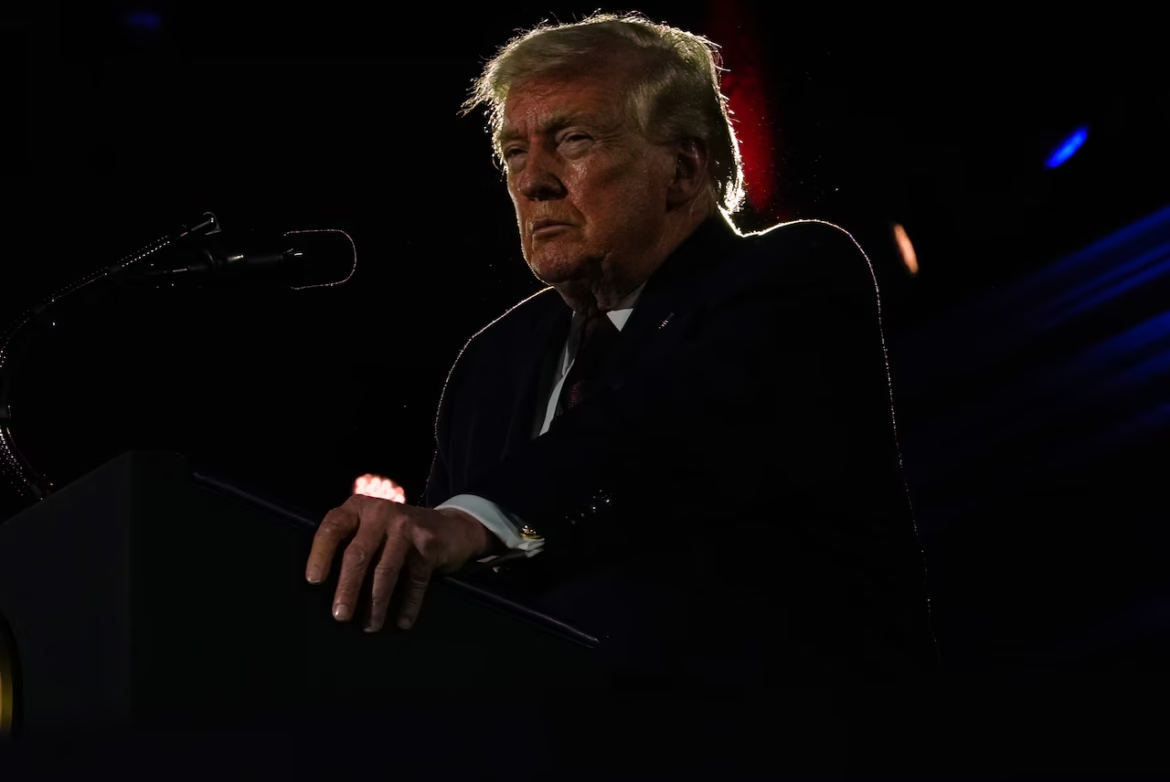
Trump’s visible frustration makes plain that he has been denied the quick, surgical operation he had hoped for. That frustration has now pushed the administration to weigh a far riskier step: the deployment of American ground forces onto Iranian territory. Such a move would dramatically escalate the war and risk turning it into the very protracted conflict Trump has long vowed to avoid.
Trump’s political objectives are clear. He wants Iran to see American boots on the ground as an unmistakable statement of American will. He wants regional allies to understand that the United States is not abandoning them. And he wants to resolve the central political quandary: how to bring the Iranians to the table quickly for negotiations that end the fighting on favorable terms. Militarily, the goals are equally specific: securing Iran’s stocks of enriched nuclear material, reopening the Strait of Hormuz, and conducting limited raids to seize refineries, bases, or islands that create leverage for diplomacy. Most of these operations would be short—hours or days at most.
Yet in war the enemy still gets a vote. Iran’s leaders have shown a deft hand at political maneuvering. Their paramount goal in any ground fight would almost certainly be the killing or capture of American soldiers and marines, images they calculate—probably correctly—would erode U.S. public support far more rapidly than any missile attack. Russia is already providing intelligence to Iran, and Iran’s vast terrain and 200-kilometer shoreline along the Strait of Hormuz would require far larger forces than currently contemplated to control.
As the strategist Rear Adm. J. C. Wylie wrote, “the ultimate determinant in war is the man on the scene with a gun.” Air and naval operations can degrade an adversary’s capabilities, but only sustained land combat can truly test its will. The danger for Trump is that limited raids, if they fail to deliver the political results he seeks, may erode American will instead of Iran’s.
Recent signals from the White House suggest the administration is already trying to manage expectations. Press Secretary Karoline Leavitt said Trump is “quite interested” in pressing Arab countries to help pay for the costs of the war and that private talks with Tehran are “going well.” Trump himself has warned that Iran’s energy plants and oil wells will be “obliterated” if the Strait of Hormuz is not reopened, yet he has also told aides he is prepared to wind down major combat operations even if the waterway remains largely closed. Secretary of State Marco Rubio struck a more measured tone, acknowledging that while new Iranian faces might prove more reasonable, the United States must prepare for the possibility they will not.
The United States has demonstrated its capacity to inflict overwhelming damage. It has not yet produced the strategic breakthrough it sought. Trump’s maximalist aims—regime change, the end of Iran’s missile program, the neutralisation of its proxies, and the permanent prevention of a nuclear weapon—remain unmet. The economic costs Iran has imposed on the world are equally sobering: jet fuel prices have risen 120 percent, Brent crude more than 87 percent, and natural gas in Europe more than 70 percent. The Strait of Hormuz, which normally carries one-fifth of global crude and liquefied natural gas, has been largely shut, raising the specter of simultaneous energy, semiconductor, and food crises.
A GeoPoll survey across six countries in Africa, the Middle East, and South Asia found that only 18 percent of respondents blame Iran for the conflict and its fallout; 29 percent blame the United States and 38 percent blame Israel. The campaign has also left the United States more isolated than when it began. Unlike the Iraq war, this one sought neither broad domestic nor international approval. Washington’s claim to lead a rules-based order has been undermined by the very rules it is seen to be breaking. To blunt rising oil prices, the Treasury Department lifted sanctions on Iranian and Russian crude, enriching both Tehran and Moscow—the latter now collecting an additional $150 million a day to fund its war in Ukraine.
A full reckoning can only come after the war ends. The United States may yet inflict further damage that alters this assessment. Each side will spin the outcome in its favour: Iran will celebrate its defiance, Israel will point to the temporary neutralisation of its enemies, and the administration will highlight its demonstration of brute strength. But even if the fighting stops tomorrow, the Islamic Republic’s survival will be read by its leaders as vindication. Future Iranian governments may well conclude that the most effective deterrent is the ability to impose immense costs on the global economy. Some may abandon the old nuclear fatwa and decide that a bomb is the ultimate insurance. The human toll—thousands dead, more than a million displaced—will be largely forgotten in the strategic ledger.
If the best this war can deliver is a pause before the next round, the question that will linger is painful in its simplicity: What, exactly, was it all for?
Copyright © 2021 Independent Pakistan | All rights reserved