By Staff Reporter
ISLAMABAD: The counterterrorism forces killed three militants linked to the banned Tehreek-e-Taliban Pakistan in an intelligence-based operation in the northwestern province of Khyber Pakhtunkhwa on Wednesday, officials said, as the country contends with a persistent wave of attacks that has claimed hundreds of lives in recent months.
The operation, carried out by the Khyber Pakhtunkhwa Counter-Terrorism Department in Dera Ismail Khan district, targeted members of what authorities call Fitna-al-Khawarij, a label applied to Tehreek-e-Taliban Pakistan terrorists. Acting on confirmed intelligence, teams surrounded the militants’ position early in the morning, prompting an exchange of fire when the suspects attempted to evade capture, according to a department statement.
The militants were killed in the ensuing retaliation, and their bodies were recovered and identified. Three Kalashnikov rifles, nine magazines, two hand grenades and several cartridges were seized from the site. The slain men had been directly involved in attacks on police and security forces, the statement said. “On the special instructions of the Inspector General of Police Khyber Pakhtunkhwa, targeted operations against Fitna-al-Khawarij have been intensified in response to the attacks on the police,” the department noted, adding that the scope of investigations and search operations had been expanded amid suspicions of additional terrorists and facilitators in the area.
Zulfiqar Hameed, the province’s inspector general of police, and the additional inspector general of the counterterrorism department praised the special weapons and tactics teams for their success. “He added that the response to attacks on police and security forces will be very severe and the struggle will continue until the last khawarij is destroyed,” the statement said.
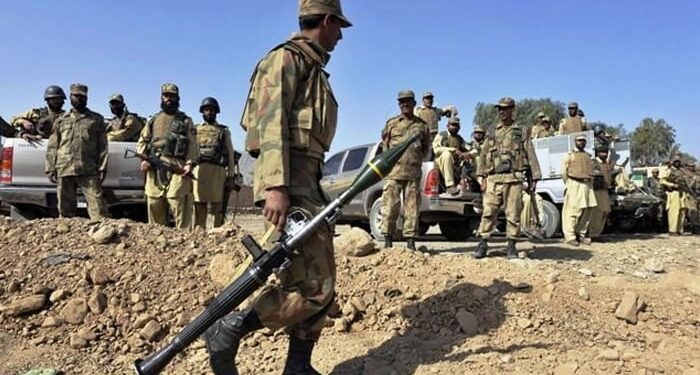
The raid follows a similar operation just days earlier in Balochistan’s Kalat district, where security forces killed four militants accused of Indian sponsorship on Jan. 12. Troops engaged the suspects’ location after reports of their presence, recovering weapons and ammunition in an intense firefight, the military’s Inter-Services Public Relations wing reported. The militants belonged to groups Pakistan terms “Fitna al Hindustan,” and sanitisation efforts continue to root out any remaining threats.
Balochistan, bordering Iran and Afghanistan, has endured a longstanding insurgency by Baloch separatist outfits like the Balochistan Liberation Army and Balochistan Liberation Front, which Islamabad alleges receive Indian support — a charge New Delhi rejects. In response, provincial authorities have launched an advanced threat assessment center to enable proactive prevention. “Information that was once scattered is now shared and acted upon in time, allowing the state to move from reacting after incidents to preventing them before they occur,” Hamza Shafqaat, Balochistan’s additional chief secretary, posted on X.
Pakistan’s border regions witnessed escalating violence, particularly since the Tehreek-e-Taliban Pakistan scrapped its ceasefire with the government in November 2022 and pledged to ramp up assaults. The group, along with Afghan-based militants, has been blamed for targeting security personnel, civilians and infrastructure in Khyber Pakhtunkhwa and Balochistan.
In a Jan. 6 briefing, Lt. Gen. Ahmed Sharif Chaudhry, director general of the Inter-Services Public Relations, outlined the scale of the challenge, revealing that forces conducted 75,175 intelligence-based operations nationwide in 2025, including 14,658 in Khyber Pakhtunkhwa and 58,778 in Balochistan. Those efforts addressed 5,397 terrorism incidents, with 3,811 in Khyber Pakhtunkhwa and 1,557 in Balochistan. Security forces eliminated 2,597 terrorists, including in 10 major attacks that involved Afghan militants and deliberately hit civilians and soft targets.
The toll has mounted rapidly in recent days. On Monday, at least nine people — seven police officers and two civilians — were killed in attacks in Tank and Dera Ismail Khan districts. Saturday saw security forces kill 11 terrorists in two operations in Khyber Pakhtunkhwa, but the day also brought losses: a counterterrorism official was gunned down by motorcyclists in Peshawar, and another was killed in Bannu.
The previous day, a policeman was slain in an ambush in Bajaur tribal district, and another died in a similar attack in Khyber. Last week in Bannu, three officers were injured when militants fired on a police vehicle escorting prisoners to Hangu, and a former tehsil nazim survived a bomb blast outside his office on Jan. 6. In another incident on Tuesday, militants killed four members of a pro-government peace committee in Bannu’s Huwaid area while they travelled in a car. The victims, identified as Naseeb Ur Rehman, Hamid Naseeb, Ziaullah and a man known as Fauji, were businessmen aiding anti-Taliban initiatives. “All four were businessmen and were actively involved with the Peace Committee in efforts against the Taliban,” said Raza Khan, deputy superintendent of police. These committees, formed during the 2007-2014 conflict to protect villages and monitor militants, remain prime targets for the Tehreek-e-Taliban Pakistan.
A day prior, an improvised explosive device in Tank district killed six police officers. While no claims of responsibility emerged for these strikes, the Tehreek-e-Taliban Pakistan has admitted to similar operations, including ambushes on convoys, stations and checkpoints, as well as official kidnappings. Pakistan accuses Afghanistan of harboring groups like the Tehreek-e-Taliban Pakistan and alleges Indian backing for insurgents, claims both Kabul and New Delhi deny. The military has pledged to sustain its “Azm e Istehkam” campaign unabated, aiming to eradicate foreign-sponsored terrorism entirely.
Copyright © 2021 Independent Pakistan | All rights reserved