By Staff Reporter
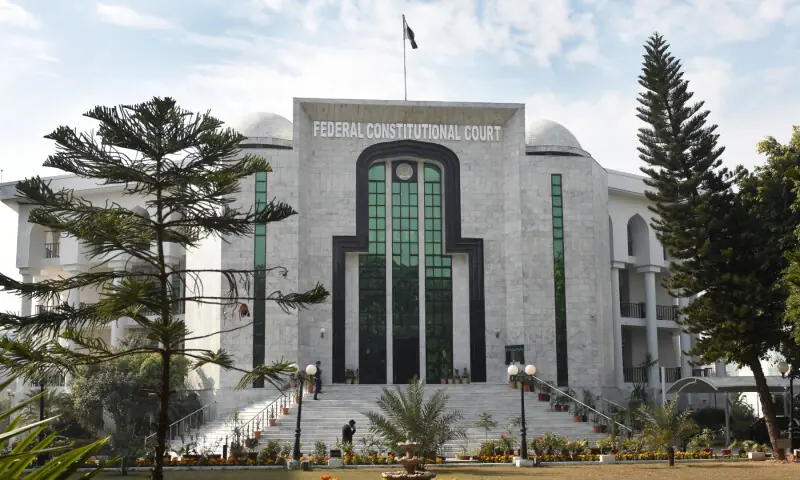
ISLAMABAD: The Federal Constitutional Court sided on Monday with a Chinese telecommunications giant in a ruling that could reshape how major corporations settle their tax obligations with the revenue authority, finding that companies can offset their super tax bills against available tax credits rather than being forced through a lengthier refund process.
The decision came from a two-judge bench led by FCC Chief Justice Aminuddin Khan, with Justice Aamer Farooq authoring the six-page judgment. The ruling reversed a March 25 order from the Islamabad High Court, which had rejected an identical claim by CM Pak Limited, the operator behind the Zong mobile network.
At the heart of the case was a technical but consequential question of tax law: whether Section 4C of the Income Tax Ordinance, which governs the super tax imposed on Pakistan’s highest-earning sectors, allows companies to apply tax credits under Section 168 directly against what they owe — or whether they must instead seek reimbursement later through the refund process outlined in Section 170.
Justice Farooq came down firmly on the side of adjustment. “We find no justification for holding that super tax paid under Section 4C of the Income Tax Ordinance is incapable of being adjusted where there is a tax credit under Section 168 of the ordinance, thereby compelling the taxpayer to pursue only the refund mechanism under Section 170,” he wrote.
The dispute traces back to February, when the Federal Board of Revenue moved to collect on the super tax obligation after the FCC had separately upheld the constitutionality of Section 4C in an earlier case. That earlier ruling had settled a broader legal fight over whether the tax — created by the National Assembly as an added levy on income in specified sectors — could survive constitutional scrutiny at all. Once that question was resolved, the FBR issued a notice demanding payment from CM Pak.
The telecom firm pushed back, arguing it was owed relief because of taxes already withheld. According to correspondence between the company and tax officials, CM Pak said it held Rs2.2 billion in excess taxes deducted at source from the 2022 tax year — money it argued should count against the new super tax bill. The FBR rejected that argument, and when CM Pak took the matter to the Islamabad High Court, the company lost there too, setting up Monday’s appeal to the constitutional court.
In his opinion, Justice Farooq worked through the statutory language line by line, rejecting the FBR’s narrower reading of how Section 4C interacts with the rest of the tax code. He noted that tax credits and refunds serve fundamentally different legal functions — the former operates as an offset against liability, while the latter requires a formal application to the tax commissioner under a separate, self-contained process.
The FBR’s position, Justice Farooq found, would have required the court to treat Section 4C’s reference to “all provisions of Chapter X” — the section of tax law governing credits, collection, and adjustment — as though it only incorporated procedural rules, ignoring the substantive credit mechanism laid out in Section 168. The judge rejected that reading as inconsistent with the plain text of the statute. He found no principled basis for such selective incorporation, adding that if Chapter X applied at all, its provisions had to be given full effect according to their terms, including Section 168 where relevant. Reading such a restriction into the law, he wrote, would amount to imposing a limitation the legislature never intended.
The court also pointed to the specific wording lawmakers chose in drafting Section 4C(3), which requires that the super tax be paid, collected, and deposited according to the timeline set out in Section 137(1), with all provisions of Chapter X applying as well. Because Section 137(1) already addresses the timing and mechanics of payment, Justice Farooq reasoned, the additional reference to Chapter X’s full scope must have been meant to do more — otherwise, the second phrase would serve no purpose at all. He wrote that reducing that later phrase to the same narrow procedural function as the first would render it redundant.
Had Parliament wanted to limit the incorporation to purely procedural matters, the court noted, it could have said so explicitly. Absent that kind of language, judges have no basis to impose the limit themselves, the ruling found.
With Monday’s decision, the FCC set aside the high court’s earlier order and cleared the way for CM Pak to press its adjustment claim before the appropriate tax authority, which will now have to evaluate the request under the terms laid out in the Income Tax Ordinance. The ruling is likely to reverberate well beyond the telecom sector, offering a legal template for other large taxpayers facing similar super tax bills and looking to apply existing credits rather than wait on the refund process.
Copyright © 2021 Independent Pakistan | All rights reserved