By Staff Reporter
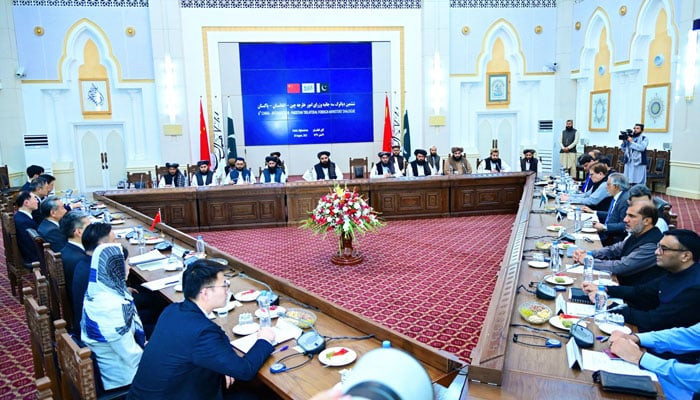
ISLAMABAD: Pakistan, China and Afghanistan pledged on Wednesday to step up their joint fight against terrorism and expand cooperation across a range of fields, from trade and transit to health and education, as their foreign ministers gathered in Kabul for high-level talks.
The commitments emerged from the sixth trilateral foreign ministers’ dialogue, involving Pakistan’s Deputy Prime Minister and Foreign Minister Ishaq Dar, China’s Wang Yi and Afghanistan’s Amir Khan Muttaqi, with discussions centering on political, economic and security ties.
“The three sides committed to strengthening joint efforts against terrorism. They also reaffirmed their commitment to deepening collaboration in trade, transit, regional development, health, education, culture, and combating drug trafficking, as well as extension of CPEC (China Pakistan Economic Corridor) to Afghanistan,” Pakistan’s Foreign Office said in a statement.
Ahead of the main session, Dar met Muttaqi on the sidelines for bilateral talks, where they highlighted the upward trajectory in political and economic relations between Islamabad and Kabul. The pair reaffirmed their dedication to close coordination on counter-terrorism and broader regional peace and stability, according to the Foreign Office. They hailed the recent upgrade in diplomatic ties, moving from charge d’affaires to full ambassadorial level, as a milestone in mending long-strained relations. Both sides expressed satisfaction that most agreements from prior engagements had been put into action or were close to fruition, bolstering bonds especially in trade and transit.
Dar “acknowledged the encouraging progress in political and commercial ties, while expressing that progress in the security domain, especially in counter-terrorism, continues to lag behind,” the Foreign Office said. He pointed to a fresh wave of terrorist strikes within Pakistan, blamed on outfits based in Afghanistan, and pressed Kabul to adopt “concrete and verifiable measures” against banned groups like the Tehreek-i-Taliban Pakistan and the Balochistan Liberation Army/Majeed Brigade.
In response, Muttaqi reiterated Afghanistan’s pledge that its soil would not serve as a launchpad for attacks by any terrorist entity against Pakistan or elsewhere, the Foreign Office added.
Dar had touched down in Kabul earlier in the day, greeted at the airport by Afghan Deputy Foreign Minister Dr Mohammad Naeem, other officials and Pakistan’s Ambassador Ubaidur Rehman Nizamani. The Kabul gathering revived the China-Afghanistan-Pakistan foreign ministers’ dialogue, dormant since 2023, building directly on groundwork laid in Beijing three months earlier.
On May 21, the same trio of ministers convened informally in the Chinese capital, sealing an agreement in principle to exchange ambassadors, a pivotal move toward normalising Islamabad’s dealings with the Taliban-led government in Kabul after years of friction.
Those Beijing discussions formed part of China’s push to defuse regional discord and promote connectivity under its Belt and Road Initiative, with Pakistan and China underscoring consensus on stretching the China-Pakistan Economic Corridor into Afghanistan. Beijing, eyeing stability and economic linkages in the neighbourhood, orchestrated the meeting to restart the stalled trilateral format.
Among the Beijing outcomes were vows to bolster security and anti-terrorism efforts, encompassing collective measures against militants and outside meddling, alongside a plan to reconvene formally in Kabul for the sixth round. That momentum followed an Afghan appeal earlier in May for “mutual respect and constructive engagement” with both Pakistan and China, as outlined in an interior ministry statement. The call came in the wake of a Kabul visit by special envoys Mohammad Sadiq from Pakistan and Yue Xiaoyong from China, who conferred with Afghan Interior Minister Sirajuddin Haqqani.
China’s Yi in Pakistan
Meanwhile, Chinese Foreign Minister Yi arrived in Islamabad on Wednesday to co-chair the sixth round of the China-Pakistan Foreign Ministers’ Strategic Dialogue, Pakistan’s foreign office announced, days after the top diplomat held high-level talks in India amid simmering regional tensions.
Wang’s visit follows his meetings in New Delhi on Monday with Indian Foreign Minister Subrahmanyam Jaishankar, National Security Adviser Ajit Doval, and Prime Minister Narendra Modi. The discussions focused on the contentious India-China border dispute in the Himalayan region, a longstanding issue that has strained ties between the two Asian powers.
The Chinese minister’s arrival in Pakistan also comes months after a brief but intense military standoff between India and Pakistan in May, during which Islamabad deployed Chinese-manufactured fighter jets and missiles in response to Delhi’s actions. India has alleged that Beijing provided active support to Pakistan’s military operations during the flare-up, a claim that has further complicated the regional dynamic.
Pakistan’s Deputy Prime Minister and Foreign Minister Ishaq Dar welcomed Wang upon his arrival in the capital, according to the foreign office.
“Mr. Wang Yi is visiting Pakistan to co-chair with DPM/FM the 6th round of Foreign Ministers’ Strategic Dialogue being held on 21 August 2025,” the foreign office said in a statement.
Established in 2017, the strategic dialogue serves as a high-level platform for both nations to discuss regional developments, reaffirm mutual interests, and coordinate on multilateral issues. The talks are expected to focus on deepening the “All-Weather Strategic Cooperative Partnership” between Beijing and Islamabad, a relationship Pakistan views as critical to its economic and geopolitical strategy.
China remains Pakistan’s largest trading partner, with bilateral trade surpassing $25 billion in recent years. The China-Pakistan Economic Corridor (CPEC), a flagship project of China’s Belt and Road Initiative, has seen significant Chinese investment in Pakistan’s power, transport, infrastructure, and telecommunications sectors. The multi-billion-dollar initiative has bolstered economic ties, though it has also drawn scrutiny over debt sustainability and regional security concerns.
Copyright © 2021 Independent Pakistan | All rights reserved