By Staff Reporter
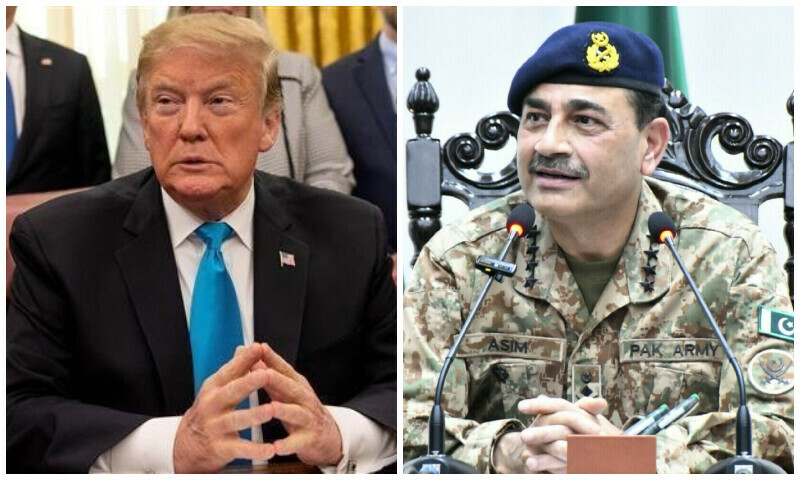
ISLAMABAD: President Trump again praised Pakistan’s top military leader, Field Marshal Syed Asim Munir, as a “highly respected general,” the latest in a string of compliments that underscore a striking thaw in relations between Washington and Islamabad during his administration.
The remarks came during a news conference at Trump’s Mar-a-Lago residence, where he also announced plans for a new class of heavily armed warships to be named in his honor, a distinction typically bestowed on former presidents. Asked about negotiations between Russia and Ukraine, Trump claimed his administration had “stopped eight wars” so far. “We stopped a potential nuclear war between Pakistan and India,” he said. “The head of Pakistan and a highly respected general — he is a field marshal — and also the prime minister of Pakistan said that President Trump saved 10 million lives, maybe more, by getting that war.” “You know, eight planes were shot down, the war was starting to rage,” the president added.
The praise for Field Marshal Munir, who serves as both chief of defence forces and chief of army staff, builds on a rapport that began with their meeting in Washington in June. On June 19, Trump hosted the Pakistani general for an unprecedented luncheon at the White House. Since then, the president has repeatedly singled out Field Marshal Munir for acclaim, at one point calling him “my favourite field marshal.”
In comments on Oct. 29, while discussing a trade deal with India and his admiration for Prime Minister Narendra Modi, Trump said of Pakistan’s leadership: “Likewise, the prime minister of Pakistan is a great guy, and the field marshal — they have a field marshal. You know why he’s a field marshal? He’s a great fighter. He really is. He’s a great guy, too.”
A day earlier, the president had highlighted Field Marshal Munir’s role in brokering a ceasefire after a May clash between Pakistan and India. That conflict erupted after an attack on tourists in occupied Kashmir, which India blamed on Pakistan without providing evidence. Pakistan rejected the accusations, with its foreign ministry dismissing India’s version as “replete with fabrications.”
The four-day fighting involved fighter jets, missiles, artillery and drones, resulting in dozens of deaths. Pakistan said it downed six Indian jets, including French-made Rafales; India admitted “some losses”. In September, Prime Minister Shehbaz Sharif told the United Nations General Assembly that his country’s air force had turned “seven of the Indian jets” into scrap and dust. Trump has variously described the episode as involving seven or eight aircraft shot down.
The evolving US-Pakistan dynamic has drawn attention from analysts, who see it as a pivot in American foreign policy toward South Asia. In an analysis published this week in The Financial Times, journalist Alec Russell hailed Field Marshal Munir as one of the most effective strategic leaders navigating shifts in the global order. “First prize for adjusting to the tempo of Trump’s casual approach to the world has to go to Pakistan’s Field Marshal Asim Munir,” Russell wrote.
He portrayed the general as a prime example of a “multi-aligner,” balancing ties across major powers. “He is the very model of a middle power multi-aligner, skipping from Washington to Beijing, Riyadh to Tehran.” The piece contrasted Pakistan’s agility with India’s struggles to adapt to Trump’s informal style and the changing geopolitical landscape. “All this is much to the frustration of India, which has not indulged Trump and is finding the middle power game is not as easy as it had hoped,” it said.
The Financial Times report followed a similar assessment in The Washington Times, which described 2025 as a turning point in US-Pakistan relations, marking a “dramatic shift” from suspicion to partnership. Retired Brig. Gen. Mark Kimmitt, a former deputy assistant secretary of defense for Near East and South Asia and assistant secretary of state for political-military affairs, wrote that at the year’s start, Pakistan was seen in Washington as aligned with the Taliban, politically unstable and diplomatically isolated. Its economy, still recovering from 2022-2023 floods and reliant on foreign aid, faced warnings of its gravest national security threats in decades.Yet by year’s end, General Kimmitt noted, Pakistan had transformed from “pariah to partner,” emerging as a “pillar of President Trump’s evolving foreign policy vision for South Asia.”
Senior Trump advisers initially viewed Pakistan warily, particularly over its China ties, expecting to prioritise India and the Quad alliance while marginalising Islamabad. The thaw began with “a series of discreet counterterrorism exchanges,” signaling Pakistan’s readiness for cooperation, according to the analysis. At the center was Field Marshal Munir, whose bond with Trump developed a “chemistry that advisers half-jokingly described as a budding bromance.” In Washington’s “newly fluid court politics,” the general was depicted as a “deliberate mystery, a disciplined dark horse who tightly manages his public image.” Pakistan, sensing opportunity, “leaned confidently into the attention.”
The White House luncheon marked a historic first for a Pakistani military chief. “The cameras loved the spectacle. Trump loved it even more, and the narrative surrounding Pakistan shifted almost overnight from suspicion and caution to fascination and celebration,” General Kimmitt wrote. Less than two months later, Field Marshal Munir visited US Central Command headquarters for talks with its outgoing commander, Gen. Michael Kurilla, and the chairman of the Joint Chiefs of Staff, Gen. Dan Caine. As 2026 approaches, General Kimmitt wrote, Pakistan occupies a central role in Trump’s strategy for South Asia and the Far East.
Copyright © 2021 Independent Pakistan | All rights reserved