By Staff Reporter
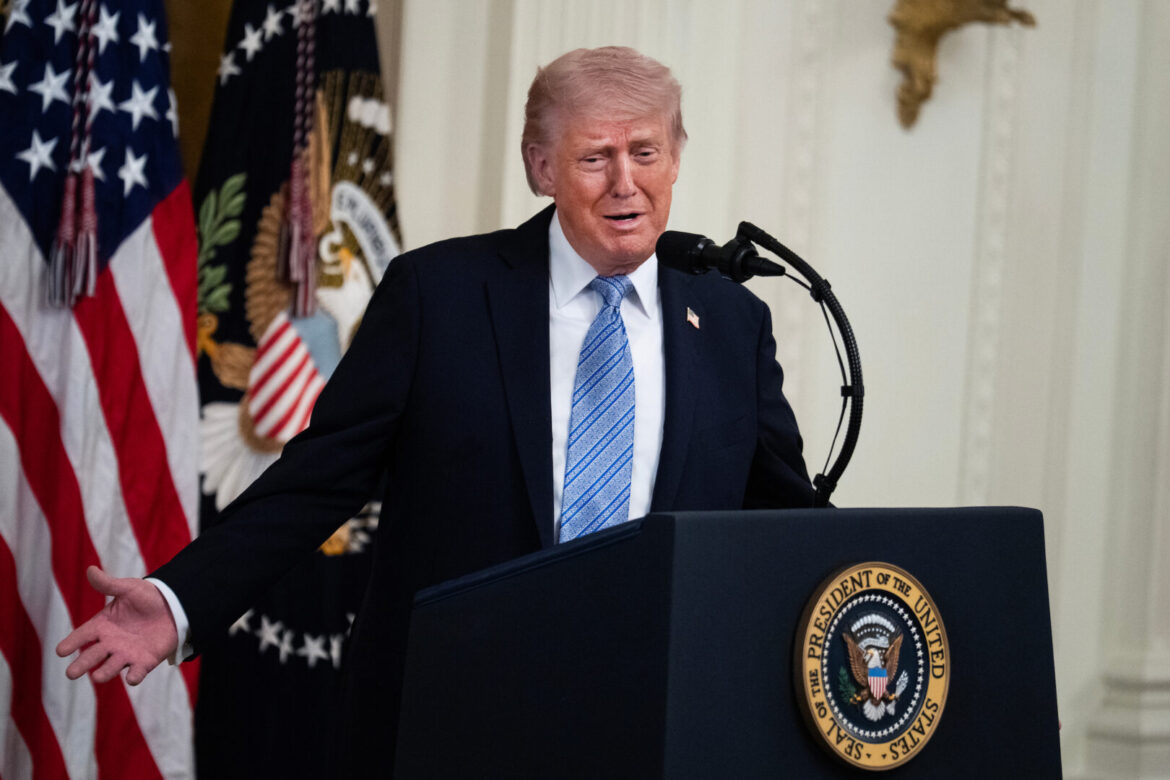
ISLAMABAD: With his secretary of state dangling the prospect of a historic breakthrough from halfway around the world, President Donald Trump on Sunday appeared to deliberately cool expectations of an imminent agreement with Iran, instructing his negotiators not to rush and insisting that the weight of the moment — and the pressure of America’s naval blockade — was working in Washington’s favor.
The whipsaw of signals came on a day of intense diplomatic activity, as American and Iranian officials edged closer to a framework that could end three months of war, reopen the Strait of Hormuz to global shipping, and begin what both sides hope will be a 60-day negotiating window over the most contentious issue of all: Iran’s nuclear program.
“The negotiations are proceeding in an orderly and constructive manner, and I have informed my representatives not to rush into a deal,” Trump wrote on Truth Social. “Time is on our side. The Blockade will remain in full force and effect until an agreement is reached, certified and signed.”
Hours earlier, Secretary of State Marco Rubio, speaking to reporters during a visit to New Delhi, had offered a strikingly different forecast. “I do think perhaps there is the possibility that in the next few hours the world will get some good news,” he said, adding that any agreement would start a “process that can ultimately leave us where the president wants us to be, and that is a world that no longer has to fear or worry about an Iranian nuclear weapon.”
The divergence illustrated the precarious, and at times contradictory, nature of negotiations that have stretched across three months of war, economic disruption, and shifting demands — and that now appear to be approaching either a turning point or another near miss.
A war born in February, a ceasefire holding by a thread
The conflict began on February 28, when the United States and Israel launched coordinated strikes on Iran, killing thousands of people, including the country’s supreme leader and other senior officials. Tehran responded by closing the Strait of Hormuz — the narrow chokepoint through which roughly one-fifth of the world’s oil and liquefied natural gas normally flows — effectively holding global energy markets hostage. Oil, gas, and food prices have spiked sharply in the months since, rattling economies from Tokyo to Berlin and dragging down Trump’s domestic approval ratings.
A ceasefire has been in place since April 7, though both sides have occasionally exchanged fire. The US Navy has maintained a blockade of Iranian ports throughout. Iran, in turn, has permitted only a fraction of normal shipping through the strait — Iranian Revolutionary Guard commanders said 33 vessels were allowed through in the past 24 hours, compared with roughly 140 on a typical pre-war day.
Even under optimistic scenarios, the damage to global energy flows will not be fully repaired quickly. The head of the Abu Dhabi National Oil Company said last week that full flows through the strait are unlikely to resume before the first or second quarter of 2027.
The outlines of a deal
Regional officials with knowledge of the negotiations told The Associated Press on Sunday that the United States and Iran are close to a framework agreement that would formally end the war, gradually reopen the Strait of Hormuz, and initiate a 60-day negotiating period over the remaining disputed issues, including sanctions relief and the fate of Iran’s nuclear stockpile.
Under the emerging terms, as described by Iranian state media and confirmed in broad strokes by regional officials, the US would agree to lift its naval blockade within 30 days, release a portion of Iran’s funds frozen under international sanctions, and allow Iran to sell oil and gas through sanctions waivers during the negotiating period. In exchange, Iran would restore normal passage through the strait under Iranian management — a formulation that Tehran’s advisers have insisted upon.
“Managing the Strait of Hormuz is Tehran’s legal right,” said Mohsen Rezaei, an adviser to Supreme Leader Ayatollah Mojtaba Khamenei, in remarks reported by Iranian state media. He said Iranian stewardship of the waterway “ends 50 years of insecurity in the Persian Gulf.”
On the nuclear question — the most fraught element of the entire negotiation — the emerging framework would defer substantive talks for 60 days following any deal. Iran holds 440.9 kilograms of uranium enriched to 60 percent purity, according to the International Atomic Energy Agency, a short technical step from the 90 percent threshold required for weapons-grade material. One regional official with direct knowledge of the talks said some of that stockpile would likely be diluted, while the rest could be transferred to a third country; Russia has offered to accept it.
Iranian President Masoud Pezeshkian told state television that his government was “still prepared to assure the world that we are not seeking nuclear weapons.” But his country’s foreign ministry has also reaffirmed what it calls an “inalienable” right to nuclear technology, and it was unclear Sunday whether any such assurance would be written into the text of an agreement. Iran’s embassy in India pointedly said as much in a social media response to Rubio’s remarks.
Netanyahu, the spoiler
The wild card hovering over the entire enterprise is Israel, which has its own history with Iran’s nuclear program, its own military equities in Lebanon, and its own direct line to the Oval Office.
Israeli Prime Minister Benjamin Netanyahu, in a statement posted Sunday on X, said he and Trump had spoken and had agreed that any final agreement must eliminate Iran’s nuclear capability entirely — not merely constrain it. “That means dismantling Iran’s nuclear enrichment sites and removing its enriched nuclear material from its territory,” he wrote. “President Trump also reaffirmed Israel’s right to defend itself against threats on every front, including Lebanon.”
A senior Israeli official, speaking on condition of anonymity, told AFP that Trump had made clear he “will not sign a final agreement absent these conditions.” Netanyahu also shared an image of himself and Trump standing back to back, captioned: “Iran will never have a bomb.”
Analysts watching the negotiations cautioned that Netanyahu’s public framing could complicate or even derail what the Americans and Iranians are attempting. Abdullah Bandar Al-Otaibi, an assistant professor at Qatar University, said Netanyahu’s statements amounted to a warning shot: “If this diplomatic framework fails to meet Israel’s standards, Israel is fully prepared to resume and expand military operations independently.”
Abbas Aslani, a senior research fellow at the Center for Middle East Strategic Studies, put it more bluntly. “Israel will likely use secondary fronts — such as Lebanon — to complicate the implementation process and provoke a reaction, hoping to force Washington to abandon the talks,” he said.
In Lebanon, the situation remains volatile. A US-brokered ceasefire took effect on April 17, but fighting has continued, concentrated in the south. Hezbollah has launched daily drone and rocket attacks on Israeli forces and northern Israel; Israel has struck targets across the country while maintaining a ground presence in large portions of the south. More than 3,000 people have been killed in Lebanon in the latest round of fighting, according to the Lebanese Health Ministry. Twenty-two Israeli soldiers and a defense contractor have been killed in or near southern Lebanon, along with two civilians in northern Israel, according to Netanyahu’s office.
Gila Gamliel, a Likud member and part of Netanyahu’s national security cabinet, described Israel’s posture as one of watchful hesitation. “We are taking a wait-and-see approach,” she told Israel’s Army Radio.
Iran’s mixed signals
Iranian officials have confirmed the existence of a draft framework but have been careful to manage domestic expectations, particularly given the scars left by a cycle of negotiations and military strikes over the past year.
Iran’s semi-official Tasnim News Agency, which has close ties to the Islamic Revolutionary Guard Corps, reported on Sunday that differences remained over one or two clauses of the draft, and said that “there would be no final understanding if the United States continued to create obstacles.” Foreign Ministry spokesman Esmail Baghaei said on Saturday that the week had brought “a reduction in disputes,” but acknowledged that “there are still issues that need to be discussed through mediators.”
Iranian-American scholar Vali Nasr, writing on social media, offered a more unsettling read of Tehran’s thinking. “The deal in play looks like a win for Iran,” he wrote. “But Tehran is not convinced that it is not a dress rehearsal for war now or in 30 days. In fact, the more generous the terms for Iran, the more the suspicion that the US is not serious about peace and wants to distract Iran ahead of another attack.”
Meanwhile, Ali Abdollahi, the head of Iran’s central military command, made a rare public appearance at Tehran’s Grand Mosalla mosque, telling the congregation: “We are on a war footing and all our armed forces are fully ready, with all their resources and equipment, to confront any enemy.” State media covered the appearance prominently.
From Tehran, Al Jazeera correspondent Resul Serdar said Iranians have been telling him they are open to diplomacy, but feel the American side keeps moving the goalposts. “Each time they are exchanging proposals and messages, the United States is coming up with new and excessive demands and also changing its position,” he said.
A regional coalition pushing for closure
In Washington, Trump said Saturday’s call with leaders from Saudi Arabia, the United Arab Emirates, Qatar, Egypt, Jordan, Turkey, Pakistan, and Bahrain had been “very good,” and that the regional partners had urged him toward the emerging framework. He thanked “all of the countries of the Middle East for their support and cooperation.”
Prime Minister Shehbaz Sharif, who mediated the first direct face-to-face talks between American and Iranian delegations in April, said Pakistan hopes to host another round “very soon.” Army chief, General Asim Munir — who traveled to Tehran on Friday and Saturday for talks with Iranian officials — also participated in Saturday’s call.
Oman, which has historically served as a backchannel between Washington and Tehran, was also active: Omani and Iranian officials held a meeting Sunday to discuss the principles governing freedom of navigation through the strait.
European leaders, anxious to see energy prices fall and the global economy stabilized, greeted the day’s developments with cautious optimism. European Commission President Ursula von der Leyen hailed “progress towards an agreement.” British Prime Minister Keir Starmer pledged to work with “international partners to seize this moment.”
Trump draws the contrast with Obama
Throughout Sunday’s social media posts, Trump was at pains to distinguish whatever is being negotiated from the 2015 Joint Comprehensive Plan of Action — the Obama-era nuclear accord that Trump withdrew from in his first term and has long pilloried as “one of the worst deals ever made by our Country.”
“Our negotiations represent the exact opposite of the terrible Obama JCPOA,” he wrote, calling that agreement “a direct path to Iran developing a Nuclear Weapon.” He added: “Our relationship with Iran is becoming a much more professional and productive one. They must understand, however, that they cannot develop or procure a Nuclear Weapon or Bomb.”
Whether the current talks produce something durable enough to withstand those competing pressures — from Israel, from Iran’s hardliners, from markets, and from Trump’s own political base — remains to be seen. Senior American officials have not elaborated on whether Sunday’s references to a deal concerned the interim memorandum of understanding still under negotiation, or the far more complex final peace settlement that would require months of additional work.
Trump, for his part, closed his Sunday message with a note of caution that, given the stakes, functioned almost as a warning. “Both sides must take their time and get it right,” he wrote. “There can be no mistakes.”
Copyright © 2021 Independent Pakistan | All rights reserved