By Staff Reporter
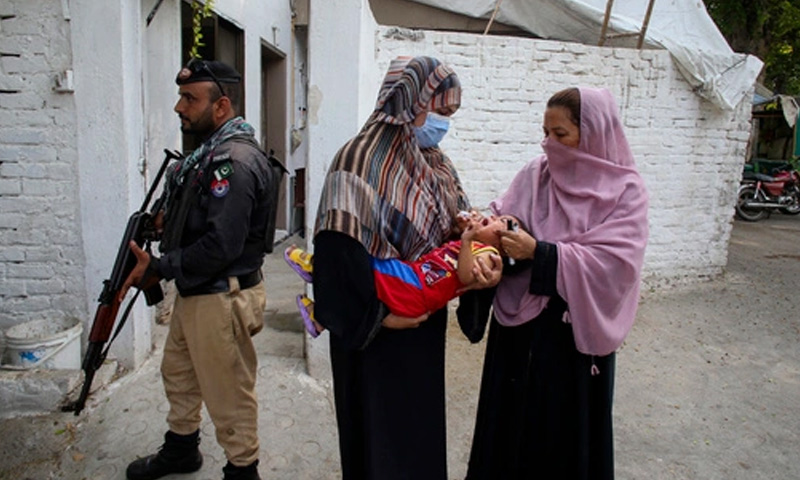
QUETTA: Two police constables were shot dead on Tuesday while guarding a team of female polio workers in the restive south-western province of Balochistan, in the latest attack on officers protecting vaccinators in one of the last countries where the disease remains endemic.
Constables Muhammad Yasir and Abdul Rauf were killed when gunmen on a motorcycle opened fire on them in Killi Jamal Abad, a neighbourhood roughly a mile and a half from the centre of Noshki city, according to Munawar Zaman, the city’s station house officer. The two men had been deployed to protect a team of health workers who were going door to door administering oral polio drops to children as part of a week-long national campaign that began on Monday.
Zaman said the polio team itself, made up of both male and female workers, escaped unharmed and was moved to a place of safety. The gunmen fled the scene after stripping the dead officers of their weapons, he added, and police have since cordoned off the area and launched a search operation for those responsible. No group had claimed the attack by Tuesday evening, and the anti-polio campaign in the immediate area has been suspended.
The killings came just a day into a sub-national immunisation drive covering 115 districts across Pakistan, in which more than 31 million children under the age of five are due to receive vaccine drops. In Balochistan alone, where the campaign is running across all 32 districts, officials are aiming to reach 2.3 million children, with the effort concentrated on high-risk areas after two positive environmental samples of the virus were recently detected in the province.
Balochistan’s chief minister, Sarfraz Bugti, ordered the provincial home department to produce a report on the incident and paid tribute to the two constables, saying they had given their lives in the line of duty. He said police were investigating to establish the motive behind the attack and identify those involved, and stressed that safeguarding the teams carrying out the national immunisation effort was of the utmost importance.
Tuesday’s killings extend a grim toll that has built up around Pakistan’s vaccination campaigns for years, but which has become markedly worse over the past twelve months. The same Noshki locality, Killi Jamalabad, was the scene of an almost identical attack in late May last year, when officer Waheed Ahmed, also guarding a polio team, was shot dead by unidentified assailants. A second officer was killed in similar circumstances the following month, in April 2025, in Balochistan’s Naseerabad district, while the vaccination team he had been guarding was on a lunch break.
The violence has been at least as severe in Khyber Pakhtunkhwa, the north-western province that neighbours Balochistan and shares its history of militant resistance to immunisation efforts. In May this year, two constables were killed within a single day in separate ambushes in the Bajaur district: Syed Aziz, shot in the Qila Nazakai area of Salarzai, and Syed Qadir Shah, shot while returning from polio duty in the nearby village of Tabei, who later died of his wounds. The attacks struck as a fresh week-long campaign was getting under way across 79 high-risk districts nationwide, targeting more than 19 million children.
The following month brought further bloodshed. In April, a police officer was killed and four of his colleagues wounded when gunmen attacked personnel guarding polio teams near Chapri Waziran in Hangu district; the dead officer, Israrul Haq, was a trainee constable from Shangla. The Kohat deputy inspector general said police killed two of the attackers in a retaliatory operation, though others escaped. Two days later, in Dera Murad Jamali in Balochistan, constable Farman Bashir Behrani was shot dead by motorcycle-borne gunmen as he stood guard outside a house where a team was vaccinating children. Weeks before that, in February, an officer guarding a polio team in the Roghani area of Chaman was fatally wounded in a similar attack; the vaccinators escaped unhurt.
The pattern was just as unrelenting through 2025. That year closed with an attack in Bajaur on 16 December, in which constable Sajjad and a civilian were killed when gunmen opened fire on a polio team in the Tangai area of Salarzai. The previous October had brought three separate attacks in Khyber Pakhtunkhwa within as many days: constable Maqsood was killed in Nizampur while female workers vaccinated children inside a house; a Levies constable, Abdul Kabeer, was shot dead in Swat despite additional security; and a third constable was killed in Nowshera by two gunmen, according to a local police official.
Behind the immediate violence lies a public health crisis that the attacks themselves continue to deepen. Pakistan’s most recent polio case was confirmed in an eight-month-old child in Bannu district, taking the national total for 2026 to four — three of them from the wider Bannu Division, an area where vaccination teams have struggled since last year to reach children consistently because of security constraints. Health officials say the virus’s persistence is directly linked to children missing vaccination rounds in precisely the areas where insecurity restricts access, with poliovirus continuing to circulate in southern Khyber Pakhtunkhwa even as transmission has fallen elsewhere.
The broader trend has nonetheless been one of steady improvement. Pakistan recorded 74 polio cases in 2024 and 31 in 2025, a marked decline attributed to sustained, high-quality vaccination coverage, though numbers remain well above the historic low of a single case recorded in 2021, itself down from 147 cases in 2019. Officials say that since September 2023 there has been a renewed uptick in polio activity, notably in Karachi, complicating what had looked like a decisive march towards eradication.
Pakistan and Afghanistan remain the only two countries in the world where the wild poliovirus has never been stopped. The disease is highly contagious and has no cure, and can leave children with lifelong paralysis or, in rare cases, kill them. It can, however, be reliably prevented: the oral vaccine used in Pakistan has been administered safely across 195 countries, including every Muslim-majority nation, and health authorities describe it as both safe and effective when children are able to receive it.
Copyright © 2021 Independent Pakistan | All rights reserved