“Pakistan needs massive financial support. This is not a matter of generosity; it is a matter of justice.”
By Staff Reporter
KARACHI: UN Secretary-General António Guterres reiterated that the needs in flood-ravaged Pakistan are enormous and called for urgent financial support, as he wrapped up a two-day trip aimed at raising awareness of the climate-driven disaster with flights over some of the hardest hit areas.
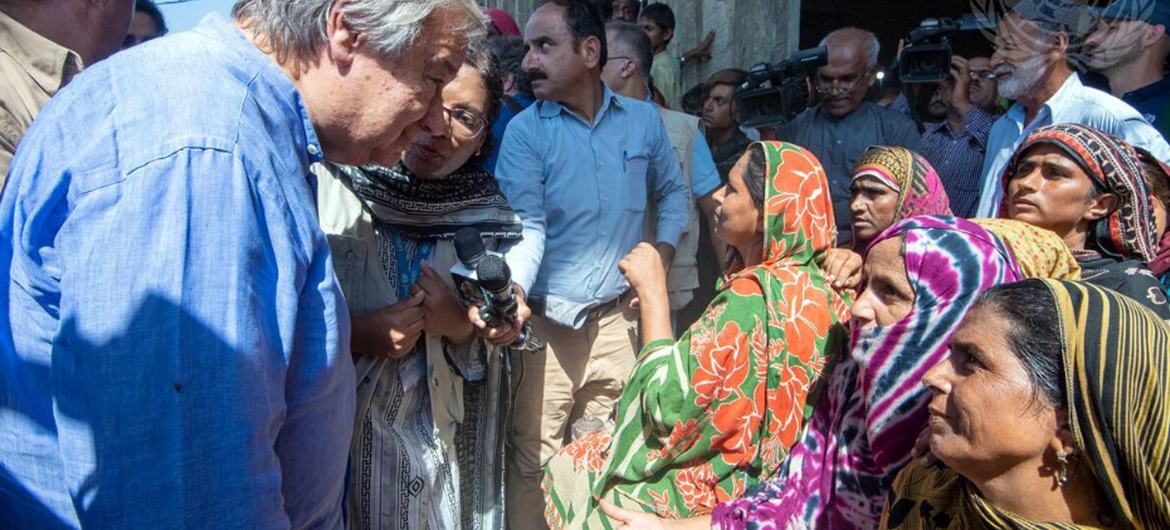
Guterres toured flood-affected areas of the district of Sukkur in southern Sindh province and Osta Mohammad in southwest Baluchistan province — some of the worst affected areas of the country.
He met with local residents, some of whom were directly impacted by the floods.
Record monsoon rains and glacier melt in the country’s northern mountains have triggered flash floods and rain-induced landslides that have killed at least 1,400 people, sweeping away houses, roads, railway tracks, bridges, livestock, and crops.
Huge areas are inundated, and hundreds of thousands of people have been forced from their homes. The government says the lives of nearly 33 million people have been disrupted. Pakistan estimates the damage at $30 billion, and both the government and Guterres have blamed the flooding on climate breakdown.
“I have seen many humanitarian disasters in the world, but I have never seen climate carnage on this scale. I have simply no words to describe what I have seen today: a flooded area that is three times the total area of my own country, Portugal,” Guterres told reporters as he concluded his field visits.
“Pakistan needs massive financial support. This is not a matter of generosity; it is a matter of justice.”
A video released by the government showed Guterres seated next to Prime Minister Shehbaz Sharif as they viewed flood-damaged areas from an aircraft window. “Unimaginable,” Guterres said, surveying the damage.
In July and August, Pakistan had 391mm (15.4in) of rain, or nearly 190 percent more than the 30-year average. Sindh province has seen 466 percent more rain than average.
Guterres said the world needed to understand the impact of climate breakdown on low-income countries.
“Humanity has been waging war on nature and nature strikes back,” he said.
“Nature strikes back in Sindh, but it was not Sindh that has made the emissions of greenhouse gases that have accelerated climate change so dramatically. There is a very unfair situation relative to the level of destruction.”
The Secretary-General paid tribute to the massive response efforts of the Pakistani authorities – civilian and military, national and regional.
“I also want to thank the civil society, humanitarian organizations, and my UN colleagues who have rushed in. I also want to take profit to thank all those donors who have started to support Pakistan in this terrible hour.”
In Karachi, Guterres said that climate change caused by human activity is supercharging storms and catastrophes in Pakistan, but also in Chad, the Horn of Africa with their terrible drought and the risk of famine, and beyond.
“All these countries did not cause the problem – but they are paying the price.”
These extreme weather events have the fingerprints of human activity all over them – specifically, the burning of fossil fuels heating our planet, he added.
He pointed that Pakistan is paying the price of something that was created by others.
“Today, it’s Pakistan. Tomorrow, it could be your country, wherever you live. This is a global crisis… it demands a global response,” UN chief said.
“Here from Pakistan, I want to reinforce a clear point: Wealthier countries are morally responsible for helping developing countries like Pakistan to recover from disasters like these, and to adapt, to build resilience to climate impacts that unfortunately will be repeated in the future.”
Copyright © 2021 Independent Pakistan | All rights reserved