By Staff Reporter
ISLAMABAD: Pakistan accused India of being a “regional bully” during a heated exchange at the United Nations General Assembly on Friday, responding to an Indian diplomat who branded Pakistan as “Terroristan” and accused it of harboring terrorism.
The verbal sparring, which unfolded on the fifth day of the 80th UNGA session in New York, highlighted the deepening rift between the two nuclear-armed neighbors, whose relations have deteriorated sharply since a military flare-up earlier this year. The episode came in the absence of the customary face-to-face confrontation between the countries’ prime ministers, but it nonetheless drew sharp rebukes in the Right of Reply segment.
Indian representative Rentala Srinivas fired the opening salvo, declaring: “No arguments or untruths can ever whitewash the crimes of Terroristan.”
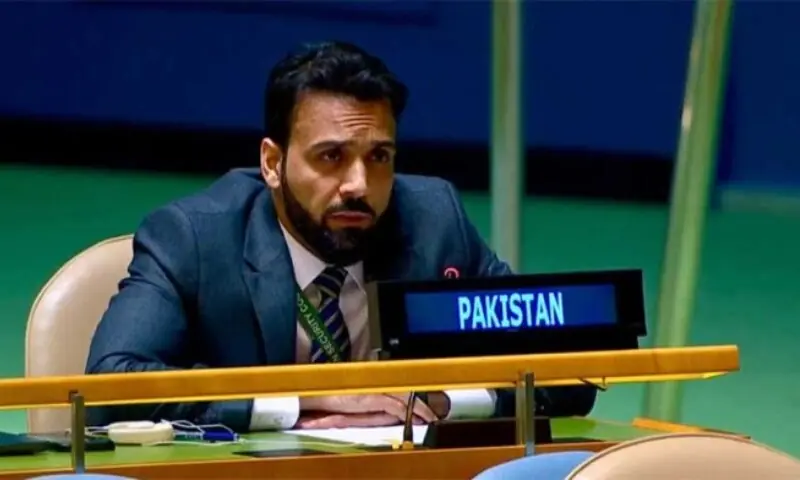
Muhammad Rashid, second secretary at the Pakistan Mission, swiftly condemned the remarks as “utterly shameful,” adding that India had stooped so low as to distort the name of a fellow UN member state. Refuting terrorism claims made earlier by Indian External Affairs Minister S. Jaishankar, Rashid called the distortion attempt “undignified” and went on to say that India itself “is not just a serial perpetrator of terrorism, but a regional bully that is holding South Asia hostage to its hegemonic designs and radical ideology.”
He urged the international community to pay attention to India’s “reckless behaviour.”
“By engaging in this kind of rhetoric, India diminishes its own credibility, showing the world that it has no substantive argument to offer—only, I am sorry to say, cheap slurs which are not worthy of serious discourse,” Rashid said.
Questioning the tone of the language, he added: “Such language reflects neither maturity nor responsibility. Instead, it exposes that India is frustrated and reveals its pettiness on the world stage.”
Rashid said India “itself has been implicated in supporting and sponsoring terrorism beyond its borders.” Calling it unfortunate, he said Indian “intelligence operatives have been accused of financing and directing groups engaged in sabotage and targeted killings across the world.” “Undermining regional stability and violating international law is a habit for India,” he said.
Rashid also noted that actions such as these “expose duplicity of India’s counterterrorism claims, and raise concern regarding India fuelling terrorism rather than combating it.”
He stressed that the claims made by Jaishankar were “completely devoid of facts” and an attempt to “malign” Pakistan’s name.
Outlining Pakistan’s losses in the fight against terrorism, Rashid highlighted that Pakistan is “one of the strongest pillars in leading global efforts for combating terrorism.”
On the other hand, India, the diplomat pointed out, “is in the league of those who illegally occupy territories, oppress populations and violate fundamental human rights, as is the case in Indian Illegally Occupied Jammu and Kashmir.”
“State terrorism — in the form of: extrajudicial killings, arbitrary arrests, detentions, staged encounters and collective punishment under the cover of counter terrorism,” he said.
While reaffirming Pakistan’s commitment to peace in South Asia, Rashid noted that “these goals cannot be achieved through threats and intimidation.”
On that note, he invited India to “embrace” peace, stating, “True progress requires sincerity, mutual respect, dialogue and diplomacy — principles Pakistan has upheld, and which India must finally choose to embrace, if it truly seeks peace.”
The exchange, reported Sunday by the Associated Press of Pakistan, underscores the long-fraught ties between the two countries, which have fought four wars since gaining independence from British rule in 1947. Earlier this year, a brief but intense military escalation erupted after India launched air strikes in Pakistan over the Pehalgam attack in occupied Kashmir, which killed more than two dozen people. Pakistan denied involvement, and the crisis eased following US intervention. Since then, relations have become exceedingly sour.
The back-and-forth followed an address to the UNGA on Friday by Pakistani Prime Minister Shehbaz Sharif, who highlighted the need for “proactive” rather than “provocative” leadership for South Asia, citing India’s recent aggression against Pakistan.
Copyright © 2021 Independent Pakistan | All rights reserved