By Staff Reporter
ISLAMABAD: The death toll from a suicide bombing at a Shiite mosque on the outskirts of the capital Islamabad rose to 36 on Saturday as more victims succumbed to their injuries, hospital officials said, while security forces arrested family members of the identified attacker and a key facilitator was reported killed in a raid.
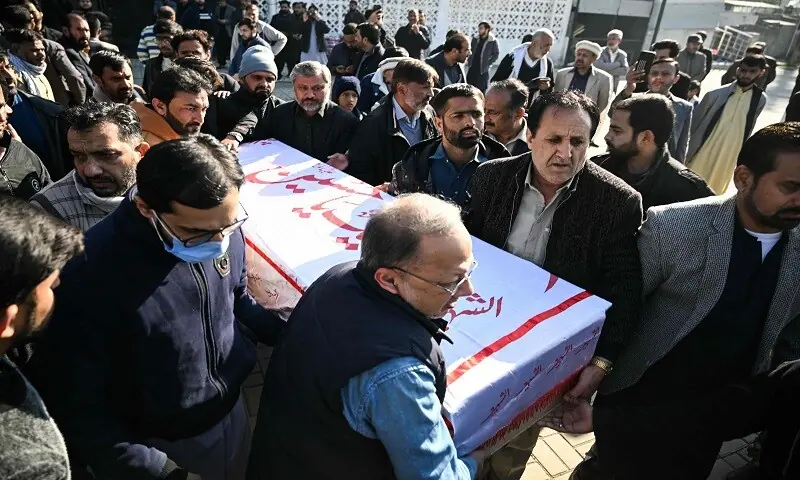
The explosion at the Imambargah Qasr-i-Khadijatul Kubra in the Tarlai Kalan suburb during Friday prayers had initially killed at least 31 people and injured 169 others. But by Saturday, officials at the Pakistan Institute of Medical Sciences (PIMS) confirmed the higher tally, with expectations it could climb further given the critical condition of several survivors.
“A 21-year-old man, who was brought from the imambargah, died,” said Dr. Aneeza Jalil, a spokesperson at PIMS, speaking to a local newspaper. She added that nine of the injured are in “very serious condition.” “The number of deaths has reached 33, and nine patients are in very serious condition,” Jalil said, noting that 149 injured and 28 bodies were brought to the hospital on Friday. Separately, Dr. Riaz Janjua at HBS Hospital confirmed three deaths from the attack were reported there.
The explosion tore through the Imambargah Khadijah-tul-Kubra in the Tarlai Kalan suburb during Friday prayers, with the bomber detonating his explosives near the last row of worshippers after being challenged by security guards at the entrance. Police said the attacker opened fire on the guards before rushing farther into the compound, injuring two of them.
The Islamic State claimed responsibility for the assault, which marked the second major bombing in Islamabad in recent months and heightened fears that militant groups operating along Pakistan’s volatile borders are expanding their reach into the heavily fortified capital. It followed a November suicide blast near a district courthouse that killed at least 12 and wounded dozens.
Shiite Muslims, a minority in predominantly Sunni Pakistan, have long been targeted by extremist groups, especially in border regions adjacent to Afghanistan. But large-scale sectarian violence in Islamabad has been relatively rare, making Friday’s assault a stark reminder of the country’s persistent security challenges.
A message from the ISIS-linked Amaq News Agency said the bomber fired on “temple (Mosque) guards” before detonating an explosive vest inside the mosque, according to the SITE Intelligence Group, which monitors jihadist organisations. The group published a translated copy of the message, in which Amaq praised the attack on the “central temple [mosque]” in Tarlai district, claiming it inflicted a “large number” of casualties among a “crowd of Shia.”
The claim was posted on “private communication channels of the Islamic State,” said Riccardo Valle, a security consultant at the research platform Khorasan Diary. Valle added that messages had also appeared on other official ISIS channels, and he shared screenshots of some postings. ISIS identified the attacker as “Sayf Allah al-Ansari,” releasing a photo of a masked man. The nom de guerre “Ansari” often indicates a local operative. The group claimed the assault in the name of its “Pakistan Province” branch via Telegram channels. “Attacking a Shia mosque with a suicide bomber is the archetypal ISIS attack, both for the extreme method employed and for the target, which is sectarian,” said Colin P. Clarke, executive director of the Soufan Center, a security research organisation.
Pakistani authorities, however, identified the bomber as Yasir, a 32-year-old resident of Peshawar’s Gunj area in the walled city, whose severed head was found at the scene. His identity card from the National Database and Registration Authority was recovered at the blast site.
Talal Chaudhry, Pakistan’s minister of state for interior, told reporters at a news conference that the attacker had been identified through forensic analysis but was not an Afghan national, though he had travelled to Afghanistan multiple times. Chaudhry did not disclose the man’s name or other details, saying investigators were still gathering evidence.
Chaudhry said militants were targeting “soft targets” like mosques and schools, often motivated by money rather than religion. “They are not carrying out attacks for religion, but for dollars,” he said, claiming Pakistan had evidence India had “tripled its investment” in terrorism. He pledged a detailed report within 72 hours, including on handlers, and affirmed commitment to the National Action Plan against terrorism. “We are a frontline state that is protecting the world,” Chaudhry said. “We are going to win this war, and we are winning this war.”
Security sources said the bomber had lived in Afghanistan for the past five months, receiving training in weapons and suicide tactics, and had undergone “extreme religious indoctrination” there before returning to Pakistan last year.
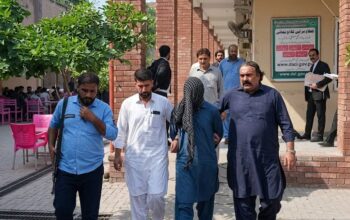
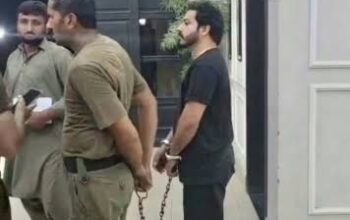
In a wave of operations launched across the country following the attack, officials arrested the bomber’s brother in Peshawar and his brother-in-law in Karachi. “The most significant arrest is that of the suicide bomber’s mother, who was detained from a house in a posh sector of Islamabad,” security sources said. A key facilitator of the bomber was killed in Nowshera. “Following the terrorist incident in Islamabad, security agencies have launched operations across the country,” the sources added. Searches continue in Peshawar and Nowshera to dismantle the bomber’s network.
Defence Minister Khawaja Muhammad Asif, in an interview with a private news channel, said the bomber was a Pakistani national who had visited Afghanistan several times in recent months. It was “not yet determined” which group was responsible, Asif said, but he suggested foreign involvement. In a social media post, he wrote that it had been “proven” the attacker travelled to and from Afghanistan, adding, “The collusion between India and Afghanistan is being revealed.”
Asif accused India of waging “war through proxies” after a “humiliating defeat” last year, vowing the state would respond “to this brutality with full force.” He linked the timing to Pakistan’s recent agreements with Kazakhstan and Uzbekistan and the revival of the Basant festival, calling it an attempt “to sabotage us and our progress.” “India cannot engage in an all-out clash with Pakistan, so it is using proxies and Afghanistan to disrupt peace here,” Asif said.
Mosharraf Zaidi, a spokesman for Prime Minister Shehbaz Sharif, repeated the accusations in a social media post, blaming India for using proxies to launch attacks inside Pakistan amid strengthening ties between New Delhi and Kabul. India’s foreign ministry condemned the bombing and sent condolences, rejecting the allegations as “baseless.” Afghanistan’s Taliban government also denounced the attack, with foreign ministry spokesman Abdul Qahar Balkhi calling it a “contradiction to Islamic and humanitarian values.” Balkhi described Asif’s comments as “regrettable,” saying the Pakistani minister “hastily attempted to attribute the incident to Afghanistan without presenting any credible evidence.”
Pakistan has long accused militant groups of using Afghan soil as a base for cross-border attacks, a charge Kabul denies. Last year, Islamabad expelled 900,000 Afghans and conducted airstrikes into Afghanistan, including Kabul, accusing the Taliban of aiding extremists. The Taliban insists the insurgency is Pakistan’s internal issue.
Eyewitness accounts painted a harrowing picture of the chaos. Zaheer Abbas, who was praying inside the mosque, told BBC Urdu he heard bullets before the blast. “After that, we bowed and then prostrated, and then there was an explosion,” Abbas said. “After which there were injured people lying everywhere.” Abbas said he “lost his senses” in the aftermath but was pulled out by emergency services and released from the hospital with minor injuries. “Fortunately, I did not suffer much injury.”
Muhammad Shakir, an Islamabad resident, said his uncle, Ishtiaq Butt, 63, died in the bombing. “My uncle was living a retired life and was a regular at the mosque,” Shakir said. “We are devastated by the loss.” Syed Ashfaq, the mosque’s caretaker who lives next door, heard gunfire and rushed to help. “By the time I reached it there had already been an explosion,” Ashfaq told the BBC. “Bodies were lying everywhere, some were missing arms, some missing legs. We took the most injured in our own vehicle [to hospital].”
Footage on social media showed scattered footwear, shattered glass, and people amid the wreckage. Several wounded lay on the lawn outside as rescue workers arrived. Hospitals across Islamabad, including the Pakistan Institute of Medical Sciences and Polyclinic Hospital, declared emergencies and appealed for blood donations. Pictures from local hospitals showed victims arriving by ambulances and private vehicles. Many of the injured were in critical condition, health officials said.
Tarlai Kalan, once a semirural area, has grown rapidly with Islamabad’s expanding population. Residents said the mosque was a key gathering place for the local Shiite community, especially during weekly prayers.
Prime Minister Sharif condemned the attack, expressing “deep grief” over the deaths and directing the interior ministry to investigate and identify those responsible. “No one will be allowed to disseminate chaos and unrest in the country,” he said. President Asif Ali Zardari called targeting innocent civilians “a crime against humanity,” praying for the injured’s recovery and directing top medical care for them. In a post on X, he noted international support, saying, “Such solidarity reinforces our shared stand against violence. Pakistan remains resolute in upholding peace, resilience & national unity.”
The bombing comes amid surging violence nationwide. Last week, 58 civilians were killed in coordinated attacks in Balochistan claimed by the Balochistan Liberation Army. The military reported killing over 200 militants in response. In Khyber Pakhtunkhwa, attacks by the Pakistani Taliban have intensified since the Taliban’s 2021 return to power in Afghanistan. Nearly 700 attacks killed over 1,000 people across Pakistan last year, more than half in the border province, according to the Pak Institute for Peace Studies.
A report by the Pakistan Institute for Conflict and Security Studies noted a 74% surge in combat-related deaths last year, with 3,413 total fatalities — up from 1,950 in 2024 — and militants accounting for over half. “The attack is a clear reminder that the reach of extremist violence is expanding,” said Syed Kaleem Imam, a former inspector general of Islamabad police. “Islamabad was never completely off the militants’ list of targets, and the attack reflects changes in intent rather than capability.”
Imam added that security operations had disrupted some groups but not eradicated their ideology or networks. “Their ideology and recruitment networks were not fully dismantled, and that weakness is now visible almost every day.”
Copyright © 2021 Independent Pakistan | All rights reserved