By Staff Reporter
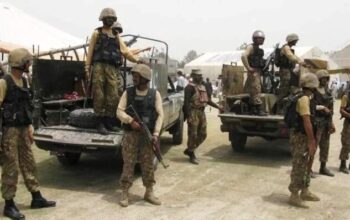
ISLAMABAD: Security forces clashed with militants in three fierce firefights along the rugged border with Afghanistan this week, leaving 19 soldiers martyred and 45 insurgents killed in the latest flare-up of violence in the country’s volatile northwest, the military said on Saturday.
The encounters, which unfolded over four days in the restive Khyber Pakhtunkhwa province, highlight the deepening security crisis Pakistan has grappled with since a tenuous truce with the Pakistani Taliban collapsed nearly three years ago.
The military’s media wing, the Inter-Services Public Relations, or ISPR, described the dead militants as members of “Fitna al Khwarij,” a term Islamabad uses to designate the banned Tehreek-i-Taliban Pakistan, or TTP, and to underscore its accusations of Indian sponsorship behind the group’s resurgence.
The ISPR detailed the operations in Bajaur, South Waziristan, and Lower Dir districts. The engagements targeted militants accused of orchestrating terrorist attacks, with Pakistan pointing to Afghan nationals’ involvement and expressing alarm over the use of Afghan territory to launch assaults.
In one operation, troops raided a TTP hideout in the Bajaur district, a mountainous area long plagued by cross-border militancy. “Twenty-two Indian-sponsored khwarij were sent to hell” in an intense exchange of fire during the intelligence-based operation, the ISPR said in a statement. Weapons and ammunition were recovered from the slain militants, who “remained actively involved in numerous terrorist activities in these areas,” it added.
The second clash erupted in neighboring South Waziristan district, where 13 more militants killed. “In an encounter that took place in South Waziristan District, thirteen more khwarij were neutralised by the security forces. However, during intense fire exchange, twelve brave sons of soil, having fought gallantly, paid the ultimate sacrifice and embraced shahadat,” the ISPR said, employing the Islamic term for martyrdom often used to honor fallen troops.
A third operation on September 11 in Lower Dir’s Lal Qilla Maidan area resulted in 10 militants killed and seven soldiers martyred. The fallen soldiers were identified as Naik Abdul Jalil (North Waziristan), Naik Gul Jan and Lance Naik Azmat Ullah (both Lakki Marwat), Sepoy Abdul Malik (Khyber), Sepoy Muhammad Amjad (Malakand), Sepoy Muhammad Dawood (Swabi), and Sepoy Fazal Qayum (Dera Ismail Khan). The military said its forces also freed civilians held hostage by the militants.
The 45 militants killed across the three sites were among a broader tally of “khwarij belonging to Indian proxy Fitna al Khwarij” eliminated in separate engagements from Sept. 10 to 13, according to the press release. Pakistan has similarly branded Balochistan-based separatist groups as “Fitna-al-Hindustan” to spotlight what it calls New Delhi’s hand in fomenting unrest and terrorism within its borders.
Prime Minister Shehbaz Sharif praised the military’s actions in a statement, lauding the forces for eliminating the 35 terrorists and paying tribute to the 12 soldiers who “fought with bravery.” He offered condolences to the families of the fallen and prayed for the martyrs’ “high ranks,” according to a press release from his office reported by the Associated Press of Pakistan. “In the fight against terrorism, the security forces were standing like a solid rock,” Sharif said, adding that the entire nation stood in tribute to them. The premier reiterated the government’s unwavering commitment “to eradicate terrorism of all kinds from the country.”
The bloodshed underscores the mounting pressures on Pakistan’s counterterrorism apparatus amid a surge in attacks concentrated in Khyber Pakhtunkhwa and neighboring Balochistan. Since the TTP ended its ceasefire with the government in November 2022 — vowing to intensify strikes against security forces, police and other law enforcement — militants have repeatedly ambushed troop convoys and outposts, alongside assassinations and abductions of officials.
Intelligence assessments, as cited by the military, point to Afghan nationals’ direct involvement in these assaults. “Intelligence reports have unequivocally confirmed physical involvement of Afghan nationals in these heinous acts. Besides, [the] use of Afghan soil against Pakistan by Fitna al Khawarij terrorists continues to remain a grave point of concern,” the ISPR said. Pakistan, which has long accused Kabul of harboring threats, renewed its call for action. “Pakistan expects the interim Afghan government to uphold its responsibilities and deny use of its soil for terrorist activities against Pakistan.”
Islamabad views the TTP and the Balochistan Liberation Army — the latter recently labeled a foreign terrorist organisation by the US State Department, as enduring perils originating from Afghan territory. In response, Pakistani forces have ramped up operations, with the ISPR announcing Saturday that “sanitisation operations are being conducted to eliminate any other Indian-sponsored khwarji found in the area.” “The security forces of Pakistan are determined to wipe out the menace of Indian-sponsored terrorism from the country and such sacrifices of our brave men further strengthen our resolve.”
This week’s toll follows a string of recent skirmishes. Earlier this month, six soldiers were killed and five militants slain as troops repelled an assault on the Frontier Corps headquarters in Bannu district. From Sept. 9 to 10, security forces reported killing 14 “Indian-sponsored khwarij” in Mohmand district, four in North Waziristan and one in Bannu. On Friday, four more “Indian-sponsored terrorists” died in an intelligence-based operation in Balochistan’s Mastung district.
Last month brought one of the deadliest episodes yet. Over four days, troops gunned down 50 militants in a bid to thwart their incursion from Afghanistan into Balochistan, according to the ISPR.
Copyright © 2021 Independent Pakistan | All rights reserved