By Staff Reporter
ISLAMABAD: At least 31 people were killed and 169 others injured when a suicide bomber detonated explosives inside a Shia mosque during Friday prayers in Islamabad, officials said, sharply revising earlier casualty figures in one of the deadliest attacks to hit Pakistan’s capital in recent years.
The explosion ripped through Imambargah Khadijah al-Kubra in the Tarlai area of Shehzad Town on the outskirts of the federal capital, where worshippers had gathered for the weekly congregation, according to police and district administration spokespeople.
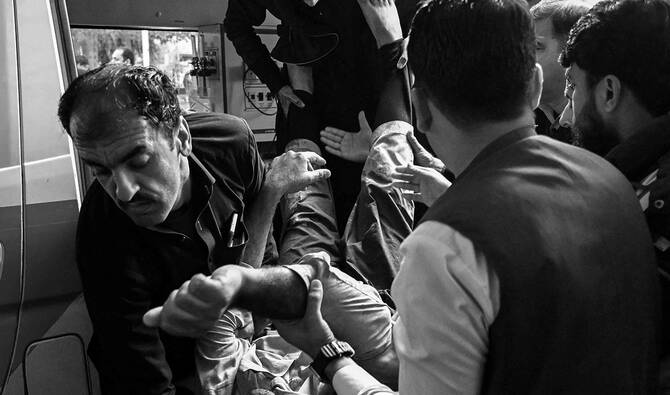
Images from the site showed bloodied bodies lying on the carpeted floor surrounded by shards of glass and debris, with dozens more wounded sprawled in the garden outside as panicked survivors called for help.
Police officials said terrorists linked to the outlawed Tehreek-e-Taliban Pakistan (TTP), also referred to as “Fitna al-Khawarij,” targeted the mosque. Eyewitnesses told a local broadcaster that the bomber was stopped at the entrance, leading to an exchange of fire before he ran about 20 metres inside and blew himself up amid the ongoing prayers.
The main door was at least 30 metres from the imambargah’s gate, and the blast used heavy explosives that damaged windowpanes of nearby homes and the three-storey mosque itself, with security guards also injured in the gunfire, eyewitnesses added.
Islamabad Capital Territory Police Spokesperson Taqi Jawad said signs pointed to a suicide bombing, though forensics teams were still ascertaining full details. He noted that among the dead was the cousin of Islamabad Inspector General of Police Syed Ali Nasir Rizvi, while another relative was injured. “The total number of fatalities from the blast has risen to 31,” a spokesperson for the Islamabad district administration said in a statement. “The number of injured brought to hospitals has reached 169.”
The Pakistan Institute of Medical Sciences (PIMS) administration said at least 18 bodies were brought to the hospital, along with more than 78 injured. Authorities at Rawalpindi’s Benazir Bhutto Hospital reported four injured were admitted, one of whom later died during treatment. Due to pressure on capital facilities, some injured were shifted to hospitals in other parts of Islamabad and neighbouring Rawalpindi, with PIMS stating it could not accommodate more patients.
Islamabad Deputy Commissioner Irfan Nawaz Memon said the blast site was completely sealed off by security personnel, including Pakistan Army troops and Rangers, who cordoned off the area as rescue operations began. Police and Rescue 1122 personnel initiated relief efforts immediately after the explosion.
An emergency was imposed at Polyclinic Hospital, PIMS, and the Capital Development Authority (CDA) Hospital, with assistant commissioners assigned to oversee treatment. On directives from the PIMS executive director, the main emergency, orthopaedic, burn centre and neurology departments were activated, a spokesperson said. The hospital appealed to citizens to donate blood.
Federal Health Minister Mustafa Kamal imposed an emergency across all federally administered government hospitals in the capital, cancelling leaves for doctors, nurses and paramedical staff. “Emergency services at PIMS and the Polyclinic are fully functional,” he said, adding that the government was utilising all available resources for treatment. Kamal condemned the suicide bombing as “highly deplorable,” saying those targeting innocent civilians were “enemies of humanity” and warning that negligence in care would not be tolerated.
In neighbouring Rawalpindi, police were placed on high alert, with officials checking security at imambargahs, mosques and other sites, according to a police statement. Meetings were held with administrators of religious places to review standard operating procedures.
Punjab Chief Minister Maryam Nawaz said in a post on X that the provincial government had dispatched 25 ambulances to Islamabad. She added that all hospitals in Rawalpindi district were on high alert, with surgical teams, anesthetists, orthopaedic and neurosurgical specialists on standby. “Blood banks are fully staffed, and operation theatres are fully equipped to ensure prompt and effective medical care for the injured,” Nawaz said, noting that the commissioner and deputy commissioner of Rawalpindi were instructed to provide every possible assistance.
The attack occurred as Uzbekistan President Shavkat Mirziyoyev was visiting Pakistan. President Asif Ali Zardari expressed deep grief over the blast, offering condolences to the families and praying for patience, according to a statement from his Pakistan Peoples Party on X. “Targeting innocent civilians is a crime against humanity,” he said, directing that all possible medical facilities be provided to the injured.
Prime Minister Shehbaz Sharif condemned the bombing, expressing sorrow over the deaths and sympathy for the bereaved. In a meeting with Interior Minister Mohsin Naqvi, he directed a thorough investigation to identify those responsible immediately and bring them to justice. Sharif instructed that the injured receive the best medical facilities, with the health minister personally monitoring the situation. “No one will be allowed to disseminate chaos and unrest in the country,” he said.
Deputy Prime Minister and Foreign Minister Ishaq Dar condemned the “cowardly suicide attack on innocent worshippers during Friday prayers at a Shia imambargah in Islamabad, killing dozens.” “Targeting places of worship and civilians is a heinous crime against humanity and a blatant violation of Islamic principles,” he said. “Pakistan stands united against terrorism in all its forms. This barbarity will not intimidate us and extremists will be brought to full account.”
Leader of the Opposition in the Senate Allama Raja Nasir Abbas expressed grief and condemned the “brutal and cowardly” attack, saying it raised major questions over the administration’s performance. “Targeting places of worship was a direct assault on humanity, religion and social values and could not be tolerated under any circumstances,” he said.
Iran’s Ambassador to Pakistan Reza Amiri condemned the attack, extending “sincere and deepest condolences” to the government and people of Pakistan, particularly the bereaved families. “Our thoughts and prayers are with the families who have lost their loved ones, and we pray for the safe and speedy recovery of the injured,” he wrote on X.
No group claimed responsibility for the blast, which comes amid a renewed surge in militant violence. Security forces recently gunned down 24 terrorists belonging to what officials described as an Indian proxy militant outfit linked to the TTP. The incident follows a suicide blast outside a district and sessions court building in Islamabad’s G-11 area on Nov. 11, 2025, which killed 12 people and injured more than 30 .It also comes days after attacks in Balochistan province, carried out by the Balochistan Liberation Army (BLA), which killed 36 civilians, including women and children, and 22 security personnel on Jan. 31 in areas including Quetta, Mastung, Nushki, Dalbandin, Kharan, Panjgur, Tump, Gwadar and Pasni.
A day earlier, the military concluded Operation Raddul Fitna 1, eliminating at least 216 terrorists, according to the Inter-Services Public Relations (ISPR). Islamabad has historically seen fewer militant attacks than Pakistan’s northwestern and southwestern regions, but Friday’s casualties heightened concerns about the capital’s vulnerability. Security remained on high alert, with investigations ongoing.
Copyright © 2021 Independent Pakistan | All rights reserved