By Staff Reporter
ISLAMABAD: Iran’s president declared on Monday that his country is now locked in “a full-scale war” with the United States, a stark public acknowledgment that came as American warplanes struck deeper into Iranian territory than at any point in months and Tehran’s own missiles reached as far as Syria, Jordan, and Kuwait.
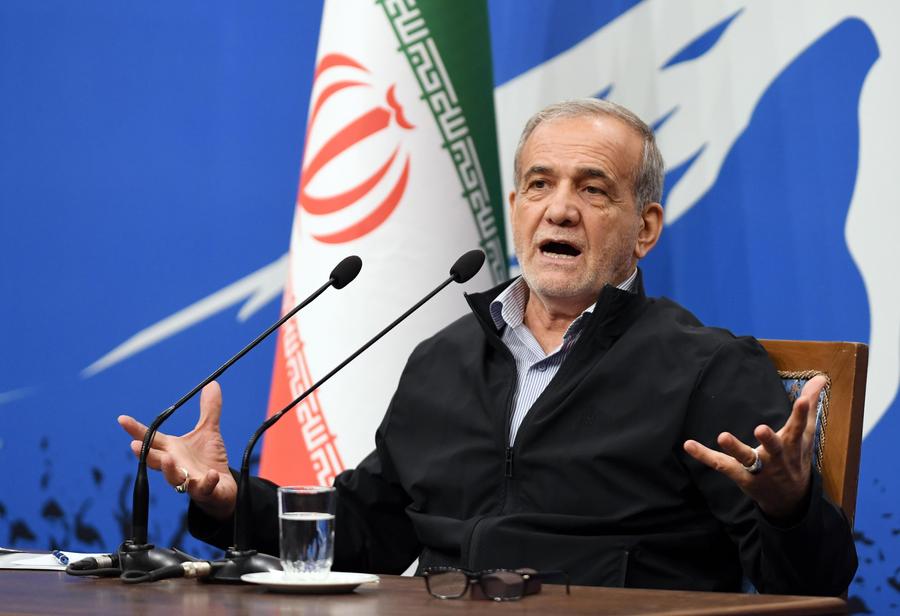
“The reality is that today the Islamic Republic of Iran is engaged in a full-scale war,” President Masoud Pezeshkian said, according to a statement from his office, adding that “we must be realistic and accept the natural consequences of this resistance.”
The declaration came on the ninth consecutive night of American strikes, which US Central Command said targeted Iranian military command centers, air defense and coastal surveillance sites, missile and drone launch positions, and communications networks. Unlike earlier rounds concentrated near the Strait of Hormuz, Monday’s bombing extended north and inland — to Tabriz, a city of roughly 520 kilometers from Tehran believed to house underground missile facilities run by Iran’s Revolutionary Guard Corps, and to Bushehr, home to Iran’s only operating civilian nuclear power plant.
“A few minutes ago, several locations in Bushehr city were hit by American enemy’s projectiles,” the province’s governor, Mohammad Mozaffari, told the state news agency IRNA. Iranian officials also reported strikes near Bandar Imam Khomeini in Khuzestan province and in Sirik, Jask, Konarak, and Chahbahar farther southeast, along the Gulf coast.
In East Azerbaijan province, home to Tabriz, the head of the local crisis management unit, Majid Farshi, told IRNA that one person had died and several others were wounded. Iran’s Foreign Ministry has said US strikes on the country’s civilian nuclear infrastructure — the Sunday bombing of a nuclear plant under construction in Darkhovin among them — serve no military purpose and are intended, in Tehran’s telling, to punish Iranian economic development.
The toll, and the dead on both sides
Iran’s health ministry said Friday that at least 50 people had been killed in the fighting and more than 500 wounded, a toll Iranian officials reiterated on Sunday. On the American side, the Pentagon confirmed three new service member deaths over the weekend — two killed in Iranian missile and drone strikes on Jordan on Friday, and a third who died in northern Iraq during the controlled detonation of an unexploded Iranian drone. A fourth American was reported missing in action. Those losses bring the confirmed US military death toll to 17 since the war began February 28 with a joint American-Israeli strike on Iran.
US President Donald Trump has warned Iran that it will pay “many times over” for every US soldier it killed, AFP reports, after Washington announced over the weekend three new military fatalities and one service member missing in action.
“Every time Iran kills an American Soldier they will pay for that killing many times over!” Trump posted on his platform, Truth Social. “This directive has been passed on to Secretary of War, Pete Hegseth, Chairman of the Joint Chiefs of Staff, Daniel Caine, and every Leader in the Military.”
Iran strikes back across the region
Iran’s Revolutionary Guards said on Monday they had struck US-linked targets in three countries overnight. In Syria, the Guards said they carried out “a surprise attack on the enemy special operations command centre” near Al-Tanf — notable chiefly because American troops withdrew from that base in February, months before the current round of fighting began. In Jordan, the Guards said ballistic missiles struck US military aircraft at Aqaba Airport, causing what a Guards statement called severe damage to several planes. And in Kuwait, the Guards said they destroyed an early-warning radar system tied to American forces there; Kuwait’s army said its air defenses engaged an incoming drone barrage.
Bahrain, which hosts the US Navy’s Fifth Fleet, sounded air raid sirens Monday morning and urged residents to seek shelter. Bahrain’s foreign ministry separately condemned what it described as Iranian drone strikes on the country’s civilian air traffic control systems, calling them a danger to ordinary air travel.
The Guards released video Monday afternoon showing four categories of ballistic missile — Kheibar Shekan, Fateh-110, Zolfaghar, and Emad — used in the latest strikes. One missile shown in the footage carried a message stenciled in Arabic and English: “Anyone who destabilises the security of the Iranian people will not themselves be safe either!”
Iran’s army spokesman, Mohammad Akraminia, framed the continued attacks as a deterrence strategy rather than open-ended escalation. “Wisdom dictates that war continues until it leads to full deterrence for the Iranian nation,” he said. “If that does not happen, the enemy will miscalculate again and commit an aggression against Iranian soil.”
A waterway under siege
The Strait of Hormuz, through which roughly a fifth of the world’s oil and gas passed before the war, has become the fighting’s central pressure point. Shipping through the strait has largely stalled. On Monday, a vessel caught fire in the strait after being struck near the Omani coastline; its crew abandoned ship, and the vessel was reported still burning hours later, according to the UK Maritime Trade Operations agency, a British military body that monitors regional shipping. A second ship was attacked later Monday off the coast of the United Arab Emirates, UKMTO said. Iran’s Revolutionary Guards said separately that two oil tankers attempting to transit the strait “exploded and were brought to a halt,” according to the semi-official Tasnim news agency.
The route around Oman’s coastline, avoiding Iranian-controlled waters, is the one American military officials have urged commercial shipping to use — a preference the Guards appear to have anticipated, having claimed responsibility for targeting tankers within the strait itself.
Both combatants have moved to choke the other’s maritime trade directly. Tehran reimposed its blockade of the strait as the ceasefire collapsed; Washington answered with a renewed naval blockade of Iran’s own ports, redirecting seven ships and disabling one in the past week, according to the US military.
Secretary of State Marco Rubio called Sunday on other nations to help shoulder the burden of protecting global shipping lanes. Iranian Foreign Ministry spokesman Esmaeil Baqaei responded Monday that Tehran would not permit the strait “to threaten Iran’s security and national interests” — an implicit rejection of outside efforts to guarantee safe passage without Iranian involvement.
A new front: Yemen’s Houthis
The conflict’s economic reach widened further Monday when Yemen’s Houthi movement, which is backed by Iran, announced a maritime embargo against Saudi Arabia, saying it would block shipping between the Red Sea and the Gulf of Aden. The Houthis said the move was retaliation for a strike on Sanaa International Airport last week, which they attributed to Saudi Arabia. Riyadh did not immediately respond to the announcement.
The threat carries particular weight because Saudi Arabia has been relying on a pipeline route to the Red Sea to move millions of barrels of oil to market while the Strait of Hormuz remains effectively closed — a relief valve the Houthis’ embargo now puts at risk. The group has demonstrated this capability before: during the war in Gaza, Houthi forces attacked more than 100 vessels in the Red Sea over several months.
Benchmark Brent crude traded Monday above $86 a barrel, and the average price of gasoline in the United States climbed to $4 a gallon — a level with obvious political stakes heading into this fall’s midterm elections. Trump has threatened to strike Iranian power stations and bridges to force Tehran to loosen its hold on the strait; the geography of Monday’s strikes, reaching well beyond the waterway itself, suggests that threat is now being carried out.
Ground invasion speculation
The scale and pattern of American bombing in southern Iran has fed speculation that US forces could be preparing for a ground offensive in the region, potentially including an assault on Kharg Island, the terminal from which Iran exports nearly all of its crude oil. Baqaei, the Foreign Ministry spokesman, said Monday that Iran was “counting down the minutes to welcome” American troops, a defiant framing rather than a confirmed warning of imminent invasion.
Analysts and Iranian commentators alike were skeptical such an operation could succeed. “It is very unlikely that they would be able to seize a place without much hardship, and then holding it would be another matter entirely,” a host on Iranian state television’s war-focused program Be Vaght-e Iran said, while acknowledging that “even if all of that happens, it would not be the end of the world.”
Despite the intensity of the fighting, both governments have signaled the door to negotiation remains open, if barely. Baqaei told reporters in Tehran that Iran had received unspecified proposals through intermediaries to end the renewed fighting — he would not say whether they involved a 10-day truce, as some American media have reported, only that “proposals have been raised through mediators and have been passed over to us.” He said Iran’s diplomatic and military tracks were moving in coordination, a comment that appeared aimed at recent reports of friction between hardline and more moderate factions within the Iranian government, and he called on countries in the region not to let American forces use their territory to stage attacks on Iran.
Rubio, for his part, said Sunday that Washington remains willing to talk, “but it has to be real.” He suggested a split may be forming among Iranian officials. “We’re going to continue to respond. If the door opens to diplomacy — if the guys that want to do something productive for Iran win and take control of that system, or take control of the negotiations — that’ll be a very positive development,” he said. “That’s not where we are tonight, unfortunately.” Washington has also said Iranian missile and drone strikes, which have now killed three American service members in the past week alone, remain an obstacle to any resumption of talks.
Mohammad Baqer Ghalibaf, the speaker of Iran’s parliament, dismissed the American overtures as insincere in a post on X Monday. “We have reached the level of a full professor on recognising these American games, and we’ve prepared ourselves on that basis,” he wrote. “Actions must confirm claims, not contradict them.”
Pezeshkian, addressing the collapsed June agreement directly during a Monday appearance in Tehran, defended the deal’s substance while acknowledging its cost. He said none of the memorandum’s 14 articles amounted to a retreat from the principles of the Islamic Republic or the country’s national interests. “We are prepared to give up our lives to defend the country and the interests of the nation, and we have no doubts in this path,” he said. “But at the same time, we must be realistic and accept the natural repercussions of this steadfastness as well” — a reference, he indicated, to the economic strain the country has absorbed since the war resumed.
The clearest public break with Tehran’s current posture came not from a government spokesman but from Mohammad Javad Zarif, the former Iranian foreign minister who helped bring the reformist Pezeshkian to power. In an essay published Monday in Foreign Affairs, Zarif argued the interim agreement had been doomed by unresolved disagreement over the Strait of Hormuz from the outset. “As the current conflict makes clear, Washington cannot eliminate the Iranian government,” he wrote. “Only diplomacy, a new peace agreement, and a new security framework produced by regional states and for regional states will allow the United States to turn its attention elsewhere.” But Zarif also cautioned his own government against overreach, writing that “if Iran repeatedly threatens maritime traffic, it could turn much of the world against it” — a rare public warning, from a figure closely tied to Iran’s reformist camp, that Tehran’s tactics risk costing it international sympathy even as it insists it is the aggrieved party.
Amid the widening violence, Pakistan pressed ahead with the diplomatic effort it has led since the war first erupted, working to revive the interim ceasefire reached last month, which had called for resolving the conflict’s remaining disputes within 60 days. Iran’s interior minister, Eskandar Momeni, arrived in Islamabad Monday for two days of talks. His Pakistani counterpart, Mohsin Naqvi, said he was optimistic the visit would produce progress; Momeni is scheduled to meet separately with Prime Minister Shehbaz Sharif and other senior officials during his stay. A Pakistani interior ministry source, speaking to a wire service ahead of the visit, confirmed Momeni’s travel plans but did not elaborate on what, specifically, the talks were meant to accomplish — leaving open whether Islamabad’s efforts this week amount to fresh momentum or simply an attempt to keep a fragile channel from going silent altogether.
Copyright © 2021 Independent Pakistan | All rights reserved