By Staff Reporter
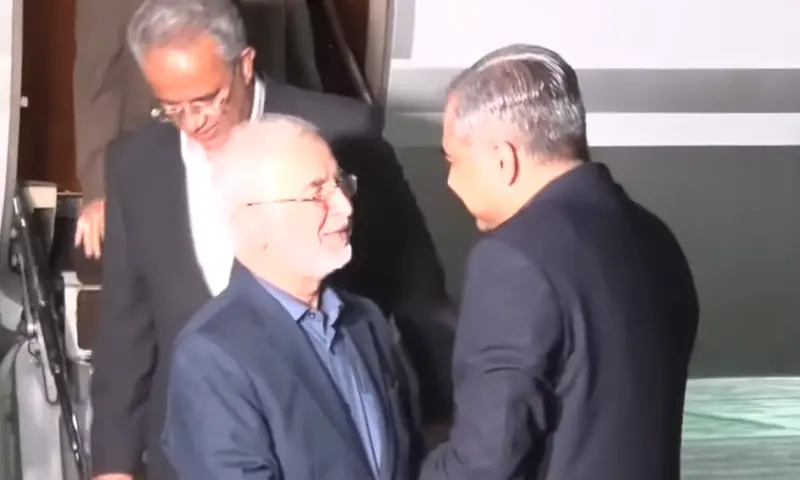
ISLAMABAD: Iran’s interior minister, Eskandar Momeni, arrived in Islamabad on Monday for two days of official talks, the latest step in Pakistan’s monthslong effort to keep alive a peace process between Iran and the United States.
Momeni left Tehran at the invitation of his Pakistani counterpart, Mohsin Naqvi, who has played a central role in mediating between Washington and Tehran. Naqvi received him at the airport, along with Iran’s ambassador to Pakistan, Reza Amiri Moghadam. Talal Chaudhry, Pakistan’s minister of state for interior, presented Momeni with a bouquet on arrival.
“Welcome to Pakistan,” Naqvi told him. According to a Pakistani foreign ministry statement, Naqvi told Momeni he hoped the Iranian minister had “brought good news,” adding: “We also hope for progress on the regional solution.”
Momeni is traveling with a large delegation. It includes the governor-general of Iran’s Sistan and Baluchestan province, a deputy interior minister, the deputy minister for urban development and transport, the head of the National Iranian Oil Company, and a special representative of Iran’s agriculture minister.
He is scheduled to meet separately with Prime Minister Shehbaz Sharif and with Field Marshal Syed Asim Munir, who holds the roles of chief of defence forces and chief of army staff. Officials said Momeni is carrying a message from Iranian President Masoud Pezeshkian on the current state of the conflict with the United States, part of what those officials described as close consultation between Tehran and Islamabad on regional developments.
Later Monday, Momeni and Naqvi met again in Islamabad. Momeni called Naqvi his “brother” and said he was glad to see him again. He described relations between the two countries as exemplary. “I have always appreciated the hospitality of the government and people of Pakistan,” Momeni said.
Naqvi said he was confident the visit would strengthen cooperation between the two countries.
The visit is Momeni’s latest contact with Pakistani officials. He and Naqvi have met several times in recent months, including during a Naqvi trip to Tehran, when the Iranian side’s visit to Islamabad was first arranged. Those meetings have covered border security, counterterrorism cooperation, immigration, and cross-border trade.
One item on this visit’s agenda, according to Pakistani officials, is the transit of Pakistani pilgrims through Iranian territory ahead of Arbaeen, the annual Shiite observance that draws large numbers of travelers through the region each year. The two sides are expected to discuss security and coordination measures for that travel.
Pakistan has led mediation between Iran and the United States since the war between the two countries began February 28. It hosted direct talks between American and Iranian officials in April and helped broker the Islamabad Memorandum of Understanding, signed by the US and Iran on June 18, alongside Qatar. That agreement was followed by a further round of talks in Bürgenstock, Switzerland, where negotiators set up a High-Level Committee and a 60-day roadmap covering Iran’s nuclear program, sanctions relief, and a mechanism for resolving future disputes.
The agreement has since come under strain. Fighting between Iran and the United States resumed this month, and both governments have accused the other of violating its terms. Pakistan has said it will continue pressing both sides to return to the memorandum’s terms and has called for restraint.
A Pakistani interior ministry official, speaking to AFP said Momeni would hold talks with Pakistani officials but did not elaborate on whether the visit was tied to Pakistan’s broader mediation role.
Iran’s foreign ministry has said diplomatic exchanges with the United States, conducted through intermediaries, are continuing despite the resumption of fighting. Foreign ministry spokesman Esmaeil Baqaei said Monday that Tehran had received proposals through mediators to end the renewed conflict, though he did not disclose their contents or say whether they involved a 10-day truce, as some American media have reported.
Pakistan’s balancing act in the region has grown more difficult in recent weeks. Islamabad maintains a longstanding defense partnership with Saudi Arabia even as it works to mediate between Iran and the United States, and renewed attacks by Yemen’s Houthi movement — which is aligned with Iran — on Saudi Arabia have raised concern about the conflict widening further. Pakistani officials have said dialogue remains the only realistic path to preventing a broader regional war.
Copyright © 2021 Independent Pakistan | All rights reserved