By Staff Reporter
ISLAMABAD: The United States and Iran traded strikes for an eighth straight day on Sunday, plunging the Middle East deeper into open warfare after an Iranian missile and drone attack on a US air base in Jordan left two American service members dead and a third missing.
The attack, which struck Muwaffaq Salti Air Base in Jordan late Friday, marked the first US combat deaths from direct Iranian fire since March, according to US Central Command. Four additional service members were medically evacuated to hospitals in Jordan but have since been discharged, and others were treated for minor injuries and returned to duty. CENTCOM said it would withhold the names of the fallen until 24 hours after their families are notified.
By Sunday evening, the death toll for American forces since the war began Feb. 28 had climbed to at least 16, with more than 430 wounded, according to US officials.
US President Donald Trump, in a telephone interview with a NewsNation reporter, called the deaths “very sad, it’s a very sad thing.” “We hate to see it happen. It’s in service to our country,” and reiterated his position that the United States will never allow Iran to acquire a nuclear weapon.
US Central Command said American forces launched a new wave of airstrikes beginning at 6 p.m. Saturday, at Trump’s direction, aimed at Iranian military assets tied to the Jordan attack and to Tehran’s broader campaign against shipping in the Strait of Hormuz.
“CENTCOM forces successfully hit Iranian military coastal surveillance and air defense facilities, maritime capabilities, and missile and drone storage sites to continue degrading Iranian military capabilities,” the command said in a statement posted to X. “American military assets also targeted Islamic Revolutionary Guard Corps forces that launched attacks against US service members in Jordan on July 17.”
Iranian state media reported strikes overnight near Sirik and Qeshm Island, both along the strait, as well as near Hajjiabad in Hormozgan province, where residents reported hearing explosions in the port city of Bandar Abbas. No casualties were reported from those strikes, according to Iran’s Mehr and IRNA news agencies. An under-construction nuclear power facility in the southwestern city of Darkhoveyn was also reported hit.
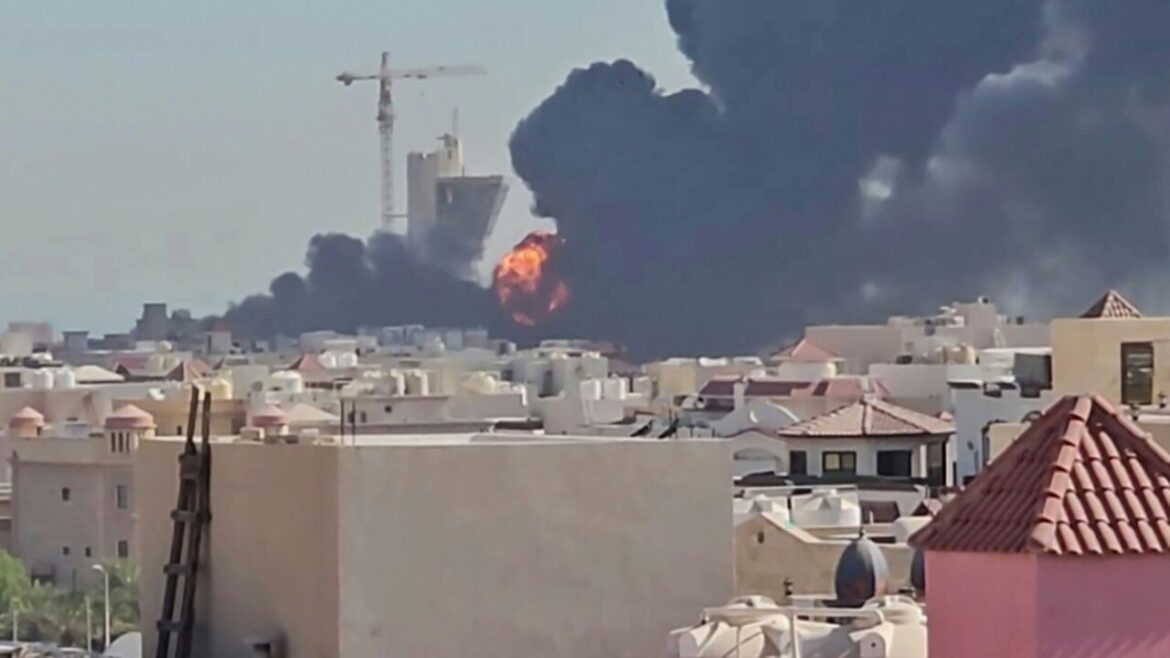
The exchange has now drawn in much of the Gulf. Kuwait said Sunday that an electrical and water desalination plant northeast of Kuwait City was struck for the second consecutive day, sparking a fire that firefighters worked through the morning to contain. The country’s Ministry of Electricity, Water and Renewable Energy called it a “heinous” act of aggression. Kuwait’s military said its air defenses were actively engaging Iranian missiles and drones, and air raid sirens sounded across Kuwait City.
In Bahrain, home to the US Navy’s Fifth Fleet, the military said it “confronted, intercepted, and destroyed a number of treacherous Iranian aerial attacks” and accused Tehran of deliberately targeting civilians. Explosions were reported in the north of the country, and sirens rang out over the capital, Manama.
Iran’s army said separately that it had carried out “large-scale attacks with kamikaze drones” against a US ammunition depot at Camp Udairi and against radar systems at Ali Al Salem Air Base, both in Kuwait, according to Iranian state television. A drone strike also hit a base belonging to the Kurdistan Freedom Party, an Iranian Kurdish dissident group, near the northern Iraqi city of Irbil early Sunday, wounding eight of its members, a military official with the group said. No group claimed responsibility, though both Iran and Iran-aligned militias in Iraq have struck the Kurdish region before.
Missiles fall near Jordan-Israel border
The fighting also spilled toward Jordan’s southern coast. Jordan’s state broadcaster said the country’s air defenses intercepted three Iranian missiles Sunday, while a fourth fell in a remote area of southern Jordan without causing casualties or damage. Some reports suggested the missiles were aimed at US military aircraft based near Aqaba, Jordan’s coastal city bordering the Israeli resort town of Eilat.
Israel’s military said it launched interceptors at missile debris to keep it from falling on Israeli territory, and that fragments were later found near Eilat. No damage or injuries were reported there. Israeli broadcasters reported that the US military evacuated refueling aircraft from Ramon Airport, north of Eilat, and that commercial flights out of the airport were delayed.
The US Embassy in Amman issued a security alert Sunday saying Jordanian authorities had evacuated Aqaba’s international airport and seaport over what it described as a “specific and credible threat.” Jordanian officials pushed back on that account. Government spokesman Mohammad Al-Momani said in a statement that no threats had been recorded by Jordanian authorities and that “the airport and port are operating normally.”
A ceasefire in name only
The renewed violence has all but finished off a fragile ceasefire brokered by Pakistan and signed in Switzerland last month, which had been intended to permanently end the fighting and reopen the Strait of Hormuz to commercial traffic. Trump declared the agreement “over” on July 8.
Iran’s deputy foreign minister, Kazem Gharibabadi, said Saturday that Tehran had suspended its own commitments under the deal in response to what he called American violations. “The United States has violated and suspended all of its commitments under the Islamabad Memorandum of Understanding,” he told state television. “We have also suspended our commitments; we are not implementing them and are busy defending our country.”
Asked about Iran’s announcement, Trump told a NewsNation reporter, “I couldn’t care less.”
Iran’s supreme leader, Mojtaba Khamenei, who has not appeared publicly since the war began, issued a written statement carried by state broadcaster IRIB warning of “unforgettable lessons” for the United States and its regional partners, whom he described collectively as the “Axis of Resistance.” He said repeated American strikes had exposed “a fundamental truth: the signature of the US president is utterly worthless and devoid of credibility.”
Blockade, closure, and a widening economic toll
Washington has reimposed a naval blockade on Iranian ports intended to choke off Tehran’s oil exports; the military said Saturday it had redirected five ships and disabled a sixth since the blockade resumed. Iran, in turn, has declared the Strait of Hormuz closed to shipping, and the Revolutionary Guard said Saturday it had blocked four vessels attempting to transit the strait under American protection. The Guard also claimed two ships had been involved in what it called “an accident” after ignoring Iranian warnings, and cautioned that any vessel “influenced” by the United States using “unsafe routes” would “certainly face accidents.”
Energy Secretary Chris Wright sought to tamp down fears of a broader supply disruption in an appearance Sunday on ABC News’ “This Week.” He said flow through the strait remained close to 7 million barrels a day, with a similar volume moving through overland bypass pipelines, and disputed reports of a sharp falloff in vessel traffic. “Almost all the public data I’ve seen is incorrect,” he said. The research firm Kpler had reported Friday that crossings through the strait fell to just eight vessels on Thursday.
Gasoline prices in the United States have continued climbing regardless. The national average stood at $3.99 a gallon Sunday, according to AAA, up from $3.87 a week earlier. Oil prices rose sharply Friday amid the escalating unrest.
Iran reports rising civilian toll
Iran’s Health Ministry said Sunday that more than 50 people have been killed and over 500 injured in American strikes since the fighting resumed three weeks ago, including eight people killed in a single strike on a bridge Friday. Ministry spokesman Hossein Kermanpour said the dead included five women and two children, with 35 women and 19 children among the wounded. Twenty-eight surgical procedures have been performed, he said, and 32 patients remained hospitalized as of Sunday.
The Gulf Cooperation Council, which includes Bahrain, Kuwait, Oman, Qatar, Saudi Arabia, and the United Arab Emirates, accused Iran on Saturday of deliberately targeting civilian infrastructure following the first strikes on Kuwait’s power and water facilities. Under international law, attacks on civilian infrastructure are prohibited, though legal experts note that facilities such as power plants or bridges can lose that protection if they are being used to support a military’s war effort — a distinction both sides have invoked to justify their targeting choices.
The Pentagon has said its own strikes have been aimed “exclusively” at military targets, including logistics infrastructure, after Iran reported American strikes on bridges and a rail station earlier in the week. Trump has threatened to expand US strikes to Iran’s power stations and bridges if Tehran does not loosen its grip on the strait.
As of Sunday evening, there was no indication that renewed diplomatic mediation was underway, and neither side showed signs of stepping back.
Copyright © 2021 Independent Pakistan | All rights reserved